
Video recording of live telehealth sessions

Virtual services have made it easier for clients to access therapy while offering greater flexibility for clinicians. With the rising popularity of remote therapy, many therapists have questions surrounding recording live telehealth sessions.
Recording telehealth sessions may seem like a helpful tool for documentation, training, and supervision. It also raises important legal, ethical, and privacy considerations.
Key takeaways
- Recording telehealth sessions is generally reserved for specific clinical purposes, such as supervision, training, or documenting progress—not routine care.
- Therapists must obtain informed consent, comply with HIPAA requirements, and follow both state and professional regulations before recording any session. Download my free telehealth consent form.
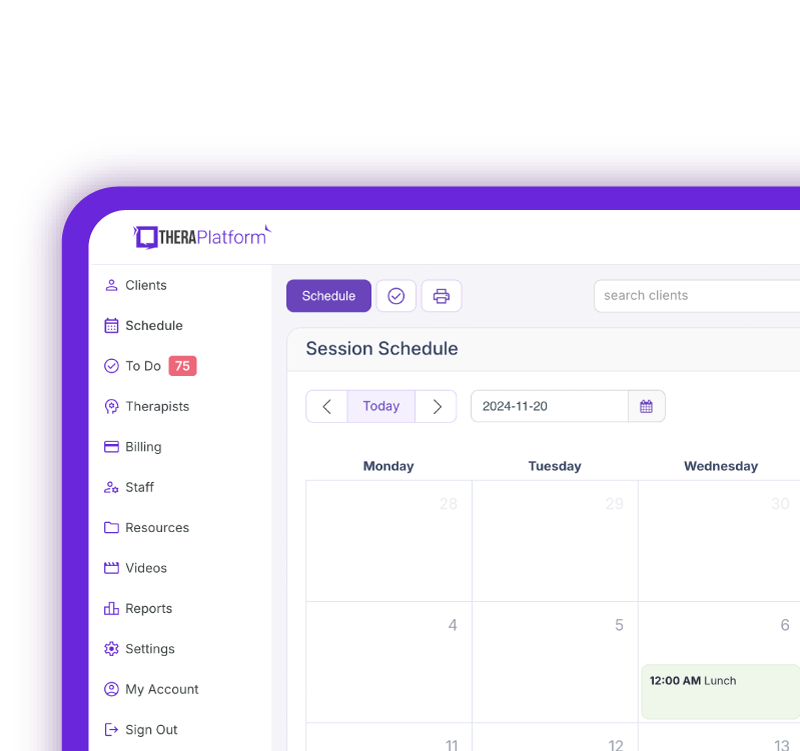
- Secure storage, limited access, documented retention policies, and HIPAA-compliant technology are essential when recordings are created. Using EHR systems with integrated teletherapy tools, such as TheraPlatform, can help therapists conduct secure and engaging teletherapy sessions and streamline admin tasks.
- Comprehensive clinical documentation often eliminates the need to retain recorded sessions while still supporting continuity of care and compliance.
→ Click Here to Enroll in My Free On-Demand Top to Bottom Teletherapy Video Course [Enroll Now]
Here we’ll guide clinicians who are considering integrating video recording into their practice, breaking down the key legal, ethical, and clinical boundaries that need to be navigated.
Can therapists record telehealth sessions?
Yes, in certain circumstances therapists can record telehealth sessions - but only when legally authorized and under highly specific, secure conditions.
Having the session take place virtually does not automatically permit clinicians to record it. It is not considered a routine practice in most clinical settings.
Appropriate recording of sessions depends on factors such as client consent, HIPAA requirements, employer policies, state laws, and the specific telehealth platform being utilized.
Telehealth sessions can only be recorded if the provider conducts the session over a specialized, fully encrypted video platform that operates under a signed Business Associate Agreement (BAA).
This should be done to ensure full compliance with healthcare data laws at the federal and state level. Recording sessions over standard Zoom, Skype, or FaceTime recording functions is not legal for clinical use.
Streamline your practice with One EHR
- Scheduling
- Flexible notes
- Template library
- Billing & payments
- Insurance claims
- Client portal
- Telehealth
- E-fax

Why do therapists record telehealth sessions?
Clinicians rarely record telehealth sessions.
However, on occasion there may want to record them for clinical purposes such as:
- Clinical supervision
- Student training
- Monitoring client progress over time
- Self-review of clinical performance and use of intervention techniques
- Viewing details to complete accurate documentation
- Clinical documentation typically provides sufficient information from sessions without the need for taking additional measures associated with recording a session.
Consideration | Best practice |
|---|---|
Client consent | Obtain informed written consent before recording and explain its purpose, storage, and retention. |
HIPAA compliance | Use a HIPAA-compliant telehealth platform with encryption and a signed BAA. |
Recording purpose | Record only for legitimate clinical, educational, or supervisory reasons. |
Storage | Store recordings securely with restricted access and encryption. |
Documentation | Continue completing thorough treatment notes; recordings should not replace documentation. |
Retention | Follow organizational policies and applicable legal requirements for retaining and deleting recordings. |
Legal and ethical considerations of recording teletherapy sessions
Clinicians must consider both legal requirements and ethical responsibilities before proceeding with recording a telehealth session.
HIPAA compliance
Video recordings contain highly sensitive electronic protected health information (ePHI), which must be protected under HIPAA Privacy and Security Rules.
To remain compliant, clinicians must:
- Store, transmit, and access video recordings securely using HIPAA-compliant systems.
- Avoid saving recordings on unsecured platforms such as personal devices.
- Fully encrypt audio and video data from end to end.
- Use a teletherapy platform that automatically signs a BAA.
Client consent around recording of live telehealth sessions
One of the most important measures to take before recording a session is obtaining informed client consent.
Providers should inform clients of:
- The purpose(s) of recording the session
- Who will have access to viewing it
- Where it will be hosted and stored
- How long the recording will be retained
- Their right to withdraw consent at any time without a negative impact resulting on their care
State regulations around recording live telehealth sessions
State laws regarding recording consent vary significantly. In some states, only one party must consent to recording. Other states require that everyone participating in the recording provide consent.
Clinicians must understand and follow the laws of both the state where they live and the state where their client is located when providing telehealth. They should also refer to specific state licensing boards, professional code of ethics, and their malpractice carrier for additional guidance when considering recording sessions.
Practice Management + EHR + Telehealth
Manage more in less time in your practice with TheraPlatform
Risks and best practices of recording telehealth sessions
Providers should carefully weigh the additional privacy and security risks associated with recording therapy sessions against any potential benefits. Recordings that are improperly or not securely stored, shared, or accessed can expose sensitive client information, with legal implications.
Before making the decision to record a session, it’s important that providers consider the purpose of recording and whether comprehensive clinical notes could be used instead to accomplish the same goal.
If the clinician determines recording a session is truly necessary and appropriate, they should keep the following best practices in mind:
- Sessions should only be recorded for a clear clinical or educational purpose, or for supervision.
- Receive and document informed consent from the client/guardian.
- Conduct sessions over a secure, HIPAA-compliant videoconferencing platform that uses encrypted recording and storage.
- Protect client/clinician therapeutic rapport by introducing the concept of recording transparently.
- Complete a practice run, checking sound and video before recording the session to avoid technical glitches that can interrupt clinical flow.
- Limit and document what individuals will be authorized to access the recorded session.
- Develop policies for retaining and deleting recordings that adhere to legal requirements and organizational procedures.
- Review recording practices periodically to ensure continued compliance with professional standards and applicable laws.
Free Resources for Therapists
Click below and help yourself to peer-created resources:

Secure documentation tips for recording telehealth sessions
Thorough documentation remains an essential component of clinical practice, whether sessions are recorded or not. Clinicians should complete documentation that accurately summarizes the session while protecting the client’s privacy.
Documentation strategies include:
- When applicable, document the purpose of recording the session and note that informed consent was obtained.
- Complete treatment notes promptly following a session, while details remain fresh.
- Avoid relying on the recording as a substitution for written notes. Document detailed clinical observations, interventions, data, and recommendations.
- Use a secure, HIPAA-compliant EHR to store documentation.
- Establish and follow your practice’s policies for retaining and documenting recordings.
By maintaining accurate, timely documentation, clinicians can reduce the need for retaining recordings longer than necessary while ensuring continuity of care.
Recording live telehealth sessions can be appropriate in certain clinical situations, such as for clinical supervision, training, monitoring client progress, or professional development. In most cases, comprehensive documentation can achieve the same purposes, and recording sessions carries significant legal, ethical, and privacy responsibilities.
Therapists should weigh the risks and benefits of recording therapy sessions, carefully evaluating when recordings are truly necessary. Before hitting the record button, therapists must ensure they have obtained appropriate client consent, are complying with HIPAA and state regulations, and use a secure system to transmit and protect sensitive information.
A secure telehealth and documentation platform can help simplify compliance with these requirements. TheraPlatform offers a HIPAA-compliant teletherapy platform and integrated electronic health record (EHR). With TheraPlatform, therapists can conduct teletherapy sessions, complete documentation, securely store client records, and manage other aspects of their practice all in one centralized system.
Choosing the best HIPAA-compliant teletherapy platform
Telehealth use has skyrocketed since the pandemic, with teletherapy emerging as a trusted, convenient, and secure alternative to in-person care for both children and adults. Therapists and clients report high satisfaction, and teletherapy now accounts for 13–17% of U.S. healthcare visits.
To protect privacy, providers must use HIPAA-compliant video platforms. The top platforms not only secure sessions with encryption but also support scheduling, billing, documentation, and client portals to streamline practice management.
The best teletherapy platforms go beyond video conferencing. By combining compliance, reliability, stable video, resources, games and practice management tools, they help therapists deliver care that’s safe, effective, and adaptable to modern client needs.
Marketing is also another aspect of owning a practice that can be conducted through a secure HIPAA-compliant platform as you can communicate with existing clients via chat, email and more.
Why therapists choose TheraPlatform as their teletherapy platform
Whether for solo practice or larger clinics, therapists choose TheraPlatform for its blend of usability, flexibility, and robust telehealth tools.
Watch this video to discover how TheraPlatform elevates Telehealth sessions
Here are top reasons why therapists choose TheraPlatform for teletherapy:
- Efficiency and convenience: Everything down to payments, scheduling, documentation, and insurance claims is managed in one integrated platform, saving time and reducing friction.
- Security and compliance: TheraPlatform is fully HIPAA and PIPEDA compliant, with encrypted video sessions, secure data storage, and 24/7 monitoring for peace of mind.
- Engagement tools: Built-in interactive features like whiteboards, games, media sharing, screen annotation, and therapy-specific “apps” enhance client engagement especially useful in pediatric and speech therapy.
- Client-centered functionality: The secure client portal empowers clients to book sessions, complete forms, submit documents, and make payments, reducing admin work for the therapist.
- Customization and flexibility: Therapists can create and customize templates for notes, treatment plans, and intake forms allowing them to tailor workflows to their practice style.
- All-in-one practice management: Combines telehealth, EHR, billing, insurance, scheduling, and documentation, eliminating the need for multiple tools or software.
- Therapy-specific design: Unlike generic telehealth platforms, TheraPlatform is purpose-built for mental health, speech therapy, OT, PT, and more with features tailored to each specialty.
- Professional credibility: Recording features, branded portals, and compliance tools help therapists present a more professional, trustworthy experience to clients.
- Positive user experience: Therapists appreciate having everything in one place and often report a smoother workflow, fewer tech issues, and faster onboarding.
What therapists are saying about TheraPlatform telehealth
Therapists praise TheraPlatform for its ease of use, seamless scheduling, and built-in billing tools like superbills. They value the platform’s features including intuitive charting, customizable notes, and interactive telehealth tools as well as the responsive support team, which listens to feedback and implements updates.
Many highlight that the platform offers the best of all worlds, combining excellent video conferencing with resource sharing and an engaging, client-centered teletherapy experience.
"There's seriously no better platform out there! Easy to use … syncs to your personal schedule, provides superbills …"- Coastlinespeechtherapy (Source)
“It is not just the platform, it is the team behind TheraPlatform, always willing to help and receptive to feedback to bring updates requests to live,” Orly, Smarty Therapy PC (Source)
"The video conferencing is excellent and the ability to share resources and the interactive screen make Telehealth a rich experience."- Kathy J. (Source)
"TheraPlatform has been the best of all worlds! … intuitive charting, in-system billing, customizable notes …"-Kendrah B. (Source)
Streamline your practice with One EHR
- Scheduling
- Flexible notes
- Template library
- Billing & payments
- Insurance claims
- Client portal
- Telehealth
- E-fax
Resources
TheraPlatform is an all-in-one EHR, practice management, and teletherapy software with AI-powered notes built for therapists to help them save time on admin tasks. It offers a 30-day risk-free trial with no credit card required and supports mental and behavioral health, SLPs, OTs, and PTs in group and solo practices.
More resources
- Therapy resources and worksheets
- Therapy private practice courses
- Ultimate teletherapy ebook
- The Ultimate Insurance Billing Guide for Therapists
- The Ultimate Guide to Starting a Private Therapy Practice
- Insurance billing 101
- Practice management tools
Free video classes
- Free on-demand insurance billing for therapist course
- Free mini video lessons to enhance your private practice
- 9 Admin tasks to automate in your private practice
References
Alyahya, R. S. (2025). The satisfaction of clients and caregivers with telehealth speech-language pathology services. Digital Health, 11, 20552076241313163. https://journals.sagepub.com/doi/10.1177/20552076241313163
Ivanova, J., Cummins, M. R., Ong, T., Soni, H., Barrera, J., Wilczewski, H., ... & Bunnell, B. (2025). Regulation and Compliance in Telemedicine. Journal of medical Internet research, 27, e53558. https://www.jmir.org/2025/1/e53558
Odeh, A., Abdelfattah, E., & Salameh, W. (2024). Privacy-preserving data sharing in telehealth services. Applied Sciences, 14(23), 10808. https://www.mdpi.com/2076-3417/14/23/10808
FAQs about the video recording of live telehealth sessions
Can therapists routinely record telehealth sessions?
No. Recording should only occur when there is a legitimate clinical, educational, or supervisory purpose and all legal, ethical, and privacy requirements have been met.
Do clients have to consent before a telehealth session is recorded?
Yes. Therapists should obtain informed consent before recording and explain why the recording is being made, how it will be stored, who can access it, and when it will be deleted.
Do recorded telehealth sessions replace clinical documentation?
No. Therapists should continue completing thorough clinical documentation, as recordings are not a substitute for accurate treatment notes.