
Mental health treatment planner

Mental health treatment planners are tools that can make treatment planning less cumbersome. Most professionals enter the field of mental health because they enjoy helping others, right? Do you want to know what they don’t like? Paperwork. Treatment planning is an integral part of therapy success, but it can be a tedious, time-consuming endeavor. Here is why using a mental health treatment planner may be right for you.
Summary
- Mental health treatment planners streamline documentation by providing ready-made presenting problems, goals, objectives, and evidence-based interventions that therapists can customize. Watch this video on Wiley Treatment planner.
- Using a treatment planner improves efficiency, reduces burnout, and helps therapists create measurable, clinically appropriate treatment plans aligned with client needs.
- Treatment planners support insurance compliance and legal protection by ensuring documentation meets payer and regulatory standards.
- AI-powered EHR integration further enhances treatment planning by automating data entry, tracking progress, and improving consistency across client records.
Streamline your practice with One EHR
- Scheduling
- Flexible notes
- Template library
- Billing & payments
- Insurance claims
- Client portal
- Telehealth
- E-fax

What is a mental health treatment planner?
A mental health treatment planner is a customizable treatment plan template that can be tailored to suit your particular client’s goals, objectives, and interventions. Traditional planners, such as those from Wiley, come in print form, but digital formats are increasingly used due to their ease of customization. Planners are also becoming more widely integrated into Electronic Health Records (EHR), making them even more practical to the treatment process.
How treatment planners aid in creating the components of a treatment plan
Treatment planners are organized from the top down, starting with the:
1) Presenting problem. These are the issues that bring the client to therapy. The treatment planner will give you options for the most common issues faced by clients. For example, it lists general problems such as “depression” and “anxiety”, as well as behavioral descriptions including “excessive worry” and “low self-esteem."
It also gives you the option to enter a diagnosis if you have one. Once you choose one (or more) problem(s), it will then provide options for the second component, goals.
2) Goals: Goals are the desired long-term outcomes for therapy. Mental health treatment planners provide choices for goals based upon the presenting problem. For example, a goal for anxiety is to “reduce the frequency and intensity of anxiety responses to improve daily functioning”. A goal related to depression is “challenge and reframe unhelpful, negative, or distorted thinking patterns”.
3) Objectives: Objectives are short-term, measurable steps a client takes toward achieving goals. Treatment planners have numerous objectives related to the goals chosen. For example, an objective for an anxiety problem may be the “client will identify three specific triggers for anxiety by the third session," while a depression-related objective is “client will verbalize at least two positive self-affirmations or strengths in each session”.
4) Interventions: Interventions are the therapist’s methods or strategies for achieving the stated goals. The interventions in a mental health treatment planner tend to be evidence-based and behavioral-focused. For example, an intervention to reduce anxiety may be to “administer a patient measure to help assess the nature and degree of the client’s fears, worries, and anxiety symptoms”. An intervention for depression would be to "identify and challenge automatic negative thoughts using a thought record worksheet”.
5) Progress and updates: Treatment plans are a guide for the therapeutic process. Therapists will want to review progress toward goals and objectives at regular intervals and update them as necessary. Treatment planners, especially those integrated with EHR platforms, allow you to set specific review dates and document progress as a percentage completion toward objectives.
If a goal or objective no longer applies, it is easy to mark it as completed and set a new goal. Plus, it stays in the client’s record as a reference for future treatment.
Practice Management + EHR + Telehealth
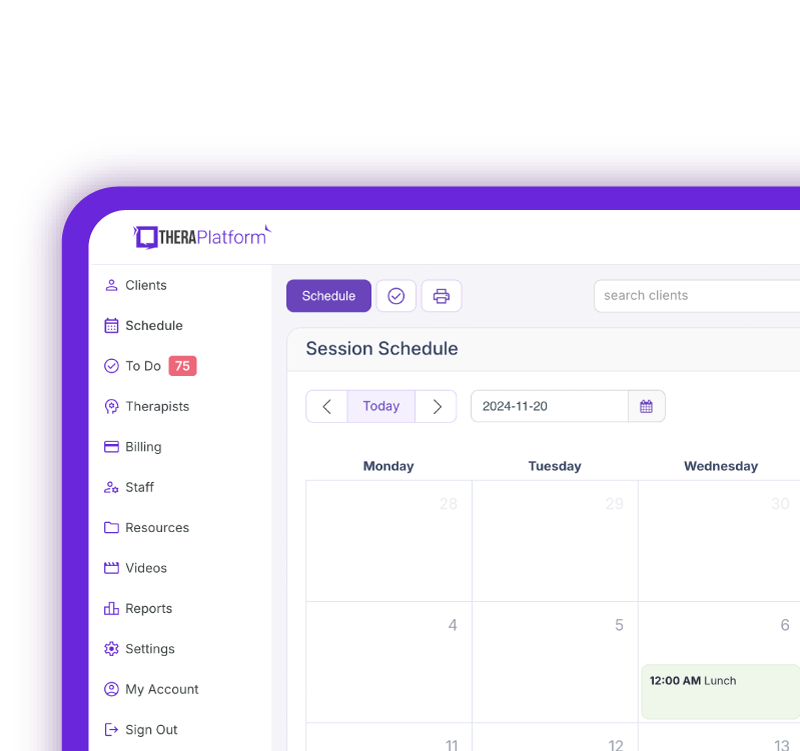
Manage more in less time in your practice with TheraPlatform
Why use a mental health treatment planner?
There are several reasons why you may want to use a mental health treatment planner:
Time saver
Efficiency is the name of the game when using a mental health treatment planner. It saves time by providing ready-made goals, objectives, and interventions. This leaves therapists time for other work-related and personal responsibilities, and reduces burnout.
Setting measurable treatment planning goals and objectives
Not only do mental health treatment planners provide you with numerous customizable choices of goals and objectives for your client’s problems, but they also make sure they are relevant and measurable. These are goals that are appropriate for the problems being treated. In fact, they may provide better ideas than the therapist would have come up with on their own.
Evidence-based customizable interventions
The interventions recommended in treatment planners are evidence-based to treat the specific problems the client is experiencing. Their implementation is backed by research to result in client improvement.
Insurance compliance and legal protection
Because the goals, objectives, and interventions presented in the mental health treatment planner are precise, behavior-based, and research-supported, they are designed to meet regulatory standards set by third-party payers, as well as state and federal review agencies. Treatment plans created by a planner should satisfy an insurance audit and protect the therapist during any potential legal proceedings.
Potential concerns
While a mental health treatment planner has many benefits, it also may hold a few concerns for therapists:
Letting the planner do all the work for you
A mental health treatment planner is meant to make your life easier, not do the work for you. Although it may be tempting to quickly check some boxes, therapists need to be creative in producing ideas for goals, objectives, and interventions, and then choose the options that match their clinical expertise.
Free Resources for Therapists
Click below and help yourself to peer-created resources:

Template sounding language
Options available in treatment planners can frequently feel impersonal or formulaic. Therapists should take care to personalize the language and content to match their voice. You want the plan to sound like you created it, not a computer program.
CBT bias
Mental health treatment planners have options that are skewed toward cognitive behavioral therapy (CBT), which may make them less useful for therapists with different theoretical orientations.
Forcing a round client into a square hole
The choices presented by a treatment planner, while numerous, are not going to satisfy every client. Treatment plans need to reflect the client’s unique needs and should be customized (and edited) to meet their goals. Plans that don’t appear to meet the objectives of a particular client could lead to insurance coverage rejection.
Watch this video to learn how to simplify treatment planning
How AI and EHR are revolutionizing mental health treatment planning
Artificial Intelligence (AI) and EHR integration have taken mental health treatment planners to another level. Many EHR systems, such as Theraplatform, offer seamless integration with mental health treatment planners, allowing for automatic population of treatment plan elements directly into client records.
This integration decreases time spent on data entry, minimizes errors, and ensures consistency across all client documentation. It also allows further editing and customization of plans, and simplifies the tracking of treatment progress over time.
Mental health treatment planners hold numerous advantages, including streamlined documentation, a strengthened clinical focus, and insurance compliance. While therapists need to be careful not to over-rely on their many attributes, they will find them an invaluable tool to aid the treatment process.
Whether you use a classic resource like Wiley’s or an AI-powered EMR/EHR like TheraPlatform, structured treatment planning leads to better outcomes—for both clients and clinicians.
What is Wiley Treatment Planner?
Wiley Treatment Planner is a widely used clinical resource designed to help mental health professionals and other therapists efficiently create treatment plans for their clients. In addition to treatment plans, the company also provides prewritten therapy notes for some diagnostic codes. It is part of the "PracticePlanners" series published by Wiley.
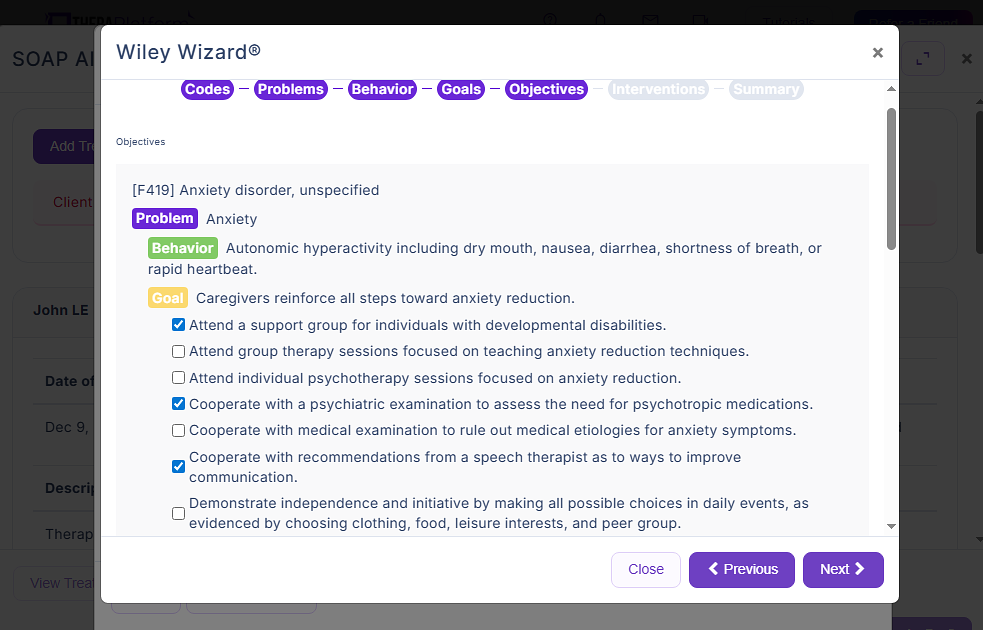
Screenshot of TheraPlatform’s Wiley Treatment Planner integration. Wiley offers thousands of prewritten, evidence-based treatment goals, objectives, and interventions for mental health therapists in private practice.
Features of Wiley Treatment Planner includes:
- Prewritten, evidence-based treatment goals, objectives, and interventions
- Treatment planners tailored to specific populations and problems, including adults, children, adolescents, couples, families, addictions, and more
- Alignment with the diagnostic criteria from the DSM-5 and ICD-10
- Prewritten therapy notes
Is there an online version of Wiley Treatment Planner and how can I get the Wiley Treatment Planner?
Wiley Treatment Planner company partnered with a select number of EHRs for mental health providers to make treatment planners available online. TheraPlatform’s EHR offers the Wiley Treatment Planner as an add-on for both assessment and treatment plans and therapy notes, such as DAP notes. You can edit prewritten notes and add your own with any therapy template on TheraPlatform.
Streamline your practice with One EHR
- Scheduling
- Flexible notes
- Template library
- Billing & payments
- Insurance claims
- Client portal
- Telehealth
- E-fax
Resources for mental health therapists
Theraplatform is an all-in-one EHR, practice management and teletherapy solution with AI-powered notes and Wiley Treatment Planners that allow you to focus more on patient care. With a 30-day free trial, you have the opportunity to experience Theraplatform for yourself with no credit card required. Cancel anytime. They also support different industries including mental and behavioral health therapists in group practices and solo practices.
More resources
- Therapy resources and worksheets
- Therapy private practice courses
- Ultimate teletherapy ebook
- The Ultimate Insurance Billing Guide for Therapists
- The Ultimate Guide to Starting a Private Therapy Practice
- Insurance billing 101
- Practice management tools
Free video classes
- Free on-demand insurance billing for therapist course
- Free mini video lessons to enhance your private practice
- 9 Admin tasks to automate in your private practice
References
Jongsma, A. E., Jr., Peterson, L. M., & Bruce, T. J. (2021). The complete adult psychotherapy treatment planner (6th ed.). John Wiley & Sons, Inc. https://www.wiley.com/en-us/grow/professional-development/books-resources/psychology-psychiatry/practice-planners/treatment-planners
FAQs about mental health treatment planners
What is a mental health treatment planner?
A mental health treatment planner is a customizable template that helps therapists create structured treatment plans with defined goals, objectives, interventions, and progress tracking.
How do treatment planners help therapists save time?
Treatment planners provide prewritten, evidence-based options that therapists can quickly customize, reducing the need to create treatment plans from scratch.
Are mental health treatment planners compatible with EHR systems?
Yes. Many modern EHR platforms integrate treatment planners, allowing therapists to auto-populate treatment plans, track progress, and maintain compliant documentation.