Trauma-Focused Cognitive Behavioral Therapy

Trauma-focused cognitive behavioral therapy (TF-CBT) was developed by Judith Cohen, Anthony Mannarino, and Esther Deblinger in 2006 to address the specific needs of children who experienced sexual abuse.
Since that time, it has expanded to treat trauma resulting from physical abuse, violence, grief, and natural disasters. Let’s take a closer look at the components of TF-CBT and how it is administered by therapists.
Summary
- TF-CBT is a structured, evidence-based therapy designed to help children and adolescents process trauma and develop healthier coping skills.
- The PRACTICE framework guides TF-CBT through psychoeducation, emotional regulation, cognitive coping, trauma processing, and safety planning.
- Caregiver involvement is a core part of TF-CBT, helping reinforce emotional safety, communication, and skill-building outside of therapy sessions. Using an EHR with a secure client portal can help therapists share homework and other materials for use outside of the session.
- Research shows TF-CBT can effectively reduce PTSD and trauma-related symptoms in children and adolescents across a variety of traumatic experiences.
Streamline your practice with One EHR
- Scheduling
- Flexible notes
- Template library
- Billing & payments
- Insurance claims
- Client portal
- Telehealth
- E-fax

What is TF-CBT?
TF-CBT possesses the following characteristics:
- It is a structured medium-length treatment designed to be delivered in 8-25 sessions.
- It utilizes cognitive-behavioral principles, including exposure techniques.
- It is targeted toward children and adolescents.
- Non-offender caretaker involvement is a key aspect of the therapy.
- Caregivers and children receive parallel and conjoint sessions.
Practice Management + EHR + Telehealth
Manage more in less time in your practice with TheraPlatform
The Three phases of TF-CBT
TF-CBT can be categorized into three phases:
Stabilization
The initial phase of TF-CBT focuses on establishing emotional and physical safety, building a strong therapeutic alliance, and equipping clients with skills to manage trauma-related distress. This phase is critical, particularly for children who experience high levels of emotional reactivity, dissociation, or avoidance.
Trauma narrative and processing
The second phase centers on the development of a trauma narrative, a structured and gradual recounting of the client’s traumatic experience. Emotional and cognitive processing also occurs, allowing children to experience and tolerate emotions associated with the trauma without avoidance or dysregulation.
Integration and relapse prevention
The final phase of TF-CBT focuses on consolidating therapeutic gains, strengthening adaptive beliefs, and preparing children to manage future stressors. Clients are supported in integrating new understandings of themselves, their trauma, and their coping abilities into their broader sense of identity and daily functioning.
Relapse prevention in TF-CBT does not assume symptom recurrence is inevitable, but rather acknowledges that stress and triggers may re-emerge over time.
Core components of TF-CBT
The main components of TF-CBT can be illustrated by the acronym PRACTICE:
Psychoeducation: Children are educated about the impact of trauma and caregivers are equipped with parenting skills. This can help alleviate feelings of guilt in children who may blame themselves for what happened.
Relaxation: Clients are taught tools to manage anxiety and distressing thoughts. These may include techniques such as deep breathing and progressive muscle relaxation.
Affective modulation: Therapists help children to recognize and manage emotions. Techniques may include self-soothing and correctly labeling feelings.
Cognitive coping: Children are educated about the connection between thoughts, feelings, and behavior. They engage in cognitive restructuring, where they begin to challenge maladaptive thoughts and replace them with more adaptive thinking.
Trauma narrative: Children create a narrative of the trauma to reduce its emotional power and reframe memories. The trauma narrative helps the child confront difficult feelings and learn to process their trauma.
In-vivo exposure: Therapists gradually expose the child to traumatic triggers to reduce avoidance and increase coping skills. These triggers can be people, objects, or situations that remind the child of the traumatic event.
Conjoint sessions: Caretaker-child sessions are used to enhance communication and processing of difficult emotions. Conjoint sessions help the child to feel understood and supported by their parents. They also teach the pair how to problem-solve as difficulties arise.
Enhancing safety: One of the main goals of TF-CBT is to create a feeling of safety for the child. This primarily involves teaching the child skills to identify and deal effectively with potentially dangerous situations. It also includes creating a safety plan to manage future risks. Other aspects may comprise assertiveness training, boundary setting, and sex education.
Free Resources for Therapists
Click below and help yourself to peer-created resources:

Who benefits from TF-CBT?
TF-CBT was conceived as a treatment for children, adolescents, and their caregivers. However, the concepts could hypothetically be adapted for adults, without the caregiver conjoint sessions. It should be noted that studies about the effectiveness of TF-CBT have focused on minor clients, and further research would be needed to determine its usefulness for adults.
TF-CBT is appropriate for clients who have experienced:
- Physical abuse
- Neglect
- Community violence
- Sexual assault
- Accidents or medical trauma
- Natural disasters
- Sudden loss or complicated grief
Is TF-CBT Effective?
Numerous scientific studies have displayed the effectiveness of TF-CBT:
- TF-CBT has consistently been found to reduce symptoms of post-traumatic stress disorder (PTSD) across multiple studies.
- Meta-analysis reveals that TF-CBT is slightly more effective than EMDR for reducing trauma symptoms in children and adolescents.
- TF-CBT has even been shown to help alleviate trauma symptoms in preschoolers.
Caregiver involvement
Parent or caregiver involvement is a primary aspect of TF-CBT. Unlike other child therapies, it is not optional or ancillary. Caregivers typically first participate in parallel sessions, meeting separately with the therapist while the child engages in individual TF-CBT sessions.
During these meetings, caregivers receive:
- Psychoeducation about trauma and its developmental impact. This helps caretakers reinterpret trauma-related behaviors as stress responses rather than willful misconduct, increasing empathy.
- Skills training. Caregivers are taught many of the same coping, emotional regulation, and cognitive skills their child is learning, enabling them to model these strategies and coach skill use at home.
- Personal trauma counseling. Caregivers are also supported in addressing their own emotional responses to the child’s trauma. Many experience guilt, anger, grief, fear, or secondary traumatic stress, which, if unaddressed, can interfere with the child’s progress.
As treatment progresses, joint parent–child sessions are introduced. Conjoint sessions allow children to share aspects of their trauma narrative, practice communication skills, and receive validation and support from their caregiver in a safe, therapeutic context.
Overall, caretaker involvement in TF-CBT enhances treatment outcomes by increasing emotional safety, improving caregiver responsiveness, and creating a supportive environment that sustains recovery.
Note: When caregivers are unavailable or inappropriate, clinicians may adapt TF-CBT by involving alternative supportive adults or focusing more heavily on individual skill development.
Therapist roles in TF-CBT
Treating a client using TF-CBT involves a three-pronged approach, where therapists treat the child and caregiver individually, as well as together as a family. It is essentially three therapies in one. Due to its subject matter and logistical demands, it can be more challenging than an average case. The therapist must embrace the following responsibilities for TF-CBT to be successful:
Collaboration in TF-CBT
TF-CBT is a collaborative exercise, where the therapist instills caregivers and children with the skills necessary to reduce traumatic symptoms and develop effective coping tools. The goal is for the child and guardian to experience the self-efficacy necessary to deal with past trauma and have a positive outlook on their future.
Documentation of TF-CBT
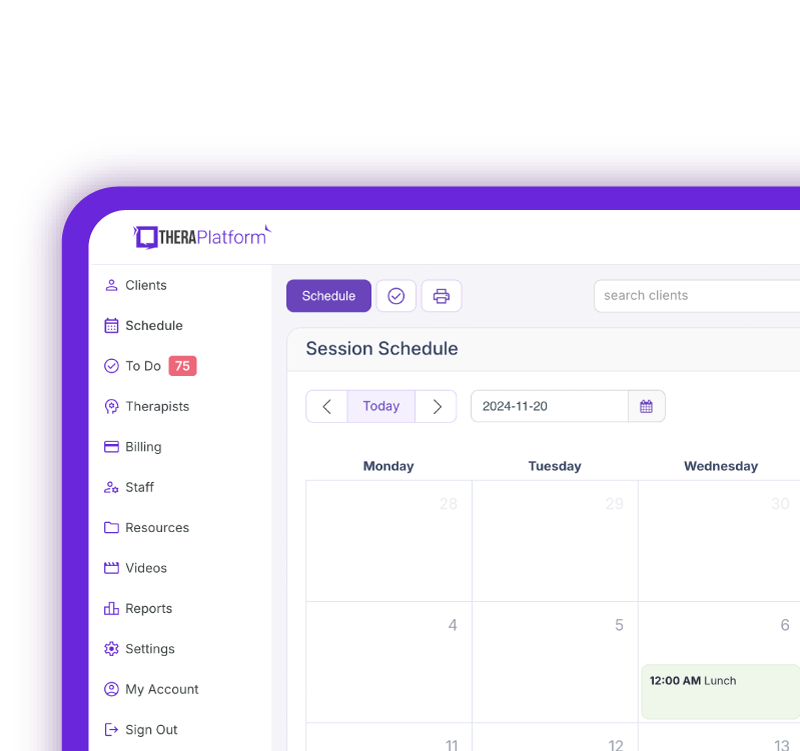
Although it is considered one case, therapists must document sessions with caretakers and their children individually. Note-taking and treatment planning tools, such as those offered with TheraPlatform, can be a valuable organizer and time-saver.
Measuring TF-CBT progress
It can be difficult for therapists to assess the progress of child clients and their trauma symptoms. Caregivers will offer their perspectives, but they frequently have their own issues and are not objective observers. The Child and Adolescent Trauma Screen (CATS) and the Child Trauma Screen (CTS) are two useful screening tools that can aid therapists in their evaluations and measure progress over time.
How EHRs can help with documentation
Modern EHR/practice management platforms (such as TheraPlatform) assist greatly with documentation by providing HIPAA‑compliant, integrated systems for note entry, storage, scheduling, and billing.
They allow therapists to:
- Use and customize templates (e.g., SOAP, DAP, and others) or build their own to streamline note writing and ensure consistency.
- Link notes to treatment plans, goals, and session history so client progress is easily tracked over time.
- Utilize e-fax and secure document sharing via client portal to safely exchange information with clients or other providers while maintaining confidentiality.
- Leverage dictation and telehealth transcription, which can automatically convert sessions into therapy or assessment notes, saving time and reducing manual entry.
- Take advantage of AI features that streamline documentation by automatically populating intake form data into assessment templates and generating complete therapy and assessment notes from the information you provide, all with a single click.
Watch this video to learn how to save time on therapy notes
Meanwhile, AI‑assisted note tools are emerging which can further help clinicians by:
- Automatically transcribing session audio (if permitted) and highlighting key moments (e.g. emotional shifts, major themes).
- Suggesting draft notes or filling in objective or assessment sections based on observed data, freeing up clinicians’ time.
- Supporting consistency and reducing missing components in notes, which helps from both clinical, legal, and insurance perspectives.
Together, structured SOAP‑type notes, good EHR platforms, and smart AI tools support better therapeutic outcomes, more efficient workflows, and stronger accountability.
Streamline your practice with One EHR
- Scheduling
- Flexible notes
- Template library
- Billing & payments
- Insurance claims
- Client portal
- Telehealth
- E-fax
Resources for mental health therapists
Theraplatform is an all-in-one EHR, practice management and teletherapy solution with AI-powered notes and Wiley Treatment Planners that allow you to focus more on patient care. With a 30-day free trial, you have the opportunity to experience Theraplatform for yourself with no credit card required. Cancel anytime. They also support different industries including mental and behavioral health therapists in group practices and solo practices.
More resources
- Therapy resources and worksheets
- Therapy private practice courses
- Ultimate teletherapy ebook
- The Ultimate Insurance Billing Guide for Therapists
- The Ultimate Guide to Starting a Private Therapy Practice
- Insurance billing 101
- Practice management tools
Free video classes
- Free on-demand insurance billing for therapist course
- Free mini video lessons to enhance your private practice
- 9 Admin tasks to automate in your private practice
References
Cohen, J. A., & Mannarino, A. P. (2015). Trauma-focused Cognitive Behavior Therapy for Traumatized Children and Families. Child and adolescent psychiatric clinics of North America, 24(3), 557–570. https://doi.org/10.1016/j.chc.2015.02.005
Cohen, J. A., Mannarino, A. P., & Deblinger, E. (2017). Treating trauma and traumatic grief in children and adolescents (2nd ed.). Guilford Press.
de Arellano, M. A., Lyman, D. R., Jobe-Shields, L., George, P., Dougherty, R. H., Daniels, A. S., Ghose, S. S., Huang, L., & Delphin-Rittmon, M. E. (2014). Trauma-focused cognitive-behavioral therapy for children and adolescents: assessing the evidence. Psychiatric Services, 65(5), 591–602.https://pmc.ncbi.nlm.nih.gov/articles/PMC4396183
Lang, J. M., & Connell, C. M. (2017). Child Trauma Screen (CTS) [Database record]. PsycTESTS.https://doi.org/10.1037/t61965-000
Lewey, J. H., Smith, C. L., Burcham, B., Saunders, N. L., Elfallal, D., & O'Toole, S. K. (2018). Comparing the Effectiveness of EMDR and TF-CBT for Children and Adolescents: a Meta-Analysis. Journal of Child & Adolescent Trauma, 11(4), 457–472.https://doi.org/10.1007/s40653-018-0212-1
McGuire, A., Steele, R. G., & Singh, A. (2021). Systematic Review on the Application of Trauma-Focused Cognitive Behavioral Therapy (TF-CBT) for Preschool-Aged Children. Clinical Child and Family Psychology Review, 24(1), 20–37.https://doi.org/10.1007/s10567-020-00334-0
The National Child Traumatic Stress Network. Trauma-focused cognitive behavioral therapy (TF-CBT): AT-A-GLANCE.
Sachser, C., Berliner, L., Holt, T., Jensen, T. K., Jungbluth, N., Risch, E., Rosner, R., & Goldbeck, L. (2017). Child and Adolescent Trauma Screen (CATS) [Database record]. PsycTESTS. https://doi.org/10.1037/t60699-000
Thielemann, J. F. B., Kasparik, B., König, J., Unterhitzenberger, J., & Rosner, R. (2022). A systematic review and meta-analysis of trauma-focused cognitive behavioral therapy for children and adolescents. Child Abuse & Neglect, 134, 105899. https://doi.org/10.1016/j.chiabu.2022.105899
FAQs about Trauma Focused Cognitive Behavioral Therapy
What does TF-CBT stand for?
TF-CBT stands for Trauma-Focused Cognitive Behavioral Therapy, a specialized therapy approach for children and adolescents who have experienced trauma.
What types of trauma can TF-CBT help treat?
TF-CBT may help children coping with trauma related to abuse, neglect, violence, accidents, medical trauma, grief, or natural disasters.
How are caregivers involved in TF-CBT?
Caregivers participate in parallel and conjoint sessions where they learn coping skills, trauma education, communication strategies, and ways to support the child’s recovery.