Speech therapy documentation software: What SLPs should look for

Speech therapy documentation software helps speech-language pathologists (SLPs) create, organize, and manage clinical records, including evaluations, treatment notes, treatment plans, progress reports, and discharge summaries. Features such as customizable templates, integrated goal tracking, and documentation automation can help streamline clinical workflows and reduce repetitive administrative work.
According to ASHA's 2025 SLP Health Care Survey, 52.6% of surveyed health care SLPs identified administrative tasks, including documentation and scheduling, among their top three barriers to providing optimal clinical care. This guide explores the documentation software features that can help SLPs manage clinical records more efficiently while supporting accurate, individualized care.
Key takeaways
- SLP-specific documentation matters. Look for software with speech therapy templates and customization options that reflect your clinical setting, population, and payer requirements.
- Integrated goal tracking can reduce repetitive work. Connecting treatment goals, session data, progress notes, and discharge documentation makes it easier to follow progress across the episode of care.
- AI can help streamline documentation, but clinician review remains essential. Features such as dictation, ambient documentation, and draft generation may save time, but SLPs are responsible for reviewing notes for accuracy.
- Consider the entire workflow. Secure intake, documentation, electronic signatures, billing integration, and protected record storage can make an all-in-one speech therapy EHR more efficient than a standalone documentation tool.
Streamline your practice with One EHR
- Scheduling
- Flexible notes
- Template library
- Billing & payments
- Insurance claims
- Client portal
- Telehealth
- E-fax

Documentation software vs. a full EHR
Standalone documentation tools primarily focus on note-taking and clinical forms. A full electronic health record (EHR), on the other hand, combines documentation with other practice functions (e.g., scheduling, client management, secure client portals, claims clearinghouses, and billing).
An all-in-one EHR that includes specialized clinical documentation can provide a smoother, more unified workflow.
Speech Therapy Documentation Software: Features at a Glance
The right documentation software should support the clinical records SLPs create throughout care, from evaluations and treatment plans to daily notes and discharge summaries. The table below highlights key features to look for and how they support speech-language pathology workflows.
Feature | What to look for | Why it matters for SLPs |
|---|---|---|
SLP-specific templates | Templates for speech-language evaluations, SOAP notes, daily treatment notes, progress reports, plans of care, and discharge summaries | Supports SLP documentation without relying on generic medical templates |
Customizable documentation | Editable templates, required and optional fields, and specialty-specific customization | Accommodates documentation for articulation, language, fluency, voice, AAC, cognition, and swallowing |
Goal and progress tracking | Short- and long-term goals, goal status, session-level performance data, and progress tracking | Helps SLPs monitor measurable outcomes and document progress over time |
AI-assisted documentation | Dictation, note drafting, and automated transfer of intake information into assessment templates, with clinician review | Reduces repetitive entry and time spent organizing information across clinical records |
Assessment workflows | Documentation of standardized assessment scores, informal assessment findings, clinical observations, and diagnoses | Keeps evaluation results accessible for treatment planning and ongoing care |
Plan-of-care management | Treatment plans connected to goals, therapy frequency, duration, and progress documentation | Helps maintain consistency between treatment plans and ongoing clinical documentation |
Secure client records | Encryption, secure storage, role-based permissions, and safeguards for protected health information | Helps protect sensitive client information throughout care |
Electronic signatures | Time-stamped clinician signatures, credentials, supervisor co-signatures, and optional client, parent, or caregiver signatures | Supports efficient finalization of treatment plans, therapy notes, and other clinical records |
Integrated workflows | Connections between intake, scheduling, documentation, billing, and claims | Reduces duplicate entry and supports continuity between clinical and administrative workflows |
Why SLP documentation has unique requirements
Speech-language pathology requires unique data tracking and the ability to capture information specific to communication and swallowing assessment and treatment. This flexibility isn’t always provided by generic medical templates.
ASHA specifically cautions that “templates developed by or adapted from other disciplines may lack the necessary specificity to describe the patient’s diagnosis and treatment."
Therefore, SLPs need to seek out software that is designed for, or can be highly customized to, speech therapy workflows.
Essential features of speech therapy documentation software
SLP-specific documentation templates
An effective platform should include templates for common SLP documentation, including:
- Evaluations
- SOAP notes
- Daily/treatment notes
- Progress notes
- Discharge summaries
Templates should seamlessly capture relevant clinical information so SLPs don’t need to work around fields that are designed for another discipline.
Watch this video to learn how to save time on therapy notes
Customizable templates
Even if documentation templates have been created specifically for SLPs, documentation requirements vary by setting, population, and payer.
If templates are customizable, clinicians can ensure they include practice-specific fields and discipline-specific workflows (e.g., documenting pediatric speech delays versus adult neurogenic communication disorders).
The ability to designate fields as required or optional can support consistent documentation without forcing clinicians to complete sections that may be irrelevant.
Treatment goals and progress tracking for speech therapists
Documentation software should allow SLPs to create individualized treatment goals, record session data, and monitor progress over time without repeatedly entering the same information.
What to look for:
- Goal creation: Create and customize measurable treatment goals, including SMART (Specific, Measurable, Achievable, Relevant, Time-bound) goals.
- Goal updates: Easily modify goals and mark them as achieved, discontinued, or ongoing.
- Session data collection: Record measurable performance, such as accuracy percentages, successful trials, cueing levels, and level of assistance, when relevant to the goal.
- Progress tracking: Review previous performance and track changes across treatment sessions.
- Integration with documentation: Connect goals and session data to treatment notes, progress reports, and treatment plan updates without duplicate entry.
Practice Management + EHR + Telehealth
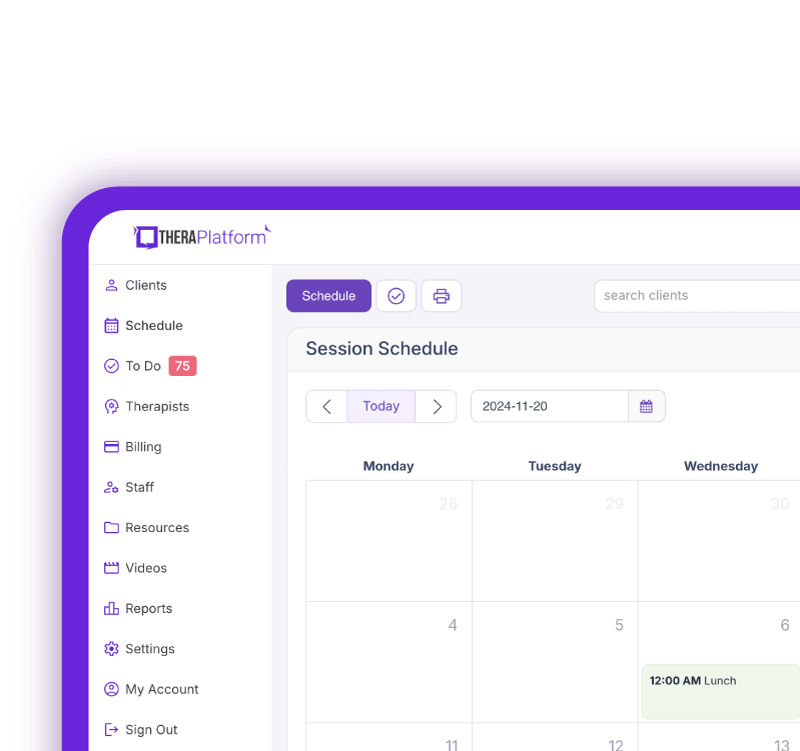
Manage more in less time in your practice with TheraPlatform
AI-assisted documentation
AI-assisted documentation tools can help speech-language pathologists reduce repetitive note-writing tasks through dictation, transcription, and automated draft generation. Available capabilities vary by platform.
What to look for:
- Dictation and speech-to-text: Allows clinicians to verbally capture session observations, interventions, and client responses. Evaluate how accurately the system recognizes clinical terminology. Learn more about artificial intelligence in speech-language pathology.
- Ambient documentation: Uses authorized session audio to generate transcripts or draft clinical notes. Evaluate recording consent, privacy safeguards, and how recordings are stored or deleted.
- AI-generated note drafts: Creates structured documentation from clinician-entered information, session summaries, or other supported inputs. Tools such as TheraPlatform's AI note-taking features offer different ways to generate clinical note drafts.
- Editing and clinician review: Allows SLPs to verify and revise AI-generated information, including treatment goals, performance data, interventions, and client responses, before signing.
AI-assisted documentation may reduce note-writing time, but clinicians remain responsible for ensuring accuracy, clinical relevance, and appropriate handling of patient information.
Secure document storage and access
Safeguarding protected health information (PHI) in clinical records should be a priority. Look for features such as role-based permissions and secure access to documentation.
Data encryption should be utilized for data both at rest and in transit.
Electronic signatures
Speech therapy documentation software should support electronic signatures within clinical documentation workflows, allowing SLPs to sign, date, and finalize evaluations, treatment notes, progress reports, and other clinical records without printing documents.
Depending on the practice's needs, the software should also allow clients, parents, or caregivers to electronically sign treatment plans, therapy notes, and other documents when applicable.
What to look for:
- Electronic signatures with dates and timestamps
- Clinician credentials associated with signed documentation
- Supervisor co-signatures when required
- Optional client, parent, or caregiver signatures on treatment plans, therapy notes, and other documents
- Tracking of unsigned or incomplete documentation
- Secure storage of signed and finalized records
How documentation software fits into the SLP workflow
An effective system should support clinical documentation from initial intake through discharge. Ideally, relevant information carries forward between records, reducing duplicate entry and helping clinicians maintain accurate, individualized documentation.
Evaluation and intake
Digital intake forms can collect client demographics, medical and developmental history, presenting concerns, insurance information, and consent forms.
During evaluations, SLPs should be able to document standardized and informal assessment findings, scores, clinical observations, diagnoses with ICD-10 codes, and recommendations.
Look for software that can automatically transfer relevant intake information into assessment templates. For example, TheraPlatform's AI Assessment feature can pull information collected during intake into the appropriate sections of an assessment template, reducing the time spent manually reviewing, organizing, and transferring information. Clinicians can then review, edit, and supplement the documentation with their own assessment findings.
Treatment planning
Following the evaluation, clinicians establish an individualized plan of care that includes treatment frequency, duration, and measurable short- and long-term goals.
The software should allow goals and relevant evaluation findings to carry forward into treatment notes and progress reports, with the flexibility to review and update information as needed.
Session documentation
During or after treatment sessions, SLPs record skilled interventions, client responses, and measurable performance data, such as accuracy percentages, trial results, and cueing levels.
Structured data collection fields, customizable notes, and optional dictation tools can help clinicians document session findings while minimizing repetitive entry.
Progress reporting and discharge
Progress reports and discharge summaries should draw on documented goals, session performance, and assessment findings collected throughout care.
SLPs can review changes over time, summarize functional communication outcomes, document goal status, and provide recommendations for continued services, home programs, or discharge, as appropriate.
Speech therapy documentation software for insurance-based practices
It is critical to take special consideration of certain documentation factors when services are billed to insurance.
Documentation plays a critical role in conveying medical necessity and why a skilled SLP must provide services.
With the right system, clinicians should be able to easily document medical necessity, skilled intervention, functional goals, and objective progress. Accurate coding, billing, and claims can also be supported through clear, consistent, accurate documentation.
Connecting documentation with billing workflows can prevent clinicians and administrative staff from repeatedly entering the same information.
Free Resources for Therapists
Click below and help yourself to peer-created resources:

Questions to ask when evaluating speech therapy documentation software
When comparing documentation tools, consider how well they support your clinical workflows, reduce repetitive tasks, and accommodate the needs of your SLP practice.
- Does the software include documentation templates designed specifically for speech-language pathology?
- Can clinicians customize templates, required fields, and documentation workflows?
- How are treatment goals, session data, and progress reports connected?
- Can clients or caregivers complete intake forms securely before an evaluation?
- Can relevant intake information automatically populate assessment templates and other clinical documents?
- What AI-assisted documentation features are available, and can clinicians review and edit the generated content?
- Does the software support electronic signatures, supervisor co-signatures, and optional client or caregiver signatures?
- How is sensitive client information protected, including information processed by AI tools?
Speech therapy documentation red flags
Keep an eye out for factors that can directly impact documentation of your clinical workflow, including:
- Limited customization
- Excessive manual entry
- Duplicate data entry
- Difficult template creation
- Poor integration with billing/scheduling
- Unclear AI/privacy policies
Choosing speech therapy documentation software
Speech therapy documentation software should improve your clinical efficiency and practice sustainability without compromising quality or accuracy.
To find the best system for your practice, consider software that offers SLP-specific and customizable templates, integrated goal tracking, secure record storage, and streamlined workflows.
Streamline your practice with One EHR
- Scheduling
- Flexible notes
- Template library
- Billing & payments
- Insurance claims
- Client portal
- Telehealth
- E-fax
Resources for speech therapists
TheraPlatform is an all-in-one EHR, practice management, and teletherapy software with AI-powered notes built for therapists to help them save time on admin tasks. It offers a 30-day risk-free trial with no credit card required and supports different industries and sizes of practices, including speech-language pathologists in group and solo practices.
More resources
- Therapy resources and worksheets
- Therapy private practice courses
- Ultimate teletherapy ebook
- The Ultimate Insurance Billing Guide for Therapists
- The Ultimate Guide to Starting a Private Therapy Practice
- Insurance billing 101
- Practice management tools
Free video classes
- Free on-demand insurance billing for therapist course
- Free mini video lessons to enhance your private practice
- 9 Admin tasks to automate in your private practice
References
Ayer, M. (2023). Relieving administrative burden on clinical staff with streamlined workflows and speech-recognition software. British Journal of Nursing, 32(Sup16b), S1-S9. DOI: https://www.magonlinelibrary.com/doi/abs/10.12968/bjon.2023.32.Sup16b.S4?journalCode=bjon
Kanaparthy, N. S., Villuendas-Rey, Y., Bakare, T., Diao, Z., Iscoe, M., Loza, A., ... & Taylor, R. A. (2025). Real-world evidence synthesis of digital scribes using ambient listening and generative artificial intelligence for clinician documentation workflows: rapid review. JMIR AI, 4, e76743. DOI: https://ai.jmir.org/2025/1/e76743
Mallipeddi, N. V., Mehrotra, A., & Van Stan, J. H. (2023). Telepractice in the treatment of speech and voice disorders: What could the future look like?. Perspectives of the ASHA Special Interest Groups, 8(2), 418-423. https://pubs.asha.org/doi/abs/10.1044/2022_PERSP-22-00098
FAQs about Speech Therapy Documentation Software
What is speech therapy documentation software?
Speech therapy documentation software helps SLPs create, organize, store, and manage clinical records such as evaluations, treatment notes, goals, progress reports, and discharge summaries.
What features should SLPs look for in documentation software?
Look for SLP-specific and customizable templates, integrated goal and progress tracking, secure record storage, electronic signatures, and efficient workflows. AI-assisted documentation and integrated assessments may also be helpful.
Can AI be used for speech therapy documentation?
Yes. AI features may assist with dictation, draft generation, and ambient documentation. However, clinicians remain responsible for reviewing AI-generated documentation for accuracy before signing.