
SLP billing metrics: what SLPs should track to get paid accurately

Speech therapy billing metrics are highly documentation- and diagnosis-driven. Precise coding, timely documentation, and strict adherence to payer-specific requirements are essential for reimbursement of speech therapy services.
Summary
- Tracking core billing metrics helps SLPs reduce denials, improve cash flow, and maintain compliance with payer requirements.
- Clean claim rate, denial rate, days in A/R, and net collection rate provide a clear picture of a practice’s financial health.
- Monitoring coding accuracy, modifier usage, and documentation timeliness prevents long-term reimbursement risks.
- Using billing data proactively allows practices to shift from reactive problem-solving to protecting revenue. An EHR can help therapists manage their billing with ease.
→ Enroll in My Free, On-Demand Insurance Billing for Therapists Course
Every detail, from evaluation codes and treatment notes to diagnosis codes and modifiers, directly determines whether a claim is paid.
Tracking the right billing metrics helps SLPs reduce denials, accelerate reimbursement timelines, improve cash flow stability, and remain in compliance with payer requirements. This way, SLPs and practice owners can move from reactive billing management to proactively protecting their revenue.
Streamline your insurance billing with One EHR
- Claim batching
- Auto claims
- Automated EOB & ERA
- Real-time claim validation
- Real-time claim tracking
- Aging and other reports

Margins are often tight, and reimbursement pressure is steadily growing. Data-driven billing management is essential.
Why billing metrics matter for SLPs
Tracking metrics is a critical aspect of a practice’s financial health. Doing so allows you to:
Prevent lost or delayed revenue: Even small coding errors, missing modifiers, or incomplete documentation can lead to denials and underpayments. By monitoring billing metrics, SLPs can identify revenue leaks before they become recurring problems.
Identify documentation and coding issues early: Metrics highlight patterns in denials or rejected claims. Identifying the cause (i.e., coding errors or documentation gaps) prevents long-term noncompliance or reimbursement risks.
Improve cash flow predictability: Tracking payment timelines and collections allows practices to more accurately predict their revenue. A predictable cash flow supports decisions on staffing, technology investments, and long-term sustainability.
Support audits and payer reviews: Having clean metrics, well-organized documentation workflows, and transparent billing processes supports compliance and reduces risk. Through consistent tracking, an SLP practice can create a defensible billing process.
Practice Management + EHR + Telehealth
Manage more in less time in your practice with TheraPlatform
Core billing metrics every SLP should track
These are the big four foundational metrics SLPs should look at to understand the health of their practice.
Clean claim rate
This is the percentage of SLP claims that are paid on their first submission. This indicates accurate use of ICD-10 codes, complete documentation, proper use of modifiers, and correct client and insurance information.
A 95% or higher clean-claim rate is ideal. A low rate often indicates workflow issues in intake, documentation, or coding that can be corrected with improved processes or tools.
Denial rate
A denial rate measures how often claims are denied and why. Common reasons for denials of SLP services include:
- Incorrect or mismatched CPT and ICD-10 codes
- Missing or incorrect modifiers
- Lack of medical necessity proven through documentation
- Authorization issues
Understanding denial frequency and causes allows SLPs to target the root cause by implementing tools to improve operations.
Days in Accounts Receivable (A/R)
This refers to the average time it takes to receive payment from payers. Lower A/R days can indicate more financial stability and reduce administrative burden.
High A/R days can be due to:
- Incomplete claims
- Slow payer processing
- Poor authorization tracking
- Inefficient follow-up workflows
Net collection ate
The net collection rate is the amount collected vs. the amount allowed. By showing how much of your earned revenue you actually collect, you can identify whether this may be low due to:
- Unresolved denials
- Ineffective appeals processes
- Write-offs
- Underbilling
Free Resources for Therapists
Click below and help yourself to peer-created resources:

Coding and documentation metrics for SLP billing
CPT–ICD-10 alignment
ICD-10 codes indicate the client’s speech, language, swallowing, or cognitive-communication diagnoses. The codes used must support the CPT code billed, which indicates the service provided.
Timed vs untimed code accuracy
Some SLP CPT codes are timed, while others are untimed. Consistently tracking time helps prevent inconsistent documentation of treatment time, discrepancies between notes and claims, and over- or under-billing units.
Modifier usage
GN modifiers are used for Speech-Language Pathology Services, and Telehealth Modifiers indicate the place of services. Incorrect or missing modifiers frequently trigger claim rejections.
Documentation completion timeliness
Late documentation often delays billing, lengthens accounts receivable (A/R) time, and increases the risk of an audit. SLPs can ensure billing workflows stay current and compliant by tracking completion times.
Payer-specific billing metrics
Not all insurance companies follow the same guidelines for claims and reimbursement. SLPs should organize data by payer to identify:
Reimbursement rates by payer
Understanding how much each payer reimburses per unit or visit helps practices identify high-value versus low-value contracts.
Denial trends by insurance plan
Certain payers may deny claims more often for specific reasons. Identifying these patterns allows the SLP to be proactive in documentation and make adjustments to coding.
Prior authorization approval rates
When a payer requires prior authorization, tracking approval rates can help identify intake workflow issues, gaps in documentation, or delays that could impact scheduling and revenue.
Visit and productivity metrics that affect SLP billing
Sessions completed vs sessions billed
All completed sessions should be properly billed. Gaps can indicate:
- Delays in documentation
- Missed charges
- Breakdowns in workflow between the SLP and the billing staff or process
Units billed per visit
Tracking average units per session ensures services are accurately represented and reimbursed. This can identify issues such as undercoding and inconsistencies across clinicians or settings.
Average reimbursement per session
This metric reflects the true financial value of a typical visit after the contractual rates and payer mix are applied.
No-show and cancellation rates
High no-show and cancellation rates directly affect revenue and the operational efficiency of an SLP practice. Tracking these metrics can help practice owners:
- Improve scheduling practices
- Enhance appointment reminder systems
- Adjust cancellation/no-show policies to protect revenue
How SLPs can use metrics to reduce denials
Metrics are most valuable when they drive action. Here are some ways SLPs can use data to improve outcomes:
- Identify top denial reasons: Look for factors like medical necessity, coding, and eligibility
- Strengthen functional outcome documentation: Clearly document measurable progress, functional goals, and rationale for skilled intervention.
- Improve intake and insurance verification workflows: Strengthen front-end processes to avoid eligibility and authorization denials.
- Adjust coding practices based on payer patterns: Customize coding and documentation practices for specific payers when they have certain requirements.
Tools that help track SLP billing metrics
SLP-friendly EHR billing dashboards
SLPs can track revenue, denials, and performance indicators in real-time through integrated dashboards. These are typically available in EHR systems designed for rehab and therapy, like TheraPlatform.
Integrated clearinghouses
Clearinghouses identify claim errors prior to submission. This can reduce rejections and improve clean claim rates.
AI-assisted SOAP notes and coding checks
AI tools can help flag errors such as:
- Misalignment of CPT-ICD 10 codes
- Missing documentation elements
- Human error
- Coding inaccuracy
Not only are billing metrics helpful tools, they are critical to the financial stability of a successful SLP practice. By tracking the right data, SLPs can strengthen compliance, improve operational efficiency, and protect their revenue. When billing processes run smoothly, clinicians can focus less on chasing payments and more on SLP providing quality clinical services.
How EHR and practice management software can save you time with insurance billing for therapists
EHRs with integrated billing software and clearing houses, such as TheraPlatform, offer therapists significant advantages in creating an efficient insurance billing process. The key is minimizing the amount of time dedicated to developing, sending, and tracking medical claims through features such as automation and batching.
Watch this video to see how TheraPlatform’s EHR saves time on insurance billing
What are automation and batching?
- Automation refers to setting up software to perform tasks with limited human interaction.
- Batching or performing administrative tasks in blocks of time at once allows you to perform a task from a single entry point with less clicking.
Which billing and medical claim tasks can be automated and batched through billing software?
- Invoices: Create multiple invoices for multiple clients with a click or two of a button or set up auto-invoice creation, and the software will automatically create invoices for you at the preferred time. You can even have the system automatically send invoices to your clients.
- Credit card processing: Charge multiple clients with a click of a button or set up auto credit card billing, and the billing software will automatically charge the card (easier than swiping!)
- Email payment reminders: Never manually send another reminder email for payment again, or skip this altogether by enabling auto credit card charges.
- Automated claim creation and submission: Batch multiple claims with one button click or turn auto claim creation and submission on.
- Live claim validation: The system reviews each claim to catch any human errors before submission, saving you time and reducing rejected claims.
- Automated payment posting: Streamline posting procedures for paid medical claims with ERA. When insurance offers ERA, all their payments will post automatically on TheraPlatform's EHR.
- Tracking: Track payment and profits, including aging invoices, overdue invoices, transactions, billed services, service providers
Utilizing billing software integrated with an EHR and practice management software can make storing and sharing billing and insurance easy and save providers time when it comes to insurance billing for therapists.
Streamline your practice with One EHR
- Scheduling
- Flexible notes
- Template library
- Billing & payments
- Insurance claims
- Client portal
- Telehealth
- E-fax
Resources for speech therapists
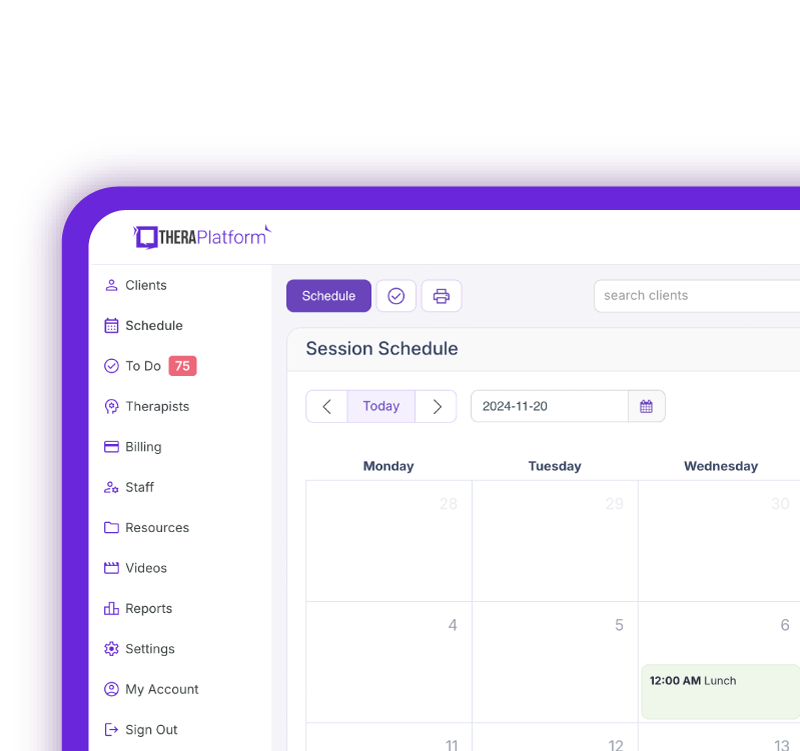
TheraPlatform is an all-in-one EHR, practice management, and teletherapy software with AI-powered notes built for therapists to help them save time on admin tasks. It offers a 30-day risk-free trial with no credit card required and supports different industries and sizes of practices, including speech-language pathologists in group and solo practices.
More resources
- Therapy resources and worksheets
- Therapy private practice courses
- Ultimate teletherapy ebook
- The Ultimate Insurance Billing Guide for Therapists
- The Ultimate Guide to Starting a Private Therapy Practice
- Insurance billing 101
- Practice management tools
Free video classes
- Free on-demand insurance billing for therapist course
- Free mini video lessons to enhance your private practice
- 9 Admin tasks to automate in your private practice
References
Burks, K., Shields, J., Evans, J., Plumley, J., Gerlach, J., & Flesher, S. (2022). A systematic review of outpatient billing practices. SAGE Open Medicine, 10, 20503121221099021. https://journals.sagepub.com/doi/full/10.1177/20503121221099021
Crooks, A. (2022). What Do Insurers Look for in Your Claims? A claims and clinical reviewer offers insights for accurate and timely reimbursement of speech-language services. ASHA Leader, NA-NA. https://go.gale.com/ps/i.do?id=GALE%7CA696405276&sid=googleScholar&v=2.1&it=r&linkaccess=abs&issn=10859586&p=HRCA&sw=w&userGroupName=anon%7E1c6f1f05&aty=open-web-entry
Hill, J., Kulkarni, A., Moll, D., Meteyard, L., Shelley, L., Chugg, G., ... & Clegg, A. (2025). Economic evaluations of speech and language therapy interventions: A scoping review. International journal of language & communication disorders, 60(4), e70091. https://onlinelibrary.wiley.com/doi/full/10.1111/1460-6984.70091
FAQs about speech therapy billing metrics
What is a good clean claim rate for SLPs?
90-95% or higher is a strong clean claim rate. Lower rates can indicate breakdowns in documentation or workflow processes.
How many days in A/R is acceptable?
30-45 days is typical. A longer timeframe suggests delays in the submission of claims, payer processing, or follow-up.
Which billing metric matters most for speech therapy?
While all are important, an SLP practice’s denial rate can be the most telling. In the world of Speech-Language Pathology, clear documentation of medical necessity is crucial. A rising denial rate may indicate issues in documentation that can impact the financial health of a practice.