
How much does occupational therapy EHR software cost?

Choosing an electronic health record (EHR) is an important financial decision for an occupational therapy practice. While monthly subscription prices are often the first number practice owners usually compare, they do not always represent the true cost of using the software.
Key takeaways
- The monthly subscription price isn’t the full cost. Add-ons, transaction fees, additional users, and administrative time can all affect the true cost of an occupational therapy EHR.
- Pricing models vary by vendor. EHRs may charge per provider, by subscription tier, based on usage, or for optional features and services.
- Look closely at what’s included. Telehealth, electronic claims, AI documentation, payment processing, and additional users may cost extra.
- Consider value as well as price. An EHR that reduces duplicate work, replaces multiple tools, and saves staff time may provide value beyond its subscription cost.
Streamline your practice with One EHR
- Scheduling
- Flexible notes
- Template library
- Billing & payments
- Insurance claims
- Client portal
- Telehealth
- E-fax

How much does an occupational therapy EHR cost?
Occupational therapy EHR pricing can vary based on the size of the practice, number of clinicians, features included, and additional services such as telehealth, electronic claims, payment processing, and AI-assisted documentation. Understanding how EHR pricing works can help therapists compare systems more accurately.
There is no standard price for occupational therapy EHR software. Some platforms designed for solo or small practices start at under $50.00 per month, while other systems start higher or provide customized pricing based on practice size and features.
Larger rehabilitation-focused EHR systems may instead provide customized quotes based on the practice and selected services.
For solo OTs, the base subscription may represent a significant portion of the software expense. Group practices need to look more closely at per-clinician costs because adding therapists can substantially change the monthly total.
How occupational therapy EHR pricing works
Cost category | What to consider |
|---|---|
Base subscription | Monthly or annual EHR fee |
Additional users | Added clinicians, admins, interns, or other staff |
Add-ons | Telehealth, AI documentation, advanced features |
Transaction costs | Claims, ERAs, eligibility checks, payment processing |
Setup costs | Implementation, training, customization, data migration |
Administrative time | Time spent documenting, entering duplicate data, processing forms, and managing separate systems |
Other software | Tools the EHR does not replace |
EHR vendors use several pricing models. Understanding the model is just as important as comparing the advertised price.
- Per-provider monthly pricing: The practice pays a monthly fee for each clinician using the software. This can make costs relatively predictable, but expenses can increase as the practice adds therapists.
- Tiered subscription pricing: Vendors may offer several subscription levels with different features. Lower-priced tiers may include basic scheduling and documentation, while higher tiers may add advanced reporting, insurance tools, telehealth, automation, or additional staff capabilities.
- Usage-based and add-on pricing: Some EHR expenses depend on how much a practice uses a particular service. Electronic claims, eligibility checks, text reminders, AI documentation, or other features may carry separate charges. Vendors may also offer optional features as monthly add-ons.
- Annual vs. monthly plans: Some vendors offer discounted pricing when practices pay annually vs. monthly. Some monthly plans can provide more flexibility; however, annual subscriptions may cost less overall.
Practice Management + EHR + Telehealth
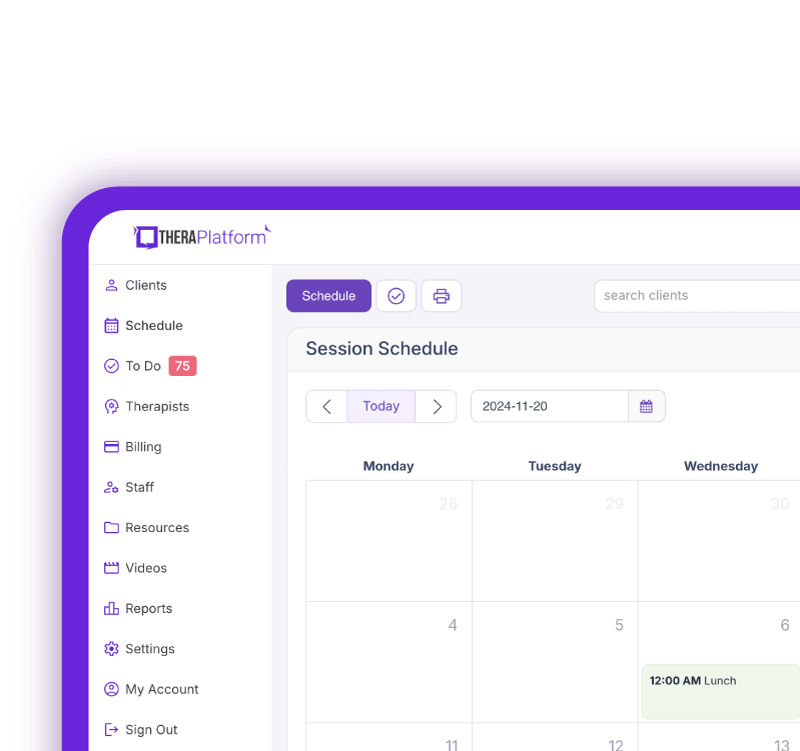
Manage more in less time in your practice with TheraPlatform
What is usually included in the base EHR price?
- Scheduling: Calendars, recurring appointments, appointment reminders, and online scheduling.
- Documentation: Evaluations, daily or progress notes, treatment plans, customizable templates, and goal tracking.
- Client management: Demographics, intake forms, client portals, secure messaging, and documentation storage.
- Basic billing/reporting: Invoices, superbills, payment tracking, and basic practice reports.
Practices should verify exactly what a vendor considers a core feature. A capability included in one platform’s base may require a higher subscription tier or add on with another.
Free Resources for Therapists
Click below and help yourself to peer-created resources:

EHR costs that may not be included
- Telehealth fees: Some platforms include individual telehealth sessions in the subscription, while others limit telehealth to certain plans or charge for advanced or group telehealth features.
- Electronic claims and ERA fees: Insurance-based occupational therapy practices should determine whether electronic claim submission and electronic remittance advice (ERA) processing are included. Vendors may charge for insurance billing as an add-on, charge per claim, or use a third-party clearinghouse with separate fees.
- Payment processing fees: Integrated credit and debit card processing generally carries transaction fees. These are often calculated as a percentage of the payment plus a fixed transaction amount.
- AI documentation fees: AI-assisted documentation is increasingly available within EHR platforms, but it is not always a part of the base subscription. Some vendors charge a monthly fee per clinician for AI note-taking or documentation tools.
- Additional clinicians or administrative users: Group practices should ask which staff accounts incur charges. Some platforms charge for additional clinicians while allowing administrative users at no additional cost. Others differentiate between full-time or part-time clinicians or different administrative roles.
- Implementation, training, and data migration: Moving from one EHR to another can involve costs beyond the subscription. Ask whether onboarding, staff training, data imports, template setup, or migration of existing client records requires additional fees.
Examples of common occupational therapy EHR pricing
Pricing varies considerably across occupational therapy EHRs. The examples below show how several commonly used platforms structure their starting prices and practice fit.
EHR | Starting published price | Additional-provider pricing | OT / practice fit |
TheraPlatform | $39/month | Varies by plan | OT documentation, billing, telehealth, practice management, and multidisciplinary practices, including OT, PT, SLP, and mental health |
SimplePractice | $49/month | Available on higher-tier plans | General private practice and behavioral health with some allied-health use |
WebPT | Around $99/month | Varies | Rehab-focused platform commonly used by PT, OT, and SLP practices |
Fusion / Ensora | Custom pricing | Custom | Pediatric and multidisciplinary therapy practices |
Pricing and included features can change, so practices should verify current pricing directly with each vendor before making a decision.
Free vs. paid EHR software for occupational therapists
A free system may offer limited documentation, scheduling, billing, integrations, customer support, or automation. For occupational therapists, those limitations may also affect the ability to customize evaluations, track functional goals, document ADLs and IADLs, record standardized assessments, manage pediatric or adult OT workflows, and follow progress across an episode of care.
A paid EHR may have a higher monthly expense, but it can combine several clinical and administrative functions in one system, such as OT documentation, scheduling, billing, telehealth, intake forms, patient communication, outcome tracking, and reporting.
Practices should also confirm that any system used to handle protected health information (PHI) provides appropriate security safeguards and supports HIPAA-related requirements.
How to calculate the true cost of an EHR
Instead of comparing subscription prices alone, calculating the estimated total monthly cost can be valuable.
EHR subscription + add-ons + transaction fees + administrative time + other software expenses
Administrative time is also an important factor to consider when calculating the true cost of EHR. In an AOTA member survey, more than half of respondents identified documentation as their biggest barrier to getting their work done (Yamkovenko).
Time spent duplicating information between systems, manually processing forms, fixing claims, or managing disconnected software has a cost, even when there is no separate invoice for it.
An EHR that helps streamline documentation and administrative tasks may provide value beyond its monthly subscription price.
Is a more expensive EHR worth it?
A more expensive EHR is not always better. According to AOTA, “more elaborate EHR systems are often cost-prohibitive and include functionality that a small therapy office will never use.”
Paying more may make sense when the additional functionality solves real clinical or administrative problems for the occupational therapy practice.
Consider whether the system:
- Saves clinicians or administrative staff time
- Supports customizable OT evaluations, treatment notes, progress notes, and discharge documentation
- Makes it easier to track functional goals and outcomes over time
- Supports the practice’s patient populations, such as pediatric, adult, neurological, hand therapy, or other specialty OT services
- Replaces multiple disconnected software tools
- Improves documentation and billing workflows
- Reduces duplicate data entry
- Supports telehealth, patient communication, or outcome measurement when those are part of the practice
- Scales as the practice adds clinicians, locations, or services
A higher monthly price may be justified if the system reduces administrative burden, improves workflow efficiency, or replaces other software subscriptions the practice would otherwise need.
Questions to ask vendors about EHR pricing
- What is the regular monthly or annual subscription price?
- How many occupational therapists, OTAs, and administrative users are included?
- What does each additional provider cost?
- Are customizable OT documentation templates included?
- Are outcome measures and goal tracking included?
- Are telehealth and electronic intake forms included?
- Are electronic claims, eligibility verification, or ERA services billed separately?
- Are there payment processing or transaction fees?
- Does AI-assisted documentation cost extra?
- Are text reminders, e-fax, or other communication tools additional charges?
- Are there setup, implementation, data migration, or cancellation fees?
- Does the price change after an introductory period?
- Is a contract required?
- Which features require a higher subscription tier?
How to compare occupational therapy EHR costs
When comparing occupational therapy EHRs, look beyond the advertised monthly subscription price. Calculate what the software will cost based on how your practice actually operates.
Consider:
- Number of OTs, OTAs, and administrative users
- Customizable OT evaluations and documentation
- Goal and outcome-measure tracking
- Pediatric, adult, or specialty OT workflows your practice needs
- Electronic claims, ERAs, and eligibility verification
- Telehealth
- AI-assisted documentation
- Text reminders and patient communication
- Payment-processing fees
- Setup, training, or data-migration costs
- Other software you would still need to purchase separately
- Clinician and administrative time that the system may save
Comparing the total cost of ownership can give you a more accurate picture of value than comparing subscription prices alone. An EHR with a higher monthly fee may ultimately cost less if it replaces other software, reduces duplicate data entry, and saves clinicians or staff time.
Streamline your practice with One EHR
- Scheduling
- Flexible notes
- Template library
- Billing & payments
- Insurance claims
- Client portal
- Telehealth
- E-fax
Resources for occupational therapists
TheraPlatform is an all-in-one EHR, practice management, and teletherapy software built with AI-powered notes for therapists to help them save time on admin tasks. It offers a 30-day risk-free trial with no credit card required and supports different industries and sizes of practices, including occupational therapists in group and solo practices.
More resources
- Therapy resources and worksheets
- Therapy private practice courses
- Ultimate teletherapy ebook
- The Ultimate Insurance Billing Guide for Therapists
- The Ultimate Guide to Starting a Private Therapy Practice
- Insurance billing 101
- Practice management tools
Free video classes
- Free on-demand insurance billing for therapist course
- Free mini video lessons to enhance your private practice
- 9 Admin tasks to automate in your private practice
References
- American Occupational Therapy Association. (2022, October 31). Response to request for information on the Medicare Access and CHIP Reauthorization Act (MACRA) https://www.aota.org/-/media/corporate/files/advocacy/aota-response-macra-rfi.pdf
- Yamkovenko, S. Q&A with Cathy Brennan, MA, OTR/L, FAOTA. American Occupational Therapy Association. https://www.aota.org/practice/practice-essentials/documentation/qa-with-cathy-brennan
FAQs about occupational therapy EHR costs
How much does occupational therapy EHR software cost?
Pricing varies widely. Some EHRs for solo and small practices start at under $50 per month, while others charge more based on clinicians, features, usage, or practice size.
What additional EHR costs should occupational therapists consider?
Potential costs include telehealth, electronic claims and ERAs, payment processing, AI documentation, additional users, training, implementation, and data migration.
How can I compare occupational therapy EHR pricing?
Compare the total cost of ownership, including the subscription, add-ons, transaction fees, number of users, other required software, and administrative time—not just the advertised monthly price.