
Occupational therapy billing metrics

Monitoring occupational therapy billing metrics can help manage one of the most complex and often overlooked aspects of an occupational therapy practice -- billing, a detail-heavy, payer-driven process.
Each submitted claim must meet strict documentation guidelines, CPT and ICD-10 coding requirements, and authorization guidelines to receive full reimbursement promptly.
Summary
- Occupational therapy billing is highly detail-driven and payer-specific, making accurate documentation, coding, and authorization essential for timely reimbursement.
- Tracking core metrics, such as clean claim rate, denial rate, days in A/R, and net collection rate, helps OTs reduce revenue loss and improve cash flow.
- Coding and documentation metrics—such as CPT–ICD-10 alignment, modifier usage, and timed code accuracy—directly impact compliance and audit readiness. Enrolling in an insurance billing course for therapists can help providers enhance their knowledge.
- Using EHR dashboards, clearinghouses, and AI-assisted tools enables proactive billing management and significantly reduces administrative burden.
→ Enroll in My Free, On-Demand Insurance Billing for Therapists Course
Having strong occupational therapy billing metrics supports clinicians in reducing denials, shortening payment timelines, and maintaining compliance with insurance requirements.
Why occupational therapy billing metrics matter
Research demonstrates that “the most common causes for inaccurate or inappropriate billing were a lack of formal education within residency curriculum, inadequate clinical documentation supporting a level of billing, and lack of a feedback system aimed to correct billing errors.”
Streamline your insurance billing with One EHR
- Claim batching
- Auto claims
- Automated EOB & ERA
- Real-time claim validation
- Real-time claim tracking
- Aging and other reports

- Prevents revenue Loss: Small documentation errors can delay payments and leave your practice underpaid. By monitoring billing metrics, therapists can catch and correct errors early, ensure claims are submitted accurately, and ensure they are fully reimbursed.
- Improves cash flow: Understanding payment timelines helps understand and forecast revenue. This supports accurate revenue forecasting and better financial planning, ensuring funds are available for day-to-day operations.
- Supports compliance: Having accurate metrics allows for compliance during audits, reducing the risk of penalties.
- Reduces administrative burden: Monitoring metrics early prevents billing errors, minimizes re-work, and frees up administrative work for staff to focus on higher-value tasks.
Core occupational therapy billing metrics
Some occupational therapy billing metrics are essential.
These key performance indicators provide insight into the financial health and operational efficiency.
- Clean claim rate: Measures the percentage of OT claims paid on first submission. A high rate reflects accurate coding, documentation, and insurance verification.
- Denial rate: Shows how often claims are denied and why. One report states that “Denial rates are typically 5%–10%, which can improve after automating workflows." Monitoring trends helps identify recurring issues such as authorization gaps or insufficient medical necessity.
- Days in Accounts Receivable (A/R): Indicates time needed to receive payment.
- Net collection rate: Compares collected revenue to allowed reimbursement. It shows overall billing efficiency and payer performance.
Practice Management + EHR + Telehealth
Manage more in less time in your practice with TheraPlatform
Coding and documentation metrics for OT billing
Accurate coding and thorough documentation are the backbone of occupational therapy billing metrics.
Key metrics to monitor include the following:
- CPT–ICD-10 alignment: Functional diagnoses support billed services, reducing denials for medical necessity.
- Timed vs. Untimed Code Accuracy (8-minute rule): Correct use of timed codes prevents underbilling and supports compliance with payer regulations.
- Modifier usage (GO, CQ/CO, Telehealth): Accurate modifiers reflect the service context, like telehealth delivery or compensation.
- Documentation completion time and consistency: Consistent and timely documentation reduces denials and improves audit readiness.
Payer-specific occupational therapy billing metrics
Different insurance payers have varying requirements, reimbursement rates, and turnaround times.
Tracking these metrics helps tailor billing practices to maximize revenue.
- Reimbursement Rates By Payer: Understand which payers provide the highest reimbursement for specific OT services. This helps you prioritize services and optimize revenue by focusing on higher-payer plans when possible.
- Authorization Approval Rates: Identify payers with strict prior authorization requirements. Monitoring approval trends helps prevent denials, ensures timely care, and reduces administrative burden.
- Claim Turnaround time: Track which insurers pay faster to prioritize follow-up. Understanding turnaround time and patterns allows for anticipating delays and allocating resources where needed.
Free Resources for Therapists
Click below and help yourself to peer-created resources:

Visit and productivity metrics that affect occupational therapy billing metrics
Operational metrics such as visits and productivity directly influence billing efficiency.
- Visits Completed vs. Visits Billed: Discrepancies may indicate missed billing opportunities or documentation gaps.
- Units Billed per Visit: Ensure accurate unit calculation for timed codes for full reimbursement.
- Average Reimbursement per Visit: Monitor how visit length, code selection, and payer mix impact revenue.
- No-show and Late Cancellation Rates: High no-show rates reduce revenue and requires policy adjustments or patient reminders.
How clinicians can use occupational therapy billing metrics
Billing metrics provide clear insight that helps OTs improve accuracy, efficiency, and revenue.
- Identify common denial reasons: Figure out what is causing the denials, such as lack of prior authorizations, medical necessity, coding errors, or insufficient documentation.
- Strengthen functional documentation: Ensure therapy notes clearly support medical necessity for each CPT code billed.
- Improve intake and insurance verification processes: Collect complete payer information upfront to prevent claim rejections.
- Adjust coding patterns based on payer trends: Monitor which codes are frequently denied or approved to optimize billing strategies.
Tools that help track occupational therapy billing metrics
- OT-specific EHR billing dashboards: Many electronic health record systems provide real-time reporting on clean claims, denials, and A/R.
- Integrated clearinghouses: Clearinghouses streamline claim submission, track denials, and provide payer insights.
- AI-assisted documentation and coding support: Emerging tools can analyze notes for coding accuracy, suggest corrections to reduce denials, and highlight missing information.
Research shows that "AI technologies have significantly improved billing accuracy, reduced administrative costs, and increased revenue collection efficiency. AI's ability to predict payment patterns and identify errors before submission has streamlined the billing process and improved reimbursement cycles.”
Occupational therapy billing is complex, but tracking the right metrics makes a difference in billing. By monitoring clean claim rates, denial rates, A/R days, coding accuracy, payer trends, and productivity, occupational therapists can prevent revenue loss, improve cash flow, and maintain compliance.
When paired with the right technology, such as EHR billing dashboards, clearinghouses, and AI-assisted coding, metrics streamline the administrative process and also allow for continuous improvement.
Overall, a proactive and data-driven approach empowers therapists to spend less time managing paperwork and more time delivering high-quality client care.
Practice Management + EHR + Telehealth
Manage more in less time in your practice with TheraPlatform
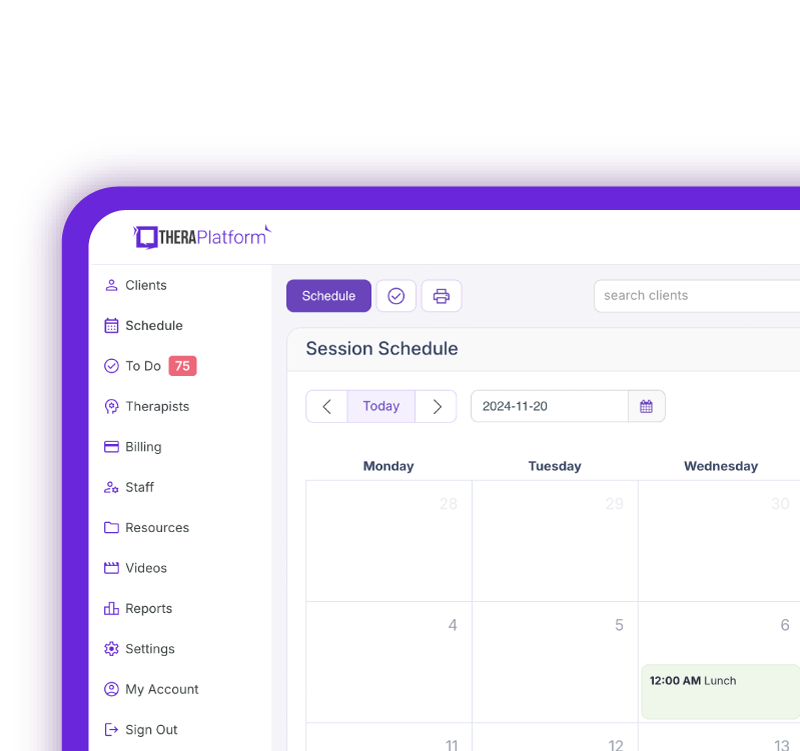
How EHR and practice management software can save you time with insurance billing for therapists
EHRs with integrated billing software and clearing houses, such as TheraPlatform, offer therapists significant advantages in creating an efficient insurance billing process. The key is minimizing the amount of time dedicated to developing, sending, and tracking medical claims through features such as automation and batching.
Watch this video to see how TheraPlatform’s EHR saves time on insurance billing
What are automation and batching?
- Automation refers to setting up software to perform tasks with limited human interaction.
- Batching or performing administrative tasks in blocks of time at once allows you to perform a task from a single entry point with less clicking.
Which billing and medical claim tasks can be automated and batched through billing software?
- Invoices: Create multiple invoices for multiple clients with a click or two of a button or set up auto-invoice creation, and the software will automatically create invoices for you at the preferred time. You can even have the system automatically send invoices to your clients.
- Credit card processing: Charge multiple clients with a click of a button or set up auto credit card billing, and the billing software will automatically charge the card (easier than swiping!)
- Email payment reminders: Never manually send another reminder email for payment again, or skip this altogether by enabling auto credit card charges.
- Automated claim creation and submission: Batch multiple claims with one button click or turn auto claim creation and submission on.
- Live claim validation: The system reviews each claim to catch any human errors before submission, saving you time and reducing rejected claims.
- Automated payment posting: Streamline posting procedures for paid medical claims with ERA. When insurance offers ERA, all their payments will post automatically on TheraPlatform's EHR.
- Tracking: Track payment and profits, including aging invoices, overdue invoices, transactions, billed services, service providers
Utilizing billing software integrated with an EHR and practice management software can make storing and sharing billing and insurance easy and save providers time when it comes to insurance billing for therapists.
Streamline your practice with One EHR
- Scheduling
- Flexible notes
- Template library
- Billing & payments
- Insurance claims
- Client portal
- Telehealth
- E-fax
Resources for occupational therapists
TheraPlatform is an all-in-one EHR, practice management, and teletherapy software built with AI-powered notes for therapists to help them save time on admin tasks. It offers a 30-day risk-free trial with no credit card required and supports different industries and sizes of practices, including occupational therapists in group and solo practices.
More resources
- Therapy resources and worksheets
- Therapy private practice courses
- Ultimate teletherapy ebook
- The Ultimate Insurance Billing Guide for Therapists
- The Ultimate Guide to Starting a Private Therapy Practice
- Insurance billing 101
- Practice management tools
Free video classes
- Free on-demand insurance billing for therapist course
- Free mini video lessons to enhance your private practice
- 9 Admin tasks to automate in your private practice
References
- (2025). AI-Driven Healthcare Billing Systems: Transforming Revenue Cycle Management.https://www.researchgate.net/publication/396714210_AI-Driven_Healthcare_Billing_Systems_Transforming_Revenue_Cycle_Management
- Burks, K., Shields, J., Evans, J., Plumley, J., Gerlach, J., & Flesher, S. (2022). A Systematic Review of Outpatient Billing Practices. SAGE Open Medicine https://doi.org/10.1177/20503121221099021
- Chandawarkar, R., Nadkarni, P., Barmash, E., Thomas, S., Capek, A., Casey, K., & Carradero, F. (2024). Revenue Cycle Management: The Art and the Science. Plastic and Reconstructive Surgery - Global Open https://doi.org/10.1097/gox.0000000000005756
FAQs about occupational therapy billing metrics
What are the most important billing metrics for occupational therapists?
Key metrics include clean claim rate, denial rate, days in accounts receivable, net collection rate, units billed per visit, and average reimbursement per visit.
How do billing metrics help reduce claim denials?
They identify recurring issues such as missing authorizations, documentation gaps, or coding errors, allowing practices to correct problems before submission.
Can technology really improve OT billing performance?
Yes. EHR dashboards, integrated clearinghouses, and AI-assisted documentation tools improve accuracy, shorten payment cycles, and reduce administrative workload.