
Left ankle pain ICD 10 code

The left ankle pain ICD-10 code is used to address a common orthopedic complaint among kids, teenagers, and adults. The underlying causes range from acute injuries like an ankle sprain to chronic joint conditions like osteoarthritis.
Summary
- Ankle pain has a wide range of causes — from sprains and fractures to nerve issues and arthritis — making thorough evaluation critical to ensure accurate diagnosis and appropriate treatment.
- Comprehensive assessment tools, such as the Ottawa Ankle Rules, FAAM, and Lower Extremity Functional Scale, help physical therapists determine severity, guide treatment, and support documentation.
- The left ankle pain ICD 10 code, M25.572 (pain in left ankle), is specific and billable, but more detailed codes should be used when possible to reflect the diagnosis and support medical necessity for insurance reimbursement. Enrolling in an insurance billing course for therapists can help providers enhance their knowledge.
- High-quality documentation should connect the patient’s symptoms to functional limitations, include measurable goals, and clearly justify the need for skilled therapy to improve reimbursement and clinical outcomes. By leveraging an EHR like TheraPlatform for efficient documentation and claim submission, therapists can tackle billing with ease.
→ Enroll in My Free, On-Demand Insurance Billing for Therapists Course
Given its location in the lower extremity, ankle pain can significantly impact a person’s mobility and make everyday tasks difficult. While some ankle pain will resolve on its own, many patients are referred to physical therapy to address this condition.
Whether you work with athletes or neurologic conditions, understanding how to evaluate and treat ankle pain is an important skill to build.
Streamline your insurance billing with One EHR
- Claim batching
- Auto claims
- Automated EOB & ERA
- Real-time claim validation
- Real-time claim tracking
- Aging and other reports

What are the most common causes of left ankle pain?
Given the complex nature of ankle anatomy, there are many potential sources of pain at the ankle.
Below are some (not all) of the common sources of ankle pain:
- Joint
- Talocrural joint
- Subtalar joint
- Tibiofibular syndesmosis
- Ligaments
- Syndesmotic ligaments
- Deltoid ligament
- Anterior talofibular ligament (ATFL)
- Calcaneofibular ligament (CFL)
- Posterior talofibular ligament
- Nerve
- Local: tibial nerve
- Referred: L4, S1 radiculopathy
- Tendons
- Achilles tendon
- Posterior tibialis tendon
- Anterior tibialis tendon
- Peroneal tendons
- Anterior or posterior soft tissue and bony impingement
Sprains, strains, nerve compressions, gout, rheumatoid arthritis, fractures, and more can affect the various anatomic structures of the ankle, causing pain.
Determining the underlying cause of ankle pain is a vital first step. We don’t want to treat an ankle fracture like an ankle strain or treat radicular pain like an ankle sprain. As a physical therapist, there are many tools to help you investigate the cause.
Practice Management + EHR + Telehealth
Manage more in less time in your practice with TheraPlatform
What outcome measures are best for documenting ankle pain in PT?
Beginning with a subjective assessment of ankle pain gives you a sense of the quality, severity, and pattern of the pain. Using standardized outcome measures can help you quantify the impact that ankle pain has on a person’s life.
There are a few measures to consider when treating ankle pain:
- Foot and Ankle Ability Measure (FAAM)
- Foot and Ankle Disability Index
- Lower Extremity Functional Scale
- Olerud and Molander Scoring System
- Cumberland Ankle Instability Tool (CAIT)
Objective testing is just as important. For instance, the Ottawa Ankle Rules should be applied to help identify patients who need an X-ray to rule out a fracture. Additional tests and measures will provide clinical insight into the potential anatomical origin and cause of the pain.
Consider these tools and tests when examining ankle pain:
- Palpation
- Active and passive ROM
- Manual muscle testing
- Passive accessory motion
- Gait assessment
- Resisted isometrics or selective tension testing
When indicated, refer for imaging like ultrasound, X-ray, CT, or MRI, and consider a referral to an ankle specialist or orthopedic physician, rheumatologist, or even spine specialist, depending on the origin of their pain.
Free Resources for Therapists
Click below and help yourself to peer-created resources:

What are the best therapy techniques for ankle pain?
Treatment for ankle pain may include manual therapy techniques like soft tissue mobilization, dry needling, IASTM, or joint mobilizations for pain relief and tissue healing.
It may also include stretching and range of motion to normalize joint mobility and muscle length; muscle strengthening, coordination, and motor control exercises to improve muscle performance around the ankle; proprioceptive training and gait training to improve joint awareness and compensatory techniques like bracing and orthotics, or assistive device training.
Treating ankle pain should be individualized to the patient’s underlying cause and their goals. When available, consult clinical practice guidelines, systematic reviews, and meta-analyses or expand your training via continuing education courses to ensure your practice is evidence-based.
For example, the APTA Academy of Orthopaedic Physical Therapy published a revised edition of their CPG on Ankle Stability and Movement Coordination Impairments: Lateral Ankle Ligament Sprains in 2021. You could also consult the 2017 CPG Treatment Guidelines for Foot and Ankle.
M25.572: Left ankle pain ICD 10 code
Because all HIPAA-covered entities are required to submit ICD-10 codes if seeking reimbursement for services from an insurance company, selecting an appropriate ICD-10 code for ankle pain is an important first step in your documentation.
These alphanumeric codes identify a medical diagnosis, but perhaps more importantly, they help insurance companies understand why the care you are providing is medically necessary and therefore, reimbursable.
The code M25.572 – the left ankle pain ICD 10 code is a generic code that can be documented to cover any cause of ankle pain. Let’s explore this code a bit further:
Is M25.572 a valid and billable left ankle pain ICD-10 code?
Yes, M25.572 (the left ankle pain ICD 10 code) is considered specific enough to indicate a diagnosis for billing/reimbursement purposes. The parent code M25.5 (pain in joint) is considered too nonspecific for billing, which is why it is important to look for codes with more characters that can provide more detail. Note that this code can be used to indicate both pain in the ankle and joints of the foot.
When should I use M25.572 versus a more specific diagnosis code (e.g., sprain or arthritis)?
Though M25.572 is the only code that specifically describes ankle pain, there are other codes related to painful ankle conditions or injuries that you may also include. Utilizing a resource like ICD-10 Data to search for the condition you are looking for can help you identify pertinent codes.
Let’s review some examples in the table below.
Ankle pain ICD 10 code | Description |
|---|---|
Sprain of unspecified ligament of ankle–Considered too nonspecific for billing purposes. | |
Sprain of the calcaneofibular ligament of left ankle, initial encounter | |
Sprain of the deltoid ligament of left ankle, subsequent encounter | |
Tarsal tunnel syndrome of the left lower limb | |
Primary osteoarthritis of the left ankle and foot | |
Achilles tendinitis, left leg |
What should I include in my documentation when using the left ankle pain ICD-10 code?
Next, accurate and thorough documentation of patient interactions is necessary for obtaining reimbursement and authorization of PT services.
When working with a patient with left ankle pain, follow these tips to ensure high-quality documentation:
- Record the patient’s subjective complaints, including the impact of their symptoms on functional tasks
- Document your objective exam findings, including tests such as range of motion and strength, as well as functional outcome measures like the Lower Extremity Functional Scale or Foot and Ankle Ability Measure
- Create individualized, measurable, and time-based goals that are tied to the patient’s functional impairments
- Include your physical therapy diagnosis and justification for the necessity of your skilled services
Managing client ankle pain with confidence
Should challenges arise in treating a patient with ankle pain, don’t panic. Remember that you have many resources at your disposal. If the patient is not responding as you’d expect, consider a referral for imaging or to a medical provider for additional testing and to confirm that a different approach to care is not needed.
If you don’t feel as confident treating ankle pain, find a colleague who will mentor you and brush up on the latest evidence using journals and continuing education courses. With a little time and practice, your confidence will certainly build.
Practice Management + EHR + Telehealth
Manage more in less time in your practice with TheraPlatform
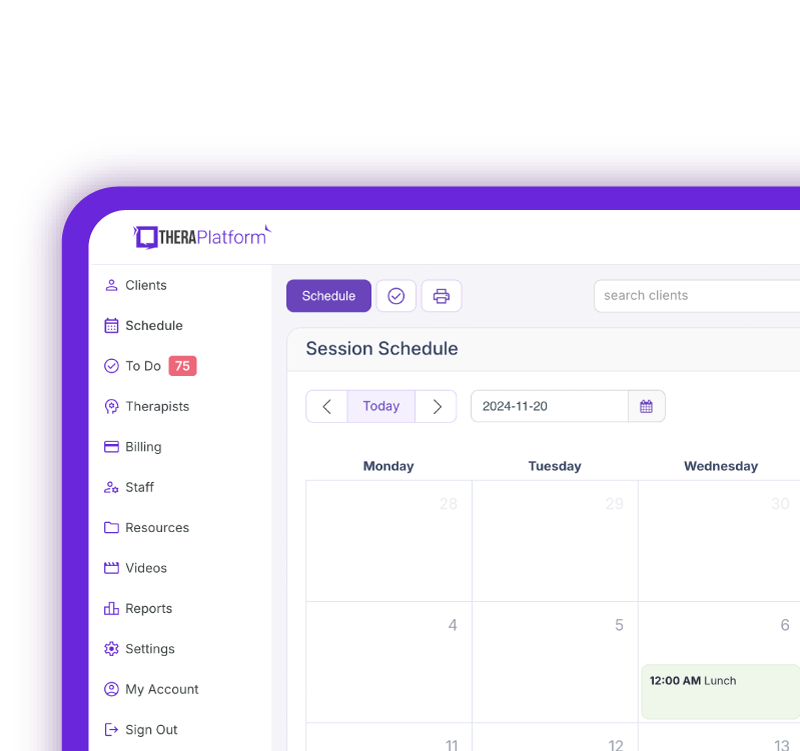
How EHR and practice management software can save you time with insurance billing for therapists
EHRs with integrated billing software and clearing houses, such as TheraPlatform, offer therapists significant advantages in creating an efficient insurance billing process. The key is minimizing the amount of time dedicated to developing, sending, and tracking medical claims through features such as automation and batching.
Watch this video to see how TheraPlatform’s EHR saves time on insurance billing
What are automation and batching?
- Automation refers to setting up software to perform tasks with limited human interaction.
- Batching or performing administrative tasks in blocks of time at once allows you to perform a task from a single entry point with less clicking.
Which billing and medical claim tasks can be automated and batched through billing software?
- Invoices: Create multiple invoices for multiple clients with a click or two of a button or set up auto-invoice creation, and the software will automatically create invoices for you at the preferred time. You can even have the system automatically send invoices to your clients.
- Credit card processing: Charge multiple clients with a click of a button or set up auto credit card billing, and the billing software will automatically charge the card (easier than swiping!)
- Email payment reminders: Never manually send another reminder email for payment again, or skip this altogether by enabling auto credit card charges.
- Automated claim creation and submission: Batch multiple claims with one button click or turn auto claim creation and submission on.
- Live claim validation: The system reviews each claim to catch any human errors before submission, saving you time and reducing rejected claims.
- Automated payment posting: Streamline posting procedures for paid medical claims with ERA. When insurance offers ERA, all their payments will post automatically on TheraPlatform's EHR.
- Tracking: Track payment and profits, including aging invoices, overdue invoices, transactions, billed services, service providers
Utilizing billing software integrated with an EHR and practice management software can make storing and sharing billing and insurance easy and save providers time when it comes to insurance billing for therapists.
Streamline your practice with One EHR
- Scheduling
- Flexible notes
- Template library
- Billing & payments
- Insurance claims
- Client portal
- Telehealth
- E-fax
Resources for physical therapists
TheraPlatform is an all-in-one EHR, practice management, and teletherapy software with AI-powered notes built for therapists to help them save time on admin tasks. It offers a 30-day risk-free trial with no credit card required and supports different industries and sizes of practices, including physical therapists in group and solo practices.
More resources
- Therapy resources and worksheets
- Therapy private practice courses
- Ultimate teletherapy ebook
- The Ultimate Insurance Billing Guide for Therapists
- The Ultimate Guide to Starting a Private Therapy Practice
- Insurance billing 101
- Practice management tools
Free video classes
- Free on-demand insurance billing for therapist course
- Free mini video lessons to enhance your private practice
- 9 Admin tasks to automate in your private practice
FAQs about the left ankle pain ICD 10 code
What is the ICD-10 code for left ankle pain?
The ICD-10 code for left ankle pain is M25.572, which is a specific, billable code used to document ankle pain for insurance reimbursement purposes.
When should therapists use M25.572 instead of a more specific code?
Use M25.572 when the exact cause of ankle pain is not yet identified. If a clear diagnosis is established (e.g., ligament sprain, arthritis, or tendinitis), a more specific ICD-10 code should be used to support medical necessity and accurate billing.
What should be included in documentation for ankle pain?
Documentation should include subjective complaints, objective findings (e.g., ROM, strength, outcome measures), functional limitations, measurable goals, and a clear justification for skilled therapy services to support reimbursement.