
Essential EHR features for mental health therapists

Electronic Health Records (EHRs) and mental health EHR features can streamline the administrative and clinical sides of running a mental health therapy practice.
Most people think of EHRs as organizational aids and time savers for medical settings, but they can also have significant clinical value for mental health.
In fact, some EHRs have been created specifically for psychotherapists. Let’s explore the most valuable mental health EHR features and how they improve the therapist experience.
Key takeaways
- Mental health EHRs can do more than organize records. They can support clinical care through therapy-specific documentation, assessments, outcome tracking, and treatment planning.
- Mental health EHR features such as automated scheduling, reminders, digital intake, billing tools, and AI-assisted documentation can reduce administrative workload and give therapists more time for client care.
- Security should be a top priority. Look for HIPAA-compliant systems with encryption, access controls, audit capabilities, and appropriate safeguards for sensitive behavioral health information.
- Choose an EHR that fits your practice today but can also scale as you add clinicians, clients, services, or locations.
Streamline your practice with One EHR
- Scheduling
- Flexible notes
- Template library
- Billing & payments
- Insurance claims
- Client portal
- Telehealth
- E-fax

What are the essential mental health practice EHR features?
An EHR is a digital platform that contains a client’s personal health information. It also includes administrative tools that help providers manage their practice. While most EHRs were not solely created for mental health, psychotherapists, especially those in private practice, can benefit greatly from their applications.
Here are the essential EHR features for psychotherapy practices.
EHR security and HIPAA compliance for mental health providers
When dealing with confidential client data and digital tools, nothing is more important than security. This starts with HIPAA-compliant teleconferencing and storage. Client data must be fully encrypted, and only authorized people can have access to your protected health information. The best EHRs have ways to control and audit who is accessing client data.
Scheduling and automated reminders in EHRs
Scheduling is a chronic area of difficulty for therapists, who have a mix of ongoing and new clients with inconsistent time slots. EHR scheduling software allows clinicians to set their availability, and clients choose their slots remotely without any human interaction. This cuts down on time and eases anxiety that clients have about calling their therapist and managing appointments. Automated appointment reminders are a handy tool to reduce client no-shows.
Mental health therapy documentation features
Documentation is one of the most time-consuming aspects of psychotherapy. Therapists must administer intake paperwork, create progress notes, and craft treatment plans. EHRs provide several tools to assist with documentation, including customizable treatment note templates, treatment planners, and some platforms offer AI-assisted documentation tools that can generate draft notes for clinician review. Not only do these resources save time, but they also provide clinical suggestions to help therapists formulate their thinking.
Billing and claims management for mental health private practices
Besides documentation, therapists probably spend most of their non-session time on billing and insurance claims. Figuring out insurance eligibility alone can take hours. EHRs simplify the billing and claims process with live eligibility verification, electronic claim submission, and claims tracking.
They also keep statistics on denials/rejections and the reasons why they occur. Further, depending on what the therapist writes in their notes and treatment plans, they can suggest appropriate diagnostic and current procedural terminology (CPT) codes.
Integrated teletherapy in EHRs for mental health therapists
An EHR used for mental health must have a built-in teletherapy platform. This videoconferencing software has to fulfill HIPAA requirements, with encrypted data transmission and secure access controls. Interactive tools, such as virtual whiteboards and screen sharing, are also necessary to provide an effective therapy experience. The ability to integrate with documentation and scheduling tools is a plus.
Client portal and digital intake EHR features
An EHR client portal is the hub of information and communication between the client and the therapist. It contains necessary documentation, including intake forms and assessment measures, which the client fills out online. It also allows document sharing, scheduling, and secure messaging. It is basically the nerve center of the therapy experience.
EHR assessment tools for mental health private practices
An area where an EHR can become very mental-health specific is in its assessment tools. EHRs may offer brief screening tools for various clinical issues, including anxiety, depression, and substance abuse. Examples include the GAD-7 and the PHQ-9. These measure the client’s current functioning and can be given throughout therapy to gauge progress. Many EHRs also score outcomes automatically and chart progress over time.
Reporting and practice analytics EHR features for mental health practices
While most therapists don’t get into counseling for the money, it is also a business. EHRs can track several variables related to the financial productivity of therapists. These include utilization rates, client turnover, cancellations, and no-show appointments. They can also monitor whether a therapist is completing their documentation on time. Group practice administrators can view relevant data to compare the performance of therapists in their practice.
EHR Feature | How It Helps Psychotherapy Practices |
|---|---|
Security and HIPAA Compliance | Protects confidential client information and controls access to sensitive records |
Scheduling and reminders | Simplifies appointment booking and can help reduce no-shows |
Therapy documentation | Streamlines progress notes, treatment plans, intake documentation, and other clinical records |
Billing and claims | Supports eligibility checks, electronic claims, coding, and claims tracking |
Integrated teletherapy | Connects secure virtual sessions with scheduling and documentation workflows |
Client portal and digital intake | Centralizes forms, scheduling, document sharing, and secure communication |
Assessment tools | Supports measures such as the PHQ-9 and GAD-7 and helps track outcomes over time |
Practice analytics | Provides insight into utilization, cancellations, documentation, and practice performance |
Further considerations for mental health EHRs
Therapists should consider the following factors when choosing an EHR.
Solo mental health therapists vs. group practice EHR needs
A group practice has different needs from a solo practitioner. Therapists working alone do everything themselves but have lower client volume and fewer complications. Group practices require an EHR that has scheduling for multiple therapists, centralized billing, and role-based access permissions.
They may also prioritize the ability to reach a live customer service agent since they are likely to have complicated issues that arise from having more therapists and clients. The capability to effortlessly share information is also important if you have a multidisciplinary practice.
For example, some practices have medication providers as well as therapists, and bigger institutions may have a variety of professionals. As noted above, comparing and tracking therapists' productivity is important for the administrators of multi-provider practices.
Practice Management + EHR + Telehealth
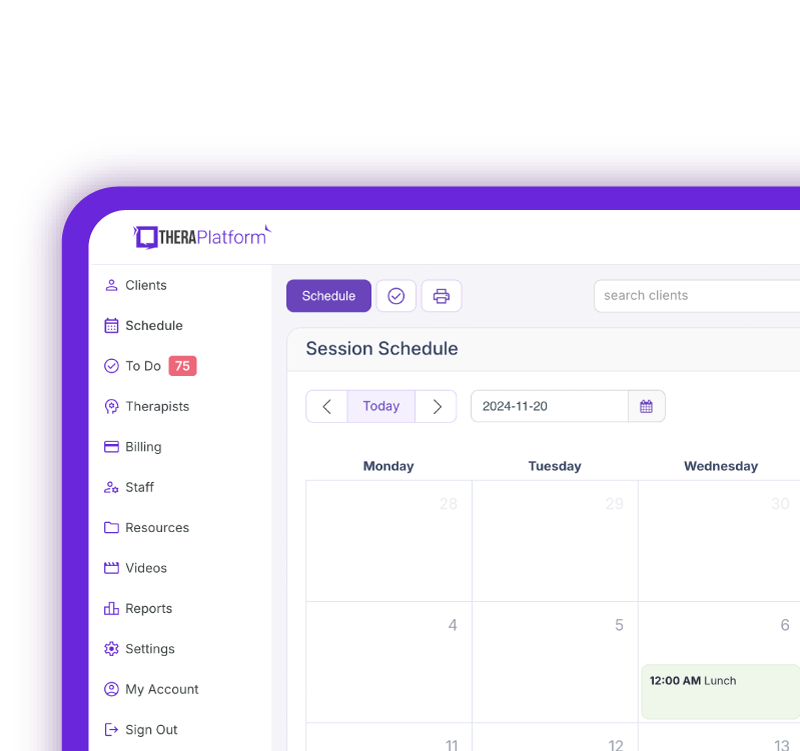
Manage more in less time in your practice with TheraPlatform
Can your EHR grow with your practice?
You, of course, require an EHR that meets your current needs. But what if you are a small group practice that is considering adding several more practitioners? Can your EHR seamlessly handle the increase in staff and client volume? It might be wise to choose an EHR that has the features needed for a small or solo practice, but can also transition to a larger business.
What EHR feature saves you the most time?
While every EHR has tools to save you time, the answer to this question may depend on your particular strengths and weaknesses. Maybe you are horrible at paperwork and want an AI notes feature that has customizable templates and creates notes for you based on session transcripts.
Or, you hate dealing with insurance companies and need an EHR that makes it easy to verify eligibility and submit claims. Whatever your biggest weakness as a clinician, it would be wise to consider an EHR that has features to combat it.
Free Resources for Therapists
Click below and help yourself to peer-created resources:

Five key questions when choosing a mental health EHR
Ask these five questions when evaluating an EHR for your mental health practice:
- Does the system support mental-health-specific note formats (e.g., DAP, BIRP, or SOAP), and can you link progress notes directly to measurable treatment plans?
- How does the platform handle specialized evaluations like psychiatric assessments, biopsychosocial intakes, and outcome tracking tools (e.g., PHQ-9, GAD-7)?
- Does the billing system automate insurance verification, claims coding, and tracking for telehealth modifiers?
- Does the software meet HIPAA security regulations and offer features like segregated psychotherapy notes, role-based access control, 42 CFR Part 2 compliance for substance use data, and specialized consent tracking for sensitive records?
- How seamless is the client portal for digital intake forms, scheduling, appointment reminders, and secure messaging?
By choosing an EHR with the right mix of clinical, administrative, and security features, therapists can spend less time managing their practice and more time focusing on client care.
Streamline your practice with One EHR
- Scheduling
- Flexible notes
- Template library
- Billing & payments
- Insurance claims
- Client portal
- Telehealth
- E-fax
Resources for mental health therapists
Theraplatform is an all-in-one EHR, practice management and teletherapy solution with AI-powered notes and Wiley Treatment Planners that allow you to focus more on patient care. With a 30-day free trial, you have the opportunity to experience Theraplatform for yourself with no credit card required. Cancel anytime. They also support different industries including mental and behavioral health therapists in group practices and solo practices.
More resources
- Therapy resources and worksheets
- Therapy private practice courses
- Ultimate teletherapy ebook
- The Ultimate Insurance Billing Guide for Therapists
- The Ultimate Guide to Starting a Private Therapy Practice
- Insurance billing 101
- Practice management tools
Free video classes
- Free on-demand insurance billing for therapist course
- Free mini video lessons to enhance your private practice
- 9 Admin tasks to automate in your private practice
References
The HIPAA Journal. HIPAA guidelines on telemedicine. https://www.hipaajournal.com/hipaa-guidelines-on-telemedicine/
Theraplatform. HIPAA compliant telehealth platforms. https://www.theraplatform.com/blog/342/hipaa-compliant-telehealth-platforms
Theraplatform. How to reduce no shows in your private practice. https://www.theraplatform.com/blog/277/how-to-reduce-no-shows-in-your-private-practice
Theraplatform. Outcome measures. https://www.theraplatform.com/blog/1620/outcome-measures
United States Department of Health and Human Services. (2026, January 30). Fact sheet 42 CFR part 2 final rule. https://www.hhs.gov/hipaa/for-professionals/regulatory-initiatives/fact-sheet-42-cfr-part-2-final-rule/index.html
FAQs about essential EHR features for mental health therapists
What features should therapists look for in an EHR?
Therapists should prioritize HIPAA-compliant security, mental-health-specific documentation, scheduling and reminders, billing and claims management, teletherapy, a client portal, digital intake forms, assessment tools, and practice analytics. The right combination depends on the size and needs of the practice.
How can an EHR save therapists time?
An EHR can automate or streamline repetitive administrative work such as appointment scheduling, reminders, intake paperwork, progress notes, insurance verification, claim submission, and outcome scoring. This can reduce the amount of non-session time therapists spend managing their practice.
What is the difference between an EHR for a solo therapist and one for a group practice?
Solo therapists may prioritize simplicity, affordability, and time-saving automation. Group practices typically need additional capabilities such as multi-provider scheduling, centralized billing, role-based permissions, performance reporting, and tools that make it easier for multiple clinicians to securely share information.