
How to reduce no shows in your private practice

Reducing no-show appointments and last-minute cancellations is a persistent challenge for therapists. These missed sessions not only lead to lost revenue but can also disrupt the therapeutic relationship and continuity of care. In this blog, we will explore practical strategies and tools that can help therapists minimize no-shows and improve client attendance.
Summary
- Missed appointments disrupt treatment progress, strain the therapeutic relationship, and lead to significant revenue loss for therapists.
- Clients commonly no-show due to forgetfulness, mental health symptoms, emergencies, or ambivalence about therapy.
- A clearly communicated and consistently enforced attendance policy helps set expectations and reduce repeat no-shows. Download my free attendance policy.
- Tools such as EHRs with teletherapy, automated reminders, self-scheduling, and storing a credit card on file greatly increase accountability and decrease last-minute cancellations.
→ Download My Free Cancellation and Termination Templates
Streamline your practice with One EHR
- Scheduling
- Flexible notes
- Template library
- Billing & payments
- Insurance claims
- Client portal
- Telehealth
- E-fax

Reports of no-show rates in private practice vary widely, but a true “did not attend rate” appears to be close to nine percent. Here are reasons why people don’t show up for their therapy appointments, the impact of their absences, and effective, yet considerate, strategies to stop it from happening.
Why clients miss mental health appointments
Clients miss mental health appointments for a variety of reasons. While some are simply mistakes, many are related to the therapeutic process.
Forgetting about their mental health appointment
Yes, people genuinely forget they have a mental health appointment. This is usually because they are over-scheduled and stressed about other aspects of their lives. One can always search for unconscious reasons why someone may no-show, but sometimes they just don’t remember.
Mental health issues
The same issues that brought someone to therapy may prevent them from attending mental health appointments.
For example, a client with depression may feel too unmotivated to get out of bed. Alternatively, a person with anxiety may want to avoid discussing their problems or be afraid to call a member of the office staff to reschedule. People come to therapy for a reason, and those reasons may interfere with attendance.
Emergencies
An emergency is anything that comes up that prevents the client from keeping their mental health appointment. This could be a work conflict, family illness, or unanticipated transportation problem. When utilizing teletherapy, a failure of technology can also prevent clients from attending.
Lack of accountability
If clients are no-shows and there are no accompanying fees, it is more likely to keep happening. Regrettably, people will take advantage of unclear expectations and inconsistent consequences.
Ambivalence about their mental health appointments
Individuals may also feel ambivalent about attending therapy. Many were not very motivated to begin with, while some may be forced into it, as often occurs with children.
On the other hand, an issue with the therapist or therapy itself might be the source. Here are some reasons that a client may feel ambivalent about the therapeutic process:
- Cost. Whenever someone uses their hard-earned money to pay for a service, they may question if it is worth the cost, especially if there are difficulties in obtaining insurance coverage.
- Convenience. If therapy is difficult to arrange, takes place at an inconvenient time, or involves commuting and transportation issues, the client may question their commitment.
- Ineffectiveness. If the client is not sure treatment is working, they may attempt a passive-aggressive way to end it.
- Unsatisfactory therapeutic relationship. The relationship between the client and the therapist is vital for treatment success. If the user is not feeling the chemistry, it may be a deterrent to participation.
Practice Management + EHR + Telehealth
Manage more in less time in your practice with TheraPlatform
The impact of client absences on practices
No-shows and late cancellations affect several aspects of the treatment experience:
Lost income
Therapists who are not firm with policies regarding client absences can lose hundreds to thousands of dollars from no-shows and cancellations.
Therapist resentment
Therapists are human beings. It is only natural that they will begin to resent a client who frequently misses appointments. Additionally, if there is difficulty in retrieving no-show fees from clients, it will begin to detrimentally affect the therapeutic relationship. Over time, a therapist may feel frustrated and undervalued, leading to burnout.
Delays in therapeutic goals
If a client is not attending therapy consistently, their progress is likely to be slowed, if not stopped altogether. The therapeutic process builds on each session, and missed appointments will undoubtedly lead to a setback in accomplishing treatment goals.
Impact on other clients
When a client does not show up for their appointment, it is a wasted time slot that another client could have utilized. Therapists are not like other medical providers, where overbooking is an acceptable practice. A no-show or late cancellation means that the time slot stands empty.
Frequently missed appointments may lead to other clients not having access to treatment and having to be placed on waitlists.
Strategies to reduce no-shows and cancellations
Therapists can take several steps to decrease the number of missed client appointments:
Be a positive role model
If you want your clients to respect their appointment times, you need to model similar behavior. It is important to keep appointments, be punctual, and not regularly rearrange session times.
Improve the therapeutic alliance
An individual will be more likely to show up for their appointment if they have a good relationship with their therapist. Studies have consistently shown that clients who experience a strong therapeutic alliance appear more invested in therapy and drop out less often.
Some ways to boost client commitment include:
- Collaborative goal-setting
- Clear communication of expectations
- Exhibit active listening
- Regularly review treatment objectives and progress.
- Maintain confidentiality and reliability to increase trust.
Clearly communicate and enforce the attendance policy
All therapists must have a policy that explains how to cancel appointments and the consequences of missed sessions. It is customary for clients to pay at least half of the session fee (and many charge the full amount) for a late cancellation or no-show.
Clients should sign a written agreement, and the policy should be reviewed during intake. The importance of continuity of care should also be explained, and how missed appointments negatively affect treatment outcomes. When missed appointments arise during treatment, therapists are encouraged to enforce the policy, discuss the client’s absence, and reemphasize the importance of consistent treatment.
Free Resources for Therapists
Click below and help yourself to peer-created resources:

Should you ever waive the no-show fee?
Some therapists feel bad about charging clients for missed sessions and are inconsistent in their policy enforcement. However, waiving a fee is not advised.
Adhering to the no-show policy shows that your time is valuable and the client must respect your boundaries. Having said that, you may want to make an exception for a trusted client with a valid reason (e.g., sudden death in the family).
After all, you are a compassionate human being, and you want to model appropriate behavior and maintain the therapeutic relationship.
Offer teletherapy
One of the primary advantages of telehealth is convenience. Clients don’t have to worry about transportation, commutes, and child care, making it much easier to fit into their busy lives. With these obstacles removed, one would surmise that the number of missed therapy appointments would decrease.
Several research studies have studied this phenomenon and the results appear to confirm those beliefs: Telehealth significantly reduces the rate of appointment non-attendance when compared to in-person treatment.
Use technology to automate scheduling and simplify cancellations
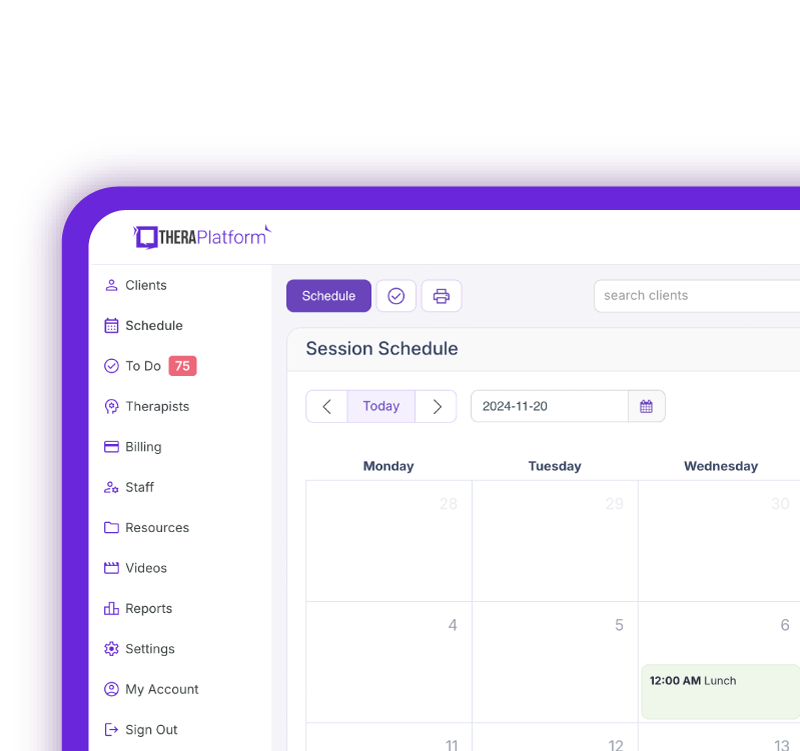
Modern practice management platforms have several features that can help decrease missed appointments:
Self-scheduling. Online scheduling makes it easy for clients to sign up for an appointment at a convenient time and reschedule if they must cancel.
It eliminates the anxiety a person may feel by having to talk to an unfamiliar office staff member or worry about having to get in touch with someone before the 24-hour cancellation window. Some tools can even sync the appointment with the person’s personal calendar, eliminating the need for any transferring.
Automate Appointment Reminders. Another helpful feature of most scheduling software is the ability to send clients automatic reminders through text messages and/or e-mail.
Reminders can be set when the appointment is scheduled and customized for the timing of delivery (e.g., 48 hours before the session). Research suggests that reminders decrease missed appointments and increase the rate of rescheduling.
Watch this video to discover TheraPlatform’s EHR benefits for your practice
Keep a credit card on file
Therapists are increasingly requiring clients to provide a credit card to pay for services at the beginning of treatment. This helps reinforce client accountability and ensures the therapist gets paid for their time.
Therapists should have a separate consent form for clients to sign that shows they understand their credit card will be automatically charged for no-shows and late cancellations in compliance with the attendance policy.
You can limit missed appointments
No-shows can produce multiple problems in your therapy practice, including lost revenue, delays in treatment progress, and damage to the therapeutic alliance. In response, therapists must implement measures to help clients take ownership of their therapy journey.
Through clear communication, a strong therapeutic relationship, and smart tech tools, including teletherapy, you can significantly reduce missed appointments in your private practice.
Streamline your practice with One EHR
- Scheduling
- Flexible notes
- Template library
- Billing & payments
- Insurance claims
- Client portal
- Telehealth
- E-fax
Resources
Theraplatform is an all-in-one EHR, practice management and teletherapy solution with AI-powered note taking features that allows you to focus more on patient care. With a 30-day free trial, you have the opportunity to experience Theraplatform for yourself with no credit card required. Cancel anytime. They also support different industries including mental and behavioral health therapists in group practices and solo practices.
More resources
- Therapy resources and worksheets
- Therapy private practice courses
- Ultimate teletherapy ebook
- The Ultimate Insurance Billing Guide for Therapists
- The Ultimate Guide to Starting a Private Therapy Practice
- Mental health credentialing
- Insurance billing 101
- Practice management tools
- Behavioral Health tools
Free video classes
- Free on-demand insurance billing for therapist course
- Free mini video lessons to enhance your private practice
- 9 Admin tasks to automate in your private practice
References
Binnie, J. Boden, Z. (2016). Non-attendance at psychological therapy appointments. Mental Health Review Journal 21 (3): 231–248. https://doi.org/10.1108/MHRJ-12-2015-0038
DeAngelis, T. (2019, November 1). Better relationships with patients lead to better outcomes. Monitor on Psychology, 50(10). https://www.apa.org/monitor/2019/11/ce-corner-relationships
Drerup, B., Espenschied, J., Wiedemer, J., & Hamilton, L. (2021). Reduced No-Show Rates and Sustained Patient Satisfaction of Telehealth During the COVID-19 Pandemic. Telemedicine journal and e-health : the official journal of the American Telemedicine Association, 27(12), 1409–1415. https://doi.org/10.1089/tmj.2021.0002
Granås, J., Strand, J., & Sand, P. (2022). A patient perspective on non-attendance for psychotherapy in psychiatric outpatient care for patients with affective disorders. Nordic Psychology, 75(4), 313–327. https://doi.org/10.1080/19012276.2022.2093777
Greenup, E.P., Best, D. (2025). Systematic review and meta-analysis of no show or non-attendance rates among telehealth and in-person models of care. BMC Health Services Research, 25(663). https://doi.org/10.1186/s12913-025-12826-2
McLean, S. M., Booth, A., Gee, M., Salway, S., Cobb, M., Bhanbhro, S., & Nancarrow, S. A. (2016). Appointment reminder systems are effective but not optimal: results of a systematic review and evidence synthesis employing realist principles. Patient Preference and Adherence, 10, 479–499. https://doi.org/10.2147/PPA.S93046
Sharf, J., Primavera, L. H., & Diener, M. J. (2010). Dropout and therapeutic alliance: a meta-analysis of adult individual psychotherapy. Psychotherapy, 47(4), 637–645. https://doi.org/10.1037/a0021175
Sumarsono, A., Case, M., Kassa, S., & Moran, B. (2023). Telehealth as a Tool to Improve Access and Reduce No-Show Rates in a Large Safety-Net Population in the USA. Journal of urban health : bulletin of the New York Academy of Medicine, 100(2), 398–407. https://doi.org/10.1007/s11524-023-00721-2
Tennant K., Long A., Toney-Butler TJ. (2023, Sep 13). Active Listening. Available from: https://www.ncbi.nlm.nih.gov/books/NBK442015
FAQs about how to reduce no show appointments and cancellations
What are the most common reasons clients miss appointments?
Clients often miss sessions due to forgetfulness, mental health symptoms, emergencies, or uncertainty about continuing therapy.
How can therapists reduce no-shows without harming the therapeutic relationship?
Clear policies, supportive conversations about attendance, automated reminders, and strengthening the therapeutic alliance all help reduce absences while maintaining trust.
Does teletherapy help decrease missed appointments?
Yes. Research consistently shows that telehealth reduces transportation, scheduling, and accessibility barriers—resulting in fewer no-shows compared to in-person sessions.