Fatigue ICD 10 code

Fatigue is a symptom of many health conditions and has a detrimental impact on quality of life and function. Among adults aged 40-98 years old, for example, fatigue is associated with a higher risk of mortality, physical decline, difficulty performing activities of daily living, and many other negative health outcomes (Knoop et al., 2021).
Summary
- Fatigue is more than being tired. Unlike normal tiredness, fatigue is persistent, often not relieved by rest, and can significantly affect daily function and quality of life.
- R53.83 is the primary ICD-10 code for fatigue. However, other related codes such as R53.82 (chronic fatigue), G93.32 (ME/CFS), R53.1 (weakness), and M62.81 (generalized muscle weakness) may be more appropriate depending on the patient's diagnosis and presentation. Enrolling in an insurance billing course for therapists can help providers enhance their knowledge.
- Documentation should focus on functional impact. Subjective reports, activity tolerance, endurance testing, and functional limitations help support medical necessity and treatment planning. Using an EHR that offers optional AI can help PTs manage complete documentation in less time.
- Physical therapists play an important role in fatigue management. Pacing strategies, energy conservation techniques, graded activity programs, and individualized treatment plans can help patients improve participation and quality of life.
→ Enroll in My Free, On-Demand Insurance Billing for Therapists Course
Many consider the terms “tired” and “fatigued” to be interchangeable, but in fact, there is an important difference between these two experiences. Feeling tired is a symptom that is relieved by rest. We often feel tired at the end of our workweek, but sleeping longer the next day or having some downtime during the weekend helps relieve it.
Fatigue, on the other hand, is a more persistent physical symptom that drains the sufferer of mental and physical energy. Unlike tiredness, fatigue is not relieved by rest and often interferes with day-to-day activities.
Physical therapists encounter complaints of fatigue both as primary symptoms of a patient’s chief complaint and as symptoms of comorbid conditions. For example, patients often experience fatigue after an orthopedic surgery, as a symptom of Multiple Sclerosis, inflammatory arthritis, or even following a concussion.
Patients undergoing treatment for cancer, those living with dysautonomia, and patients living with mental health conditions can all be impacted by fatigue, and physical therapists should be ready to address this common concern.
Streamline your insurance billing with One EHR
- Claim batching
- Auto claims
- Automated EOB & ERA
- Real-time claim validation
- Real-time claim tracking
- Aging and other reports

Fatigue ICD-10 codes
As HIPAA-covered entities, physical therapists are required to submit ICD-10 codes if they or their patients are seeking reimbursement for therapy services from an insurance company. These codes identify the medical diagnosis and help payers understand why the care PTs are providing is medically necessary and therefore, reimbursable. It also assists with care coordination between providers.
The primary fatigue ICD-10 code is R53.83 (Other Fatigue). This code is used to describe the condition of lethargy marked by extreme tiredness and inability to function at one’s usual level due to the lack of energy, which may be either acute or chronic.
The R53.83 Fatigue ICD-10 code can also refer to having difficulty concentrating and doing simple tasks due to a feeling of sluggishness or listlessness. Physical therapists encounter symptoms of fatigue in many patients.
For example, since 2020, many individuals have been impacted by Post-COVID fatigue. Fatigue is also often present secondary to deconditioning or following injury or surgery, or as a primary symptom of chronic diseases like rheumatoid arthritis or fibromyalgia.
While R53.83 is the most general Fatigue ICD 10 code, several other fatigue-related codes may be pertinent to your documentation:
R53.82: Chronic fatigue, unspecified. This code is appropriate when the client has been experiencing chronic fatigue, impacting the ability to perform normal daily activities, and which is not relieved by rest, but is not officially diagnosed as Chronic Fatigue Syndrome or Myalgic Encephalomyelitis
G93.32: Chronic Fatigue Syndrome/Myalgic Encephalomyelitis/Systemic Exertion Intolerance Disease. This code is appropriate to describe fatigue in a patient with a confirmed diagnosis of CFS/ME or SEID
R53.1: Weakness. Weakness can be a symptom of many different conditions. This code is used to describe weakness, limited mostly to one body area, either unilaterally or bilaterally.
It can be used as a descriptor of the following, according to ICD10 Data:
- Arm weakness, both sides
- Asthenia
- Late effects of stroke, weakness of arms, legs
- Leg weakness, both sides
- Weakness as a late effect of stroke
- Weakness as late effect of cerebrovascular accident
- Weakness of bilateral hands
- Weakness of bilateral legs
- Weakness of both arms
- Weakness of left arm
- Weakness of left hand
- Weakness of left leg
- Weakness of right arm
- Weakness of right hand
- Weakness of right leg
- Weakness, late effect of stroke
M62.81: Muscle Weakness (generalized). Used to describe a disorder characterized by a reduction in the strength of muscles in multiple anatomic sites.
It is important to recognize that while muscle weakness and fatigue may co-exist, they are not synonymous and should be documented appropriately based on symptom reports and clinical exam findings.
Practice Management + EHR + Telehealth
Manage more in less time in your practice with TheraPlatform
Documentation tips for using the Fatigue ICD-10 code
Thorough documentation is essential to support the fatigue ICD-10 codes. Consider the following documentation elements:
Subjective reports: Describe the patient’s subjective complaints of fatigue. Consider using a subjective outcome measure like the Fatigue Severity Scale to capture the impact of their symptoms, set goals, and track severity over time.
Objective findings: Measure and document the patient’s activity tolerance, including their need for breaks, their endurance for tests like the 6 Minute Walk Test or the 30s Chair Stand Test.
Highlight functional limitations: Fatigue is known to negatively impact function, and function is king when it comes to justifying the need for skilled therapy. Take the time to ask your patient about their functional limitations and highlight these clearly in your documentation. These activity limitations and participation restrictions can also be great targets for goal-setting.
Clearly documenting and describing your patient’s fatigue symptoms and their impact is essential for communicating the medical necessity of your care, especially if it will be one of the targets of your therapeutic interventions.
Free Resources for Therapists
Click below and help yourself to peer-created resources:

Fatigue considerations for your treatment plan
Whether fatigue is the target of your therapy or part of a comorbid condition, adjusting your treatment plan to manage fatigue is essential. Both mental and physical fatigue can show up as low activity tolerance during or after your sessions. While many patients will recover from a transient increase in fatigue, for others, like those with ME/CSF, overreaching can have longstanding and devastating consequences.
Taking the time to understand your patient’s fatigue triggers and recovery time will build trust and help you adjust your treatment plan accordingly. Fostering open communication will help ensure your patient feels comfortable being honest with you about how they feel after therapy, how long it takes them to recover, and when factors outside of your therapy session may have already lowered their reserve.
Here are a few tips you can use to manage fatigue during your physical therapy sessions and home exercise programs:
- Educate on pacing strategies and encourage your patient to consider all the factors that impact their energy levels, not just physical activity
- Use an RPE scale and set a target for exertion
- Consider a graded exercise program like the CHOP POTS protocol or the Utah ADaPT protocol
- Discuss energy conservation techniques and implement them into your sessions as needed
- Consider functional mobility training over regular exercise when appropriate
If you’ve never considered a physical therapist’s role in managing fatigue, we hope you can see the value in addressing this common and, at times, debilitating symptom. Taking the time to understand your patient’s unique experience of fatigue and documenting the impact it has on their function is an important step in justifying medical necessity for your care.
Physical therapists can have a significant impact on fatigue associated with mental health conditions, physical disease, medical treatments, surgery, and injury, and ultimately improve their clients’ quality of life.
Practice Management + EHR + Telehealth
Manage more in less time in your practice with TheraPlatform
How EHR and practice management software can save you time with insurance billing for therapists
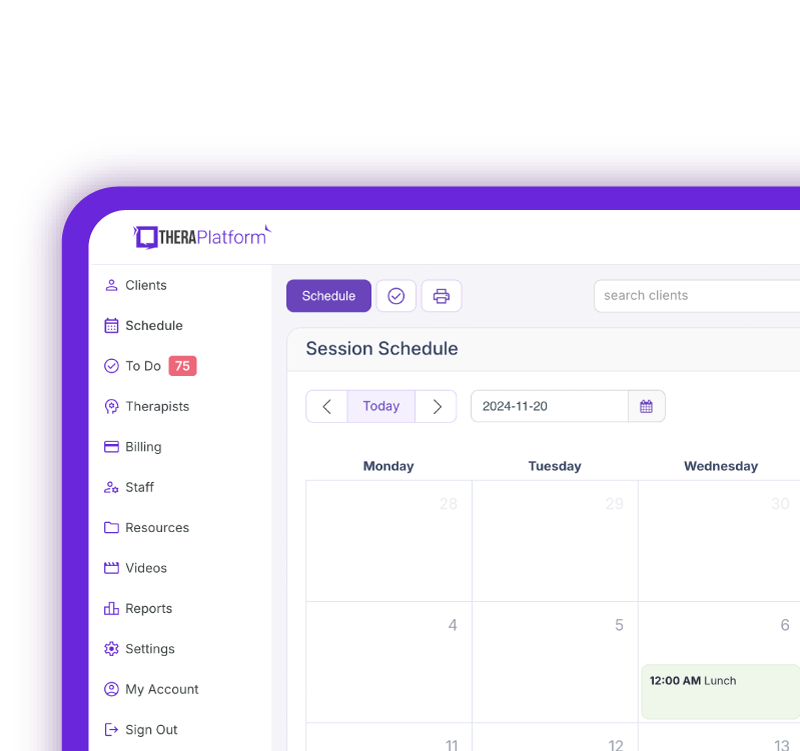
EHRs with integrated billing software and clearing houses, such as TheraPlatform, offer therapists significant advantages in creating an efficient insurance billing process. The key is minimizing the amount of time dedicated to developing, sending, and tracking medical claims through features such as automation and batching.
Watch this video to see how TheraPlatform’s EHR saves time on insurance billing
What are automation and batching?
- Automation refers to setting up software to perform tasks with limited human interaction.
- Batching or performing administrative tasks in blocks of time at once allows you to perform a task from a single entry point with less clicking.
Which billing and medical claim tasks can be automated and batched through billing software?
- Invoices: Create multiple invoices for multiple clients with a click or two of a button or set up auto-invoice creation, and the software will automatically create invoices for you at the preferred time. You can even have the system automatically send invoices to your clients.
- Credit card processing: Charge multiple clients with a click of a button or set up auto credit card billing, and the billing software will automatically charge the card (easier than swiping!)
- Email payment reminders: Never manually send another reminder email for payment again, or skip this altogether by enabling auto credit card charges.
- Automated claim creation and submission: Batch multiple claims with one button click or turn auto claim creation and submission on.
- Live claim validation: The system reviews each claim to catch any human errors before submission, saving you time and reducing rejected claims.
- Automated payment posting: Streamline posting procedures for paid medical claims with ERA. When insurance offers ERA, all their payments will post automatically on TheraPlatform's EHR.
- Tracking: Track payment and profits, including aging invoices, overdue invoices, transactions, billed services, service providers
Utilizing billing software integrated with an EHR and practice management software can make storing and sharing billing and insurance easy and save providers time when it comes to insurance billing for therapists.
Streamline your practice with One EHR
- Scheduling
- Flexible notes
- Template library
- Billing & payments
- Insurance claims
- Client portal
- Telehealth
- E-fax
Resources for physical therapists
TheraPlatform is an all-in-one EHR, practice management, and teletherapy software with AI-powered notes built for therapists to help them save time on admin tasks. It offers a 30-day risk-free trial with no credit card required and supports different industries and sizes of practices, including physical therapists in group and solo practices.
More resources
- Therapy resources and worksheets
- Therapy private practice courses
- Ultimate teletherapy ebook
- The Ultimate Insurance Billing Guide for Therapists
- The Ultimate Guide to Starting a Private Therapy Practice
- Insurance billing 101
- Practice management tools
Free video classes
- Free on-demand insurance billing for therapist course
- Free mini video lessons to enhance your private practice
- 9 Admin tasks to automate in your private practice
References
V. Knoop, B. Cloots, A. Costenoble, A. Debain, R. Vella Azzopardi, S. Vermeiren, B. Jansen, A. Scafoglieri, I. Bautmans, Ivan Bautmans, Dominque Verté, Ingo Beyer, Mirko Petrovic, Liesbeth De Donder, Tinie Kardol, Gina Rossi, Peter Clarys, Aldo Scafoglieri, Erik Cattrysse, Paul de Hert, Bart Jansen, Fatigue and the prediction of negative health outcomes: A systematic review with meta-analysis, Ageing Research Reviews, Volume 67, 2021, 101261, ISSN 1568-1637, https://doi.org/10.1016/j.arr.2021.101261
FAQs about the Fatigue ICD-10 code
What is the ICD-10 code for fatigue?
The most commonly used ICD-10 code for fatigue is R53.83 (Other Fatigue), which describes significant tiredness, lack of energy, and reduced ability to function.
What is the difference between fatigue and weakness?
Fatigue refers to a lack of physical or mental energy, while weakness refers to reduced muscle strength. Although they often occur together, they are distinct symptoms and should be documented separately.
How can physical therapists assess fatigue?
PTs may use patient-reported measures such as the Fatigue Severity Scale, evaluate activity tolerance, assess endurance through functional tests, and document the impact of fatigue on daily activities.