Best AI for therapy notes

The best AI for therapy notes can help clinicians write faster, stay compliant, and focus more on clients, and address a common pain point for many therapists – documentation overload.
Between back-to-back sessions, treatment planning, and administrative tasks leave little time for completing notes during working hours. And, therapists spending several unpaid hours a week can contribute to stress and reduced job satisfaction.
Summary
- AI for therapy notes reduces documentation time, helping clinicians spend less time on admin and more time with clients.
- Standalone AI tools (Blueprint, Freed, Upheal, Twofold) improve note-writing but don’t replace your full workflow.
- All-in-one platforms like TheraPlatform integrate AI notes with other features like scheduling, billing, and telehealth, reducing tool switching and costs.
- The right choice depends on your needs: use AI tools for faster notes or an integrated platform to streamline your entire practice.
Streamline your practice with One EHR
- Scheduling
- Flexible notes
- Template library
- Billing & payments
- Insurance claims
- Client portal
- Telehealth
- E-fax

That’s where AI for therapy notes comes in. AI technology has been exploding in the world of therapy and can help providers transcribe sessions, generate SOAP notes, and even utilize clinical language.
AI note assistants are becoming increasingly accurate and more widely available. This shift has many therapists now asking a key question:
“Do I need an AI note tool — or a complete practice platform?”
To answer this, let’s take a look past the hype and focus on how it fits into your real clinical workflow.
What therapists actually need from AI software
Before understanding the value of AI tools, let's look at how most therapists work.
The typical therapist tech stack today
- EHR (Electronic Health Record)
- Telehealth platform
- Billing software
- Scheduling tool
- AI note tool
- Intake forms
On paper, this system appears to work, but could lead to friction.
Common pain points
- Multiple logins: Switching between platforms takes extra time
- Data duplication: The same client information may be entered in multiple systems
- HIPAA risk: Using multiple tools means increased exposure points
- Higher costs: Costs paid for multiple systems
- Workflow fragmentation: Disconnected systems aren’t integrated to “talk” to each other.
The key distinction is this:
- AI notes solve one problem - documentation.
- Practice platforms, on the other hand, solve the entire workflow.
With that, let’s take a look at the individual apps and software companies offering AI for therapy notes tools and see how they compare to broader, more integrated tools.
AI tools vs. full platforms
With therapists looking to solve the notes issue, many notes-focused apps have popped up over the past few years.
Here are the best AI tools for therapy notes:
Blueprint AI
What it does well: Blueprint AI uses AI-assisted note generation to streamline clinical documentation.
Primary features:
- AI-generated treatment notes
- Customizable templates
- Integration capabilities with EHR systems
Target users: Clinicians looking to enhance their current systems without replacing them.
Strengths:
- Generates structured clinical notes
- Offers tools to track client progress over time
Limitations:
- Requires an external EHR to store records
- Add-on tool (does not include a complete system with scheduling and billing)
Practice Management + EHR + Telehealth
Manage more in less time in your practice with TheraPlatform
Freed
What it does well: Freed offers ambient AI technology that listens during sessions and generates notes automatically.
Primary features:
- Real-time note generation
- Minimal manual documentation required
- Simple interface
Target users: Solo clinicians seeking an easy solution for completing documentation with less manual input.
Strengths:
- Limited cognitive load required during and after sessions for note generation
- User-friendly
Limitations:
- No scheduling features
- No billing software
- Does not offer practice management features
Upheal
What it does well: Upheal pairs AI transcription with session analytics to offer deeper insights beyond just documentation.
Primary features:
- Session transcription
- AI-generated notes
- Self-reflection and analytics dashboards
Strengths:
- Offers reflection tools for therapists
- Captures speech metrics & highlights therapeutic dynamics to encourage clinical growth
Limitations:
- Not a practice management system
- Requires integration with your existing EHR to maintain a complete client workflow.
Twofold Health
What it does well: Twofold Health uses AI scribing to automate documentation and is designed to reduce note-writing time.
Primary features
- Automated documentation workflows
- AI session scribing
Target users: Therapists looking for quick, accurate documentation support.
Strengths:
- Reduces administrative workload
- Efficient note automation
Limitations:
- Documentation-focused only
- Does not manage full clinical workflow
Supanote
What it does well: Built to write at the level of a doctoral professional in mental health
Primary features:
- Uses an audio-based note generator for psychotherapy and coaching sessions to summarize key insights and emotions.
Target users: Mental health practices
Strengths:
- Can set individualized preferences for formatting, tone, and interventions so that the voice of the note matches your own.
- May likely capture the nuances of your patient interaction
Limitations: Needs EHR integration to cover all of private practice workflow
MENTALYC
What it does well: Therapists decide how to input important visit data into the AI tool.
Primary features: Recorded or in-person telehealth sessions can be transcribed into audio and uploaded. The tool can provide a recap, or you can write your own to review and edit.
Target users: Mental health professionals.
Strengths: Users can make decisions around inputs.
Limitations: Note-taking tools only, and must be integrated with an EHR
Autonotes
What it does well: Can customize or create your own templates to suit your workflow.
Primary features:
- Therapists can generate progress notes, SOAP and DAP notes, treatment plans, session summaries, and more.
- Offers specialty formats for couples, family, or group therapy.
Target users: Therapists and behavioral health professionals
Strengths:
- Carries forward treatment plan goals and client progress across every note to maximize clinical continuity.
Limitations: Documentation tool only
TheraPlatform
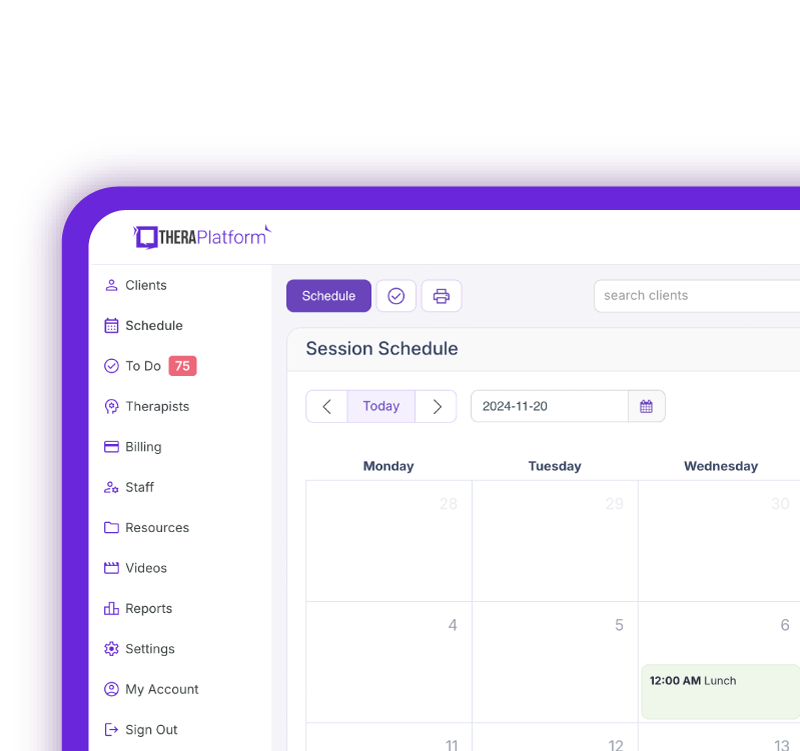
What sets it apart: TheraPlatform is a comprehensive EHR/EMR that builds AI directly into a complete EHR and practice management software rather than adding AI to a fragmented workflow.
Core features include:
- AI-generated notes and assessments
- Full EHR/EMR system
- Scheduling management
- Billing and insurance tools
- Client portal
- Integrated Telehealth
- Secure forms
- Practice analytics
Best AI for therapy notes comparison
Platform | Core Focus | Key Features | Strengths | Limitations | Best Fit |
|---|---|---|---|---|---|
Blueprint AI | AI note assistant (add-on)
| AI-generated treatment notes; customizable templates; EHR integrations | Structured clinical notes; tracks client progress; enhances existing systems | Requires external EHR; no scheduling or billing; not a full platform | Clinicians who want to improve documentation within existing systems |
Freed | Ambient AI note-taking | Real-time note generation; minimal manual | Very low cognitive load; user-friendly; hands-off documentation | No scheduling; no billing; no practice management tools | Solo therapists seeking effortless note automation |
Upheal | AI notes + analytics | Session transcription; AI-generated notes; analytics dashboards; reflection tools | Provides therapist insights; tracks speech and session dynamics; supports clinical growth | Not a full system; requires EHR integration | Therapists who want documentation plus performance insights |
Twofold Health | AI documentation automation | AI scribing; automated documentation workflows | Reduces administrative workload; fast and efficient note creation | Documentation-only; no full workflow or practice management tools | Therapists focused on speed and efficiency in note-taking |
Supanote.ai | AI notes | Generate progress notes, SOAP and DAP notes, treatment plans, session summaries and more, including specialty formats like couples, family or group therapy.
| Unique in that it was built to write at the level of a doctoral professional in mental health, which means it is more likely to capture the nuances of patient interaction | Requires external EHR | Therapists who want PhD-level notes without scheduling, billing, and telehealth |
MENTALYC | Ambient AI and transcription of recorded and in-person sessions | The tool can provide a recap, or you can write your own to review and edit. | Users can make decisions around inputs. | Note-taking tools only, and must be integrated with an EHR. | Therapists looking for a notes-taking tool only |
Autonotes | Generates progress notes, SOAP and DAP notes, treatment plans, session summaries, and more. | Offers specialty formats for couples, family, or group therapy. | Carries forward treatment plan goals and client progress across every note to maximize clinical continuity. | Requires EHR integration to manage full practice | Therapists and behavioral health professionals |
TheraPlatform | All-in-one AI-powered EHR | AI notes and assessments; scheduling; billing and insurance; telehealth; client portal; secure forms; analytics | Full workflow in one platform; reduces tool switching; lowers long-term costs; improved HIPAA security | More robust system than basic tools; may be more than needed for minimal workflows | Private practices and clinics needing an all-in-one solution |
Here’s the core difference between TheraPlatform and stand-alone AI note tools: Instead of adding AI to your workflow, TheraPlatform builds AI into your entire workflow.
The impact for therapists:
- Less tool switching: All systems are housed in one place
- Reduced admin time: Streamlined workflows
- Lower operational cost: Fewer subscriptions
- Improved security: Fewer systems equals a lower HIPAA/privacy risk
Watch this video to learn how to save time on therapy notes
When an AI note tool alone might be enough
An AI documentation tool can be a good fit if the therapist:
- Already loves their current EHR
- Only wants to accelerate note-writing
- Has minimal administrive needs
- Doesn’t require integrated billing or scheduling.
When an all-in-one platform makes more sense
An integrated platform is ideal for:
- Private practice owner
- Growing clinics
- Insurance billing workflows
- Multi-disciplinary practices (OT/PT/SLP/MH)
- Therapists who want fewer systems
An all-in-one platform can be the solution for therapists who spend time switching between tools or paying for several platforms.
Which platform should you choose based on cost?
When choosing the best AI for therapy notes, cost is always a factor, but it’s not always as simple as choosing the least expensive option. You’ll want to consider your overall goals in using the tools, your existing costs, and how you plan to use AI for therapy notes as some vendors offer a pay-per-use rate.
Assessing your goals
Here’s a balanced way to make this decision based on goals.
AI documentation assistants: Should be considered by therapists needing the best stand-alone tool to pair with their existing software to speed up the writing process, and boost productivity, including:
- Blueprint
- Freed
- Upheal
- Twofold
The best complete therapy ecosystem, offering a powerful, all-in-one solution that uses AI to streamline not just your notes, but to transform your workflow: TheraPlatform
Ask ... do you want AI to assist with one part of your workflow or power your entire practice, from intake to invoice?
Free Resources for Therapists
Click below and help yourself to peer-created resources:

Assessing costs across AI for therapy notes tools
Companies offering AI for therapy notes have different pricing plans.
- Lowest upfront cost: Upheal (free plan available with more extensive functionality starting at $19 a month for notes tools only
- Most flexible pricing: Blueprint (pay-per-session starting at 99 cents per session)
- Best for predictable pricing: Freed / Twofold (flat monthly offering limited free access and up to $19 a month as well as customized rates.)
- Best total value (bundled tools): TheraPlatform offers a 30-day free trial, and rates ranging from $39 a month to $79 a month, plus AI notes add-ons)
Assessing your monthly spend on all apps and software as a whole
Typically, therapists have multiple tools to help manage their practices, which can do the job but can also be cumbersome to manage. In addition to the toggling between tasks, there’s also the issue of paying multiple vendors each month – another admin task. Below is a breakdown of typical costs.
Tool | Typical Monthly Cost |
|---|---|
EHR / EMR | $50–$150 |
Telehealth platform | $20–$50 |
Billing software | $30–$100 |
Scheduling tool | $10–$30 |
AI note tool | $20–$100 |
Intake/forms software | $10–$40 |
TOTAL | $140–$470+ per month |
As you can see, using multiple tools for multiple tasks can add up quickly and also drain precious time away from helping clients.
Why all-in-one platforms are the next phase of therapy AI
We’re in a phase of transition with how AI technology is used in healthcare. Currently, AI is often viewed as an add-on (e.g., for note generation). However, the future of clinical technology includes AI as infrastructure (a fully integrated platform).
Therapy practices are frequently moving towards systems that:
- Unify documentation, billing, telehealth, and scheduling
- Use AI to enhance every part of the workflow, not just treatment notes.
Conclusion
In a landscape where technology seems to multiply daily, it takes a smart eye and some careful planning to feel confident you have made the right choice.
AI note-taking tools are redefining therapy documentation and shifting the priority to improving continuity of care.
Choosing the right one depends on your workflow, privacy needs, and practice size — but all share one goal: giving therapists more time to focus on care, not paperwork.
Streamline your practice with One EHR
- Scheduling
- Flexible notes
- Template library
- Billing & payments
- Insurance claims
- Client portal
- Telehealth
- E-fax
Resources
TheraPlatform is an all-in-one EHR, practice management, and teletherapy software with AI-powered notes built for therapists to help them save time on admin tasks. It offers a 30-day risk-free trial with no credit card required and supports mental and behavioral health, SLPs, OTs, and PTs in group and solo practices.
More resources
- Therapy resources and worksheets
- Therapy private practice courses
- Ultimate teletherapy ebook
- The Ultimate Insurance Billing Guide for Therapists
- The Ultimate Guide to Starting a Private Therapy Practice
- Insurance billing 101
- Practice management tools
Free video classes
- Free on-demand insurance billing for therapist course
- Free mini video lessons to enhance your private practice
- 9 Admin tasks to automate in your private practice
References
Ayer, M. (2023). Relieving administrative burden on clinical staff with streamlined workflows and speech-recognition software. British Journal of Nursing, 32(Sup16b), S1-S9. DOI: https://www.magonlinelibrary.com/doi/abs/10.12968/bjon.2023.32.Sup16b.S4?journalCode=bjon
Kanaparthy, N. S., Villuendas-Rey, Y., Bakare, T., Diao, Z., Iscoe, M., Loza, A., ... & Taylor, R. A. (2025). Real-world evidence synthesis of digital scribes using ambient listening and generative artificial intelligence for clinician documentation workflows: rapid review. JMIR AI, 4, e76743. DOI: https://ai.jmir.org/2025/1/e76743
Moura, L. M. V. R., Mishuris, R. G., Metlay, J. P., Habib, M., Ting, D. Y., Gallagher, K. L., Brodney, S., Rieu-Werden, M. L., & Haas, J. S. (2025). Hybrid ambient clinical documentation and physician performance: Work outside of work, documentation delay, and financial productivity. Journal of General Internal Medicine. https://doi.org/10.1007/s11606-025-09979-5
FAQs about the best AI for therapy notes
What is the best AI for therapy notes?
The best option depends on your needs. Standalone tools like Blueprint, Freed, Upheal, and Twofold improve documentation, while all-in-one platforms like TheraPlatform streamline your entire workflow.
Do AI therapy note tools replace an EHR?
No, most AI note tools focus only on documentation and require integration with an EHR for scheduling, billing, and client management.
When should you choose an all-in-one platform over an AI tool?
An all-in-one platform is ideal if you want to reduce tool switching, lower costs, and manage scheduling, billing, telehealth, and documentation in one system.