
HCPCS Code Search

The Healthcare Common Procedure Coding System, or the HCPCS code set, is one of the most crucial for billing services to Medicare and Medicaid beneficiaries.
Accurate billing is both a good practice and essential for the financial health of a therapy practice. Understanding how and when to use the multitude of billing codes, such as the HCPCS codes, can feel like a full-time job in itself to many therapists.
Summary
- HCPCS codes are essential for billing Medicare and Medicaid—especially for services, procedures, and equipment not covered by CPT codes, such as DME, telehealth check-ins, and home-based therapy.
- Accurate use of HCPCS codes ensures compliance and reimbursement—mistakes can lead to denials, delays, or even audits and penalties. Enrolling in an insurance billing course for therapists can help providers enhance their knowledge.
- Therapists can simplify code lookup and minimize errors by using tools like the CMS database, clearinghouses, EHR systems, and billing software with integrated code search features.
- Regular updates and payer variations pose challenges, so therapists must stay informed, document thoroughly, and cross-reference codes to ensure proper use.
→ Enroll in My Free, On-Demand Insurance Billing for Therapists Course
This guide will walk you through HCPCS codes. We’ll demystify HCPCS codes, providing a clear definition, tips for searching for the most appropriate code to use, examples, challenges to be aware of, and more.
Practice Management + EHR + Telehealth
Manage more in less time in your practice with TheraPlatform

What are HCPCS codes?
HCPCS stands for Healthcare Common Procedure Coding System, a standardized set of codes developed by CMS (Center for Medicare & Medicaid Services).
Many providers are familiar with CPT (Current Procedural Terminology) codes used for billing a broader range of medical services. HCPCS codes, on the other hand, are used to bill Medicaid, Medicare, and other insurance providers and describe services, medical procedures, and equipment not covered by CPT codes.
The HCPCS coding system is divided into two levels:
- Level I: The CPT codes are maintained by the American Medical Association (AMA). CPT codes describe diagnostic, medical, and surgical services.
- Level II: These codes cover services or equipment not included in CPT codes. This includes durable medical equipment (DME), orthotics, prosthetics, ambulance services, and certain prescriptions. Using Level II HCPCS codes can be highly relevant for therapists billing specific outpatient services and technology.
Therapists must understand and use HCPCS codes correctly for several reasons:
- Compliance: Therapists are legally required to adhere to coding guidelines. If codes are misused, the result can be fraud, penalties, or fraud accusations.
- Reimbursement: Using accurate billing codes helps ensure timely and appropriate payment for services rendered. Incorrect codes can result in payment delays and denials, or even audits.
- Data collection: Utilizing HCPCS codes contributes to a comprehensive database that can be used to track trends in healthcare. This affects outcomes, resource utilization, and informs future policy decisions.
Free Resources for Therapists
Click below and help yourself to peer-created resources:

How to search for HCPCS codes
Finding the correct HCPCS code doesn’t have to feel like searching for a needle in a haystack. Several reliable resources are available to help simplify this process for therapists.
The CMS Website. This is the official source and ultimate authority for HCPCS codes. You’ll find the most up-to-date HCPCS Level II codes here. Navigate to the “HCPCS” section within the CMS website. Then use the database to search by code number, service type, or keyword.
Keep in mind that while the CMS website is the best source for official updates, the interface may not be considered the most user-friendly for quick searches of HCPCS codes.
Healthcare clearinghouses. Clearinghouses often offer built-in robust code databases or systems for managing and utilizing them. Not only can healthcare clearinghouses serve as intermediaries between healthcare providers and insurance payers, but they typically check claims for errors before submission.
Billing software tools. Practice management software typically has HCPCS code search capabilities integrated, centralizing therapists’ billing operations. This can be a provider’s most convenient method of searching for an HCPCS code.
Therapists can often use these tools to search for codes directly within the billing system. Code suggestions and descriptions may be auto-filled, reducing the likelihood of manual coding errors.
Examples of HCPCS codes for therapists
CPT codes cover the majority of therapeutic services. However, HCPCS Level II codes have become increasingly relevant, particularly with the rise of telehealth and digital health services.
Commonly HCPCS codes used by therapists
Code | Description |
|---|---|
G2061 | 5-10 minute, brief online asynchronous digit check-in, performed by a qualified healthcare professional. This service can be provided with an established patient, for up to 7 days, cumulative, to consider whether an office visit or other service is needed. |
G0151 | Physical Therapy Services provided in the home or hospice (billed in 15-minute increments) |
A4649 | Miscellaneous DME supplies used in therapy (must be thoroughly documented) |
E1399 | Durable medical equipment, not otherwise classified (should include detailed justification) |
G0283 | Unattended electrical stimulation (the therapist sets up the e-stim device, but the patient is not directly supervised by the therapist throughout the treatment). |
Billing considerations for therapists
It’s critical for therapists to keep a few key billing considerations in mind when using HCPCS codes during billing:
- Use thorough documentation to clearly support the codes you bill.
- Services must be medically necessary to prevent audits and ensure ethical practice.
- Verify coverage and payer-specific coding guidelines before billing services.
- You may need to append modifiers to HCPCS codes to provide additional information about the service.
Tips for using HCPCS codes effectively
- Stay updated: HCPCS codes are updated quarterly. Consider subscribing to CMS updates for new code releases and changes.
- Use a practice management software: Look for robust software with a comprehensive billing system that has code searching capabilities integrated.
- Cross-reference: To ensure accuracy when in doubt, cross-reference HCPCS codes across reliable sources.
- Engage in ongoing training: Attend webinars and training often offered by billing companies and professional organizations on best practices for billing.
Challenges
Despite the helpful resources available to therapists, challenges such as these can arise:
- Ongoing changes: Codes are updated often, requiring therapists to be vigilant about monitoring updates.
- Missing or inaccurate documentation: This can lead to audits or delays in payment.
- Inconsistent payer guidelines: While some payers strictly follow CMS, others may interpret and cover codes differently, leading to confusion.
HCPCS codes are an essential component of billing in healthcare, especially for services billed to Medicare and Medicaid. Not only is proper HCPCS code searching and utilization crucial for the financial health of a practice, but it also helps ensure compliance.
Although therapists may find it hard to keep up with HCPCS codes, the right tools can make this process more manageable. This allows therapists to bill for a wider range of services.
Practice Management + EHR + Telehealth
Manage more in less time in your practice with TheraPlatform
How EHR and practice management software can save you time with insurance billing for therapists
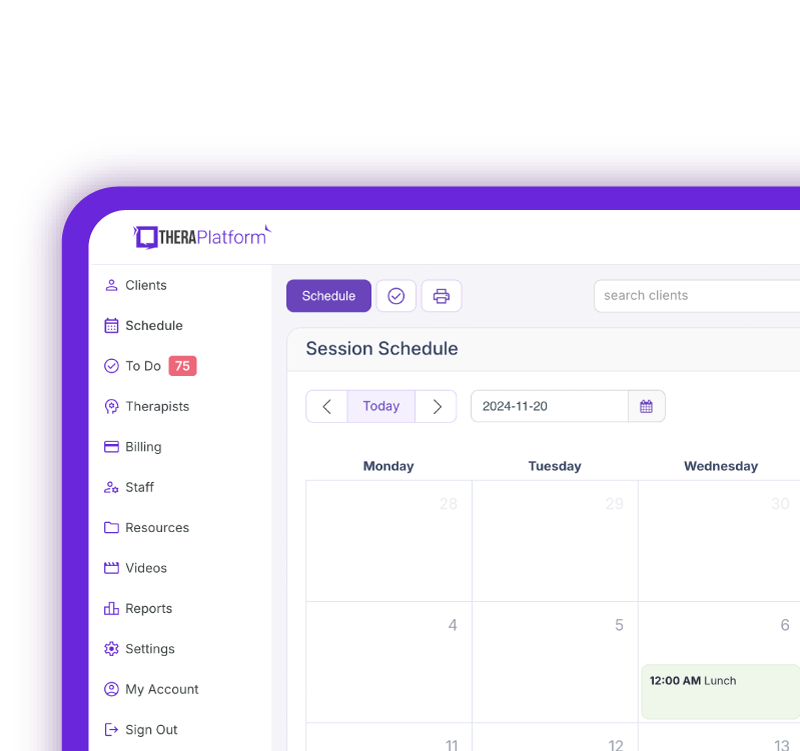
EHRs with integrated billing software and clearing houses, such as TheraPlatform, offer therapists significant advantages in creating an efficient insurance billing process. The key is minimizing the amount of time dedicated to developing, sending, and tracking medical claims through features such as automation and batching.
Watch this video to see how TheraPlatform’s EHR saves time on insurance billing
What are automation and batching?
- Automation refers to setting up software to perform tasks with limited human interaction.
- Batching or performing administrative tasks in blocks of time at once allows you to perform a task from a single entry point with less clicking.
Which billing and medical claim tasks can be automated and batched through billing software?
- Invoices: Create multiple invoices for multiple clients with a click or two of a button or set up auto-invoice creation, and the software will automatically create invoices for you at the preferred time. You can even have the system automatically send invoices to your clients.
- Credit card processing: Charge multiple clients with a click of a button or set up auto credit card billing, and the billing software will automatically charge the card (easier than swiping!)
- Email payment reminders: Never manually send another reminder email for payment again, or skip this altogether by enabling auto credit card charges.
- Automated claim creation and submission: Batch multiple claims with one button click or turn auto claim creation and submission on.
- Live claim validation: The system reviews each claim to catch any human errors before submission, saving you time and reducing rejected claims.
- Automated payment posting: Streamline posting procedures for paid medical claims with ERA. When insurance offers ERA, all their payments will post automatically on TheraPlatform's EHR.
- Tracking: Track payment and profits, including aging invoices, overdue invoices, transactions, billed services, service providers
Utilizing billing software integrated with an EHR and practice management software can make storing and sharing billing and insurance easy and save providers time when it comes to insurance billing for therapists.
Streamline your practice with One EHR
- Scheduling
- Flexible notes
- Template library
- Billing & payments
- Insurance claims
- Client portal
- Telehealth
- E-fax
Resources
TheraPlatform is an all-in-one EHR, practice management, and teletherapy software with AI-powered notes built for therapists to help them save time on admin tasks. It offers a 30-day risk-free trial with no credit card required and supports mental and behavioral health, SLPs, OTs, and PTs in group and solo practices.
More resources
- Therapy resources and worksheets
- Therapy private practice courses
- Ultimate teletherapy ebook
- The Ultimate Insurance Billing Guide for Therapists
- The Ultimate Guide to Starting a Private Therapy Practice
- Insurance billing 101
- Practice management tools
Free video classes
- Free on-demand insurance billing for therapist course
- Free mini video lessons to enhance your private practice
- 9 Admin tasks to automate in your private practice
References
Burks, K., Shields, J., Evans, J., Plumley, J., Gerlach, J., & Flesher, S. (2022). A systematic review of outpatient billing practices. SAGE Open Medicine, 10, 20503121221099021.
DOI: https://journals.sagepub.com/doi/full/10.1177/20503121221099021
Derricks, J. (2021). Overview of the claims submission, medical billing, and revenue cycle management processes. In The Medical-Legal Aspects of Acute Care Medicine: A Resource for Clinicians, Administrators, and Risk Managers (pp. 251-276). Cham: Springer International Publishing. https://link.springer.com/chapter/10.1007/978-3-030-68570-6_11
Johnson, M., Albizri, A., & Harfouche, A. (2023). Responsible artificial intelligence in healthcare: Predicting and preventing insurance claim denials for economic and social wellbeing. Information Systems Frontiers, 25(6), 2179-2195. https://link.springer.com/article/10.1007/s10796-021-10137-5
FAQs about HCPCS codes
What are HCPCS codes used for in therapy billing?
HCPCS codes are used to bill Medicare and Medicaid for services, procedures, and equipment not covered by CPT codes, such as DME, telehealth check-ins, and home-based therapy.
How can therapists search for HCPCS codes efficiently?
Therapists can use the CMS database, clearinghouses, EHR systems, and billing software with built-in code search tools to quickly find accurate HCPCS codes and reduce errors.
Why is accurate HCPCS coding important?
Accurate HCPCS coding ensures proper reimbursement, prevents claim denials, and helps therapists stay compliant with billing regulations and payer requirements.