
Dry needling CPT code

A dry needling CPT code is used for physical therapy non-commercial billing when clinicians use solid needles to relieve pain and muscle tension. The idea for dry needling developed from doctors like Jonas "Yonky" Kellgren's success in the 1930s in treating myofascial pain through procaine injection into tender points, which were often some distance from the reported site of pain.
Summary
- Dry needling is a physical therapy technique using solid needles without medication to treat myofascial trigger points and muscle pain. It includes both superficial and deep techniques, targeting local blood flow, pain relief, and muscle function.
- While most commercial insurers don’t cover dry needling, Medicare allows billing under two dry needling CPT codes (20560 and 20561) only for chronic low back pain (lasting over 12 weeks and not tied to surgery or pregnancy), with strict limitations on the number of sessions. Enrolling in an insurance billing course for therapists can help providers enhance their knowledge.
- Clinicians must obtain proper training and state-specific certification before performing dry needling. Informed consent, sterile technique, and screening for contraindications like infections or metal allergies are essential for ethical and safe application.
- Therapists must clearly document the clinical reasoning for dry needling, patient consent, technique details (needle size, placement, duration), patient response, and concurrent interventions to ensure proper care and compliance. By leveraging an EHR like TheraPlatform for efficient documentation and claim submission, therapists can tackle billing using a dry needling CPT code with ease.
→ Enroll in My Free, On-Demand Insurance Billing for Therapists Course
He discovered that the relief of pain far outlasted the life of the anesthetic medication and, in some cases, was even permanent. In the 1940s, practitioners Brav and Sigmond claimed pain could be relieved using "dry" needling without the injection of a medication, and doctors Janet Travell and David Simons began their work on myofascial trigger points and mapping out referral patterns.
Streamline your insurance billing with One EHR
- Claim batching
- Auto claims
- Automated EOB & ERA
- Real-time claim validation
- Real-time claim tracking
- Aging and other reports

The term "dry needling" was first published in the Lancet in the late 1940s, deeming it a technique that could effectively treat myofascial trigger points. Initially, compared to the traditional Chinese medicine practice of acupuncture, dry needling began to distinguish itself from this practice in the late 1900s. By the turn of the century, it was more closely associated with trigger point therapy than with acupuncture.
What is dry needling?
Dry needling has two basic techniques: superficial and deep. Both methods improve blood flow to local tissues.
- Superficial dry needling punctures only the superficial layers of tissue and aims to relieve pain in a specific dermatome via the opioid system triggered by the pinprick sensation. Superficial techniques can also be used for fascia and scar remodeling, to heal a static hematoma, and for spasticity. They are recommended when the anatomy dictates a superficial technique or when deep dry needling is not appropriate.
- Deep dry needling is used to address myofascial pain. Myofascial pain syndrome is a chronic pain syndrome characterized by myofascial trigger points, hyperirritable bundles within a taut, muscular band that, when stimulated, give rise to a referred pain and a localized muscle twitch.
These trigger points are characterized by localized ischemia, pH changes, and peripheral sensitization and are local sources of persistent nociceptive input, which can excite muscle nociceptors. This is why stimulating a trigger point can elicit a pain response some distance from the trigger point.
When a trigger point is present in a muscle, it can alter its contractility and extensibility. This can be true of both active and latent trigger points.
Deep dry needling involves puncturing deeper layers of tissue, aiming at specific trigger points to achieve a localized twitch response. This localized twitch response has been shown to alter acetylcholine levels and decrease the localized electrical activity characteristic of an active or latent trigger point, thus resolving the trigger point's effects and improving the muscle's length and strength.
Dry needling is never a stand-alone technique but should be part of a comprehensive rehabilitation program.
Practice Management + EHR + Telehealth
Manage more in less time in your practice with TheraPlatform
Dry needling ethics and safety considerations
Therapists should not practice dry needling without proper training. States typically require proof of certification and training before clinicians perform dry needling on a patient.
Check with your state board to learn the requirements in your state. Since dry needling is an invasive procedure, several essential safety considerations exist.
First, your patient has the right to informed consent about this procedure.
Though this is not an exhaustive list, some elements of informed consent for dry needling can include:
- Informing them that the needle will pierce their skin
- Presenting them with other treatment options and discussing the pros and cons
- Informing them about the probability of treatment side effects and risks like soreness, fatigue, fainting, infection, and pneumothoraces
- Explaining that dry needling is not a stand-alone treatment, and they must agree to participate in supportive therapeutic interventions
- Disclosure of financial cost to the patient associated with the technique
Be sure to have a proper method for disposing of sharps and soiled biohazard waste safely and screen for things like blood-borne pathogens ahead of time. Utilizing a clean technique is also essential to minimize infection sources.
Finally, a thorough patient history is taken to screen for contraindications and precautions.
Contraindications for dry needling can include (but may not be limited to):
- Ethical reasons not to dry-needle an individual patient
- Unreliable patient or lack of skill in a therapist
- Metal allergies
- Needle phobias
- Lymphedema at any site
- Existing infection at a site
Precautions can include:
- Hemophilia
- HIV or other blood-borne illnesses
- Blood-thinning agents
- Pregnancy
- Emphysema or COPD may alter the size of the lungs
- Laminectomy or spine surgery that may change the anatomy of the spine
Free Resources for Therapists
Click below and help yourself to peer-created resources:

Can I bill using a dry needling CPT code?
Because dry needling for trigger points does not have a national coverage determination, many commercial insurers do not cover it. Instead, most clinics bill patients directly for these services.
The Centers for Medicare and Medicaid Services have approved two dry needling CPT codes, but only for the treatment of chronic low back pain that lasts 12 weeks or longer, with no known cause, and not associated with surgery or pregnancy.
They will cover up to 12 treatments in 90 days and an additional eight if the patient demonstrates symptom improvements. No further treatments will be approved if the patient is not showing improvement after 12 visits.
The two dry needling CPT codes include:
- 20560: needle insertion without injection in 1-2 muscles
- 20561 needle insertion without injection in 3 or more muscles
Documenting dry needling CPT codes and treatments
Documenting for dry needling should include the following:
- Indication for dry needling
- Confirmation of screening and informed consent
- Which muscle(s) and where on the muscle(s) needles were placed
- Length and gauge of needle
- Specific techniques and time needles were left in
- Patient response
- Other interventions used alongside dry needling
Dry needling can be a very effective intervention when a well-trained therapist applies to the right patient. There are many course offerings to train a therapist in dry needling and opportunities for even more specialized training for pelvic floor and facial muscle needling, for example.
Some courses even offer access to an anatomy lab to help solidify your knowledge of where all the anatomical structures lie beneath the skin, an excellent review from physical therapy school.
As with all manual therapy interventions, dry needling is just one tool in your toolbox. The skill lies in understanding how to place and use the needles and how to build an individualized and comprehensive rehabilitation program to help your patients improve.
Practice Management + EHR + Telehealth
Manage more in less time in your practice with TheraPlatform
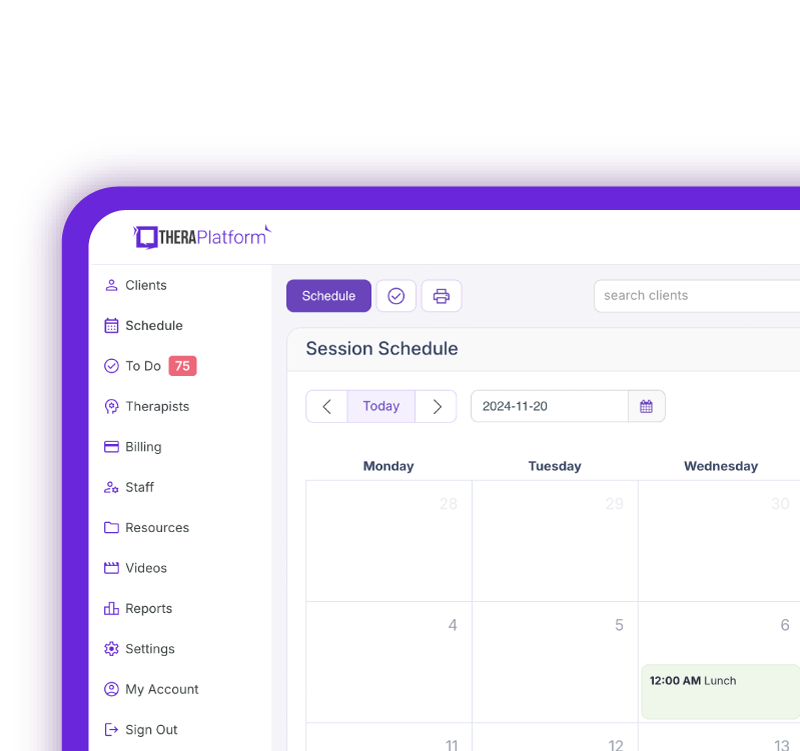
How EHR and practice management software can save you time with insurance billing for therapists
EHRs with integrated billing software and clearing houses, such as TheraPlatform, offer therapists significant advantages in creating an efficient insurance billing process. The key is minimizing the amount of time dedicated to developing, sending, and tracking medical claims through features such as automation and batching.
Watch this video to see how TheraPlatform’s EHR saves time on insurance billing
What are automation and batching?
- Automation refers to setting up software to perform tasks with limited human interaction.
- Batching or performing administrative tasks in blocks of time at once allows you to perform a task from a single entry point with less clicking.
Which billing and medical claim tasks can be automated and batched through billing software?
- Invoices: Create multiple invoices for multiple clients with a click or two of a button or set up auto-invoice creation, and the software will automatically create invoices for you at the preferred time. You can even have the system automatically send invoices to your clients.
- Credit card processing: Charge multiple clients with a click of a button or set up auto credit card billing, and the billing software will automatically charge the card (easier than swiping!)
- Email payment reminders: Never manually send another reminder email for payment again, or skip this altogether by enabling auto credit card charges.
- Automated claim creation and submission: Batch multiple claims with one button click or turn auto claim creation and submission on.
- Live claim validation: The system reviews each claim to catch any human errors before submission, saving you time and reducing rejected claims.
- Automated payment posting: Streamline posting procedures for paid medical claims with ERA. When insurance offers ERA, all their payments will post automatically on TheraPlatform's EHR.
- Tracking: Track payment and profits, including aging invoices, overdue invoices, transactions, billed services, service providers
Utilizing billing software integrated with an EHR and practice management software can make storing and sharing billing and insurance easy and save providers time when it comes to insurance billing for therapists.
Streamline your practice with One EHR
- Scheduling
- Flexible notes
- Template library
- Billing & payments
- Insurance claims
- Client portal
- Telehealth
- E-fax
Resources for physical therapists
TheraPlatform is an all-in-one EHR, practice management, and teletherapy software with AI-powered notes built for therapists to help them save time on admin tasks. It offers a 30-day risk-free trial with no credit card required and supports different industries and sizes of practices, including physical therapists in group and solo practices.
More resources
- Therapy resources and worksheets
- Therapy private practice courses
- Ultimate teletherapy ebook
- The Ultimate Insurance Billing Guide for Therapists
- The Ultimate Guide to Starting a Private Therapy Practice
- Insurance billing 101
- Practice management tools
Free video classes
- Free on-demand insurance billing for therapist course
- Free mini video lessons to enhance your private practice
- 9 Admin tasks to automate in your private practice
References
Acupuncture. (n.d.). Medicare. https://www.medicare.gov/coverage/acupuncture
Fernández-de-Las-Peñas C, Pérez-Bellmunt A, Llurda-Almuzara L, Plaza-Manzano G, De-la-Llave-Rincón AI, Navarro-Santana MJ. Is Dry Needling Effective for the Management of Spasticity, Pain, and Motor Function in Post-Stroke Patients? A Systematic Review and Meta-Analysis. Pain Med. 2021 Feb 4;22(1):131-141. doi: 10.1093/pm/pnaa392. PMID: 33338222.
Course Materials and Manual: Introduction to Trigger Point Dry Needling Level 1: ODNS-IAOM-US; given November 2020
Legge, David. A History of Dry Needling, Journal of Musculoskeletal Pain, September 2014, Vol. 22, No. 3 , Pages 301-307
Paulett, JD: Low Back Pain. Lancet 2: 272-276; 1947.
FAQs about dry needling CPT codes
What CPT codes are used for dry needling?
The two dry needling CPT codes are 20560 (needle insertion without injection in 1–2 muscles) and 20561 (needle insertion without injection in 3 or more muscles). Medicare limits coverage to specific chronic low back pain cases.
Does insurance cover dry needling?
Most commercial insurers do not cover dry needling. Medicare covers CPT codes 20560 and 20561 only for chronic low back pain lasting 12+ weeks, with strict visit limits and documentation requirements.
What documentation is required when billing dry needling?
Therapists must document clinical indication, informed consent, muscles treated, needle size and placement, duration, patient response, and concurrent interventions to support compliance and reimbursement.