Expressive language goals

Expressive language goals target a meaningful and highly visible area that speech-language pathologists frequently address in therapy. Skills in this area impact how individuals advocate for themselves, participate in class, and share ideas with the world around them.
Writing clear, appropriate goals is essential for effectively targeting expressive language skills. Expressive language goals not only help guide treatment but demonstrate measurable progress.
Let’s break down what expressive language is, common challenges in this area, and explore goal examples and templates. We’ll also explore strategies and documentation tips to support meaningful growth.
Summary
- Expressive language goals guide measurable progress. Clear, SMART expressive language goals help SLPs target vocabulary, grammar, narrative skills, and word retrieval while demonstrating functional growth.
- Expressive language impacts daily participation. Strong expressive skills support self-advocacy, classroom engagement, storytelling, and confidence in communication.
- Goals should be specific and supported by data. Effective expressive language goals include context, accuracy criteria, cueing level, and session frequency to track increasing independence. Download my free SMART goals worksheet.
- Strategic scaffolding drives success. Evidence-informed strategies such as modeling, expansion, visuals, and structured cueing hierarchies help clients meet expressive language goals in meaningful contexts. With an EHR like TheraPlatform, therapists can organize and manage client goals easily.
Streamline your practice with One EHR
- Scheduling
- Flexible notes
- Template library
- Billing & payments
- Insurance claims
- Client portal
- Telehealth
- E-fax

What is expressive language?
Expressive language is defined by the American Speech-Language-Hearing Association (ASHA) as the ability to communicate wants, needs, thoughts, ideas, and feelings through verbal or nonverbal means (i.e., sign language or augmentative and alternative communication (AAC)).
Expressive language includes:
- Grammar and syntax (sentence structure)
- Vocabulary (word knowledge and word use)
- Narrative skills (sequencing and storytelling)
- Word retrieval
Expressive vs. receptive language
To understand what expressive language is, it’s important to distinguish it from receptive language.
- Receptive language refers to the understanding of spoken or written language. This involves following directions and identifying objects or pictures.
- Expressive language refers to the ability to produce language. This includes labeling objects, combining words to form sentences, using accurate grammar, and retelling a story.
Some children have higher receptive language skills than expressive language skills (i.e., they understand far more than they can express).
Expressive language is often the first area that caregivers and teachers note as a concern because it is outwardly observable. However, SLPs should always assess both receptive and expressive language skills to gain a comprehensive look at a client’s skills and ensure appropriate goal development.
Practice Management + EHR + Telehealth
Manage more in less time in your practice with TheraPlatform
Common expressive language challenges
Clients with an expressive language delay or disorder often have difficulties in the following key areas:
- Limited vocabulary: Clients may rely on general words (e.g., “stuff”, “thing”) or familiar words. They can show difficulty labeling objects, actions, or concepts. Students can struggle to learn and retain new academic vocabulary.
- Grammar and syntax errors: This includes omitting grammatical markers (e.g., leaving off the -ed ending), and using incorrect verb tense. Difficulties with concepts like possessives, plurals, or pronouns are also common, and clients may produce short, fragmented sentences.
- Narrative and discourse skills: Difficulty organizing thoughts to participate in a back-and-forth conversation or tell a cohesive story.
- Word retrieval: Often described as a “tip-of-the-tongue” phenomenon where the individual knows the word but cannot find it. Clients may use filled words (“um”), substitute for related words, pause frequently, or describe an object instead of naming it.
Expressive language goals examples
The gold standard in the world of speech-language pathology is to set SMART (Specific, Measurable, Achievable, Relevant, and Time-bound) goals. Expressive language goals should specify the context, criteria, and level of support.
Below are several examples categorized by skill area.
Vocabulary and labeling: Vocabulary goals are important in the academic setting and for participating in daily routines.
- Goal example: The client will independently label 10 action words during structured tasks in 4 out of 5 opportunities across 3 consecutive sessions when provided with minimal cues.
Sentence Formation and Length (MLU): SLPs may target the client’s ability to use grammatical markers and correct word order to formulate cohesive sentences. This can also include use of concepts such as present progressive verbs (-ing), regular and irregular past tense verbs, conjunctions (because, and, but), and complex sentences (if, after, when).
- Expressive language goal example: The client will produce a grammatically correct sentence containing at least 5 words, with appropriate subject-verb agreement, in structured tasks in 80% of opportunities across 3 consecutive sessions, given moderate cues.
Describing and categorizing: Describing tasks can support sentence complexity and expanding vocabulary.
- Expressive language goal example: The client will describe objects using at least three different attributes (e.g., appearance, category, and function) with 80% accuracy given maximal visual support, over three consecutive sessions.
Retelling stories (Narrative skills): Narrative skills are essential for engaging in conversation and for academic success.
- Expressive language goal example: The client will retell a short story, including at least four key story elements (e.g., setting, character, problem, resolution) in correct sequence in 8 out of 10 opportunities over 3 consecutive sessions with minimal cues.
Word retrieval and naming: Word-finding issues can lead to frustration and reduced confidence in speaking situations.
- Expressive language goal example: The client will name at least 5 items within a specific category (e.g., 5 different farm animals) within 15 seconds in 4 out of 5 trials across 3 consecutive sessions independently.
Free Resources for Therapists
Click below and help yourself to peer-created resources:

Strategies to support expressive growth
Through evidence-informed approaches in meaningful contexts, SLPs can provide the scaffolding clients need to meet their expressive language goals.
Here are common strategies:
Expansion: Repeating the client’s utterance and adding more detail. Expansion involves providing a correct model without explicitly correcting the child. For example, if the client says “Doggy run”, you can expand it by saying, “Yes, the doggy is running!”
Modeling: Providing consistent, clear, grammatically accurate examples of the targeted skill. If a client struggles using the word “is”, model correct use of this and emphasize the word “is” in your own speech.
Visuals: Visuals can help clients who struggle with a variety of expressive language skills, including describing or storytelling. Graphic organizers, “story maps," or “describing wheels,” provide clients with a physical anchor for their thoughts.
Cueing: SLPs can scaffold responses by following a cueing hierarchy such as this:
- Visual cue: Pointing to a picture.
- Phonemic cue: Providing the first sound in the word (e.g., “it starts with /b/…”)
- Semantic cue: Giving a hint (“it’s a round toy that bounces”).
- Direct model: Saying the target word (e.g., “ball”)
How to track and document progress for expressive language goals
Clinical decision-making and educational or medical necessity are supported through clear documentation.
- Write measurable expressive language goals: Goals should specify percentage accuracy, number of trials, level of support, and the number of consecutive sessions.
- Track the level of support: Document the cueing level (e.g., maximum, moderate, minimal, or none) to track increased independence with the use of a skill over time.
- Efficient data systems: Digital platforms such as TheraPlatform streamline documentation by allowing SLPs to document data in real-time, track progress trends over sessions, quickly generate reports, and share updates securely with families and professionals.
- Document functional impact: Percentages aren’t everything. Note real-life improvements like reduced frustration or improved classroom participation, to show meaningful communication growth.
- Complete baseline and re-assessments: Take a baseline of skills through an initial assessment. Then re-assess at regular intervals (e.g., every 6 months) to determine whether current strategies are working and identify the need for goal modification.
Expressive language is one of the most commonly targeted areas of speech therapy. Goals should be individualized, measurable, and functional. Clinicians can create meaningful treatment plans to support communication growth by developing clear goals and tracking progress over time.
Streamline your practice with One EHR
- Scheduling
- Flexible notes
- Template library
- Billing & payments
- Insurance claims
- Client portal
- Telehealth
- E-fax
How EHRs can help with documentation
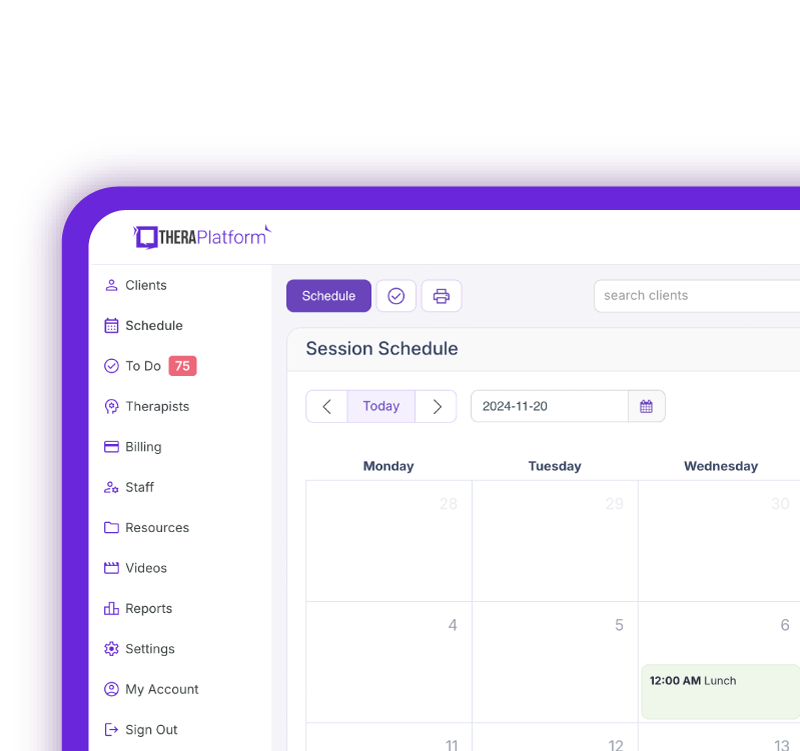
Modern EHR/practice management platforms (such as TheraPlatform) assist greatly with documentation by providing HIPAA‑compliant, integrated systems for note entry, storage, scheduling, and billing.
They allow therapists to:
- Use and customize templates (e.g., SOAP, DAP, and others) or build their own to streamline note writing and ensure consistency.
- Link notes to treatment plans, goals, and session history so client progress is easily tracked over time.
- Utilize e-fax and secure document sharing via client portal to safely exchange information with clients or other providers while maintaining confidentiality.
- Leverage dictation and telehealth transcription, which can automatically convert sessions into therapy or assessment notes, saving time and reducing manual entry.
- Take advantage of AI features that streamline documentation by automatically populating intake form data into assessment templates and generating complete therapy and assessment notes from the information you provide, all with a single click.
Watch this video to learn how to save time on therapy notes
Meanwhile, AI‑assisted note tools are emerging which can further help clinicians by:
- Automatically transcribing session audio (if permitted) and highlighting key moments (e.g. emotional shifts, major themes).
- Suggesting draft notes or filling in objective or assessment sections based on observed data, freeing up clinicians’ time.
- Supporting consistency and reducing missing components in notes, which helps from both clinical, legal, and insurance perspectives.
Together, structured SOAP‑type notes, good EHR platforms, and smart AI tools support better therapeutic outcomes, more efficient workflows, and stronger accountability.
Resources for speech therapists
TheraPlatform is an all-in-one EHR, practice management, and teletherapy software with AI-powered notes built for therapists to help them save time on admin tasks. It offers a 30-day risk-free trial with no credit card required and supports different industries and sizes of practices, including speech-language pathologists in group and solo practices.
More resources
- Therapy resources and worksheets
- Therapy private practice courses
- Ultimate teletherapy ebook
- The Ultimate Insurance Billing Guide for Therapists
- The Ultimate Guide to Starting a Private Therapy Practice
- Insurance billing 101
- Practice management tools
Free video classes
- Free on-demand insurance billing for therapist course
- Free mini video lessons to enhance your private practice
- 9 Admin tasks to automate in your private practice
References
Gaddy, C., & Crow, H. (2023). A primer on neurodiversity-affirming speech and language services for autistic individuals. Perspectives of the ASHA Special Interest Groups, 8(6), 1220-1237. https://doi.org/10.1044/2023_PERSP-23-00106
Hamilton, J. L., Hopkins, E. P., & Kerr, C. M. (2025). Goal Setting in Speech–Language Pathology: A Pilot Test of a ‘One‐Size‐Fits‐All’Planning Framework. International journal of language & communication disorders, 60(5), e70128. https://onlinelibrary.wiley.com/doi/full/10.1111/1460-6984.70128
Volkmer, A., Cartwright, J., Ruggero, L., Beales, A., Gallée, J., Grasso, S., ... & Hersh, D. (2023). Principles and philosophies for speech and language therapists working with people with primary progressive aphasia: an international expert consensus. Disability and Rehabilitation, 45(6), 1063-1078. https://doi.org/10.1080/09638288.2022.2051080
FAQs about expressive language goals
What are expressive language goals in speech therapy?
Expressive language goals are measurable objectives designed to improve a client’s ability to communicate thoughts, needs, and ideas through spoken language, sign language, or AAC.
How do expressive language goals differ from receptive language goals?
Expressive language goals focus on producing language (e.g., forming sentences, retelling stories), while receptive language goals target understanding spoken or written language.
How do SLPs measure progress toward expressive language goals?
SLPs track percentage accuracy, level of cueing, number of trials, and performance across consecutive sessions, along with documenting functional improvements in real-life communication.