Functional communication goals

Functional communication goals are the center of effective speech-language therapy. Truly meaningful progress shows when a client can use communication skills to effectively navigate everyday life.
Summary
- Functional communication focuses on real-world impact. Rather than isolated speech or language skills, functional communication goals help clients express wants, needs, emotions, and social intent across everyday settings like home, school, and the community.
- Prioritizing functional goals improves independence and quality of life. When clients can communicate effectively in meaningful contexts, it reduces frustration, supports safety, enhances social participation, and decreases reliance on challenging behaviors.
- Functional communication includes multiple modes—not just speech. Goals may involve spoken language, gestures, picture systems, or high-tech AAC, ensuring nonverbal and minimally verbal clients have reliable ways to communicate. EHRs can help SLPs organize activities related to these modes with ease.
- SMART, context-based goals support measurable progress and carryover. Writing functional goals using the SMART framework helps SLPs track progress, meet documentation requirements, and promote generalization across settings. Download my free SMART goals worksheet.
Streamline your practice with One EHR
- Scheduling
- Flexible notes
- Template library
- Billing & payments
- Insurance claims
- Client portal
- Telehealth
- E-fax
Accurate articulation, language structure, and vocabulary growth are all important. But developing functional communication goals can help individuals express their wants, needs, thoughts and social intent in ways that are practical across different environments.
Let's explore what functional communication is, why it matters, and examples of goals. SLPs, we’ll guide you through writing SMART, measurable goals that support real-world positive outcomes.
What is functional communication?
Functional communication, at its core, is the ability to receive and convey messages that serve a practical purpose in daily life. This doesn’t just mean “talking”, and includes multiple modes of communication.
Why functional communication matters
Throughout our daily life, we use communication as a primary tool for independence. When clients can communicate effectively in meaningful contexts, it can improve their participation and quality of life.
For individuals who have communication challenges, it can be difficult to make their needs known. That often leads to frustration or withdrawal. “Challenging behaviors” can be the result, though these are often just a different form of communication.
Prioritizing functional goals helps by:
- Increasing independence: Reducing dependence on prompts from caregivers
- Improving safety: Enabling the ability to express discomfort or emergencies
- Enhancing social integration: Developing meaningful relationships with others
Functional communication goals don’t focus solely on isolated speech or language skills. They are centered around why the individual is communicating and how it helps them meet their needs in the real world.
Practice Management + EHR + Telehealth
Manage more in less time in your practice with TheraPlatform
Examples of functional communication goals
Functional communication goals are context-driven, individualized, and specific to the client’s daily routines.
Here are common categories of functional goals that can be targeted in speech therapy.
- Requesting help: Requesting assistance during challenging tasks or expressing discomfort or hunger in appropriate ways is an essential skill.
- Expressing wants or needs: One of the most functional abilities an individual can work on in therapy is expressing their wants and needs. Goals may focus on requesting preferred items, activities, or breaks.
- Greeting others: Social interaction skills are a big part of functional communication. Greeting peers, responding to greetings, and initiating simple conversational exchanges are especially relevant for individuals who struggle with pragmatic skills or social language. Greetings can be targeted during times like arrival routines, community outings, or classroom transitions.
- Protesting and self-advocacy: It’s important to remember that functional communication is not just limited to positive requests. Clients should work on the ability to say “no”, express frustration, or request a change. These types of goals support emotional regulation and decrease dependence on undesirable or challenging behaviors.
Free Resources for Therapists
Click below and help yourself to peer-created resources:

Functional communication goals for nonverbal clients (AAC, gestures, picture systems)
For nonverbal or minimally verbal clients, the individual might not use speech as their primary mode of communication. Functional goals for these clients may focus on Augmentative and Alternative Communication (AAC).
AAC includes:
- Gestures and signs: Using signs like “all done” or “more” can be helpful during daily routines such as mealtime.
- Picture Exchange Communication Systems (PECS): This involves handing a printed picture or symbol to a communication partner to receive a desired item.
- High-tech AAC: The client can use a speech-generating device to select icons (through touch or alternative access methods like eye gaze or a switch). Functional speech therapy goals may involve selecting an icon to request to use the bathroom or to greet a familiar adult.
Writing SMART functional communication goals
Including measurable and context-based objectives
Not only should well-written, effective goals center around functional communication skills, but using SMART framework ensures progress is trackable and meaningful. SMART (Specific, Measurable, Achievable, Relevant, Time-bound) goals provide clarity for therapists, caregivers, and educators.
Breaking down a SMART functional communication goal
Specific: What is the exact skill? (e.g., requesting help). Avoid vague, general language such as “the client will improve communication." Specify what the client will do, such as responding to a question or requesting a desired item.
Measurable: Criteria such as as accuracy, frequency, and level of support shows how we can count or measure progress (e.g., “during 80% of opportunities with moderate cues over 3 consecutive sessions.”)
Achievable: The goals should be realistic given the client’s current level.
Relevant: Does this help the client during their everyday life? (e.g., using it in the classroom or during activities of daily living (ADLs) at home).
Time-bound: Including a timeframe of when the goals are expected to be met, support documentation requirements, and re-assessments. Time-bound goals help guide therapy planning and progress monitoring.
Tools and activities that support functional skills
Working on functional skills requires a specific set of tools and activities.
Strategies should promote active participation in activities that mirror the real world.
- Visual supports: Schedules, choice boards, and communication boards are examples of visual supports that help clients understand expectations and effectively express themselves. Clients with language processing difficulties often benefit from visuals. AAC users require consistent access to vocabulary.
- Scripts and social narratives: ocial scripts provide language models that can serve as a safety net for clients to use during predictable situations. This includes situations like greeting others, asking a friend to play, or ordering a pizza. Clients have a chance to practice the specific vocabulary they’ll need and have an idea of what to expect.
- Role-Play: Practicing functional communication skills through role-playing helps clients develop skills in a safe, supportive environment. By simulating common scenarios like asking for help, ordering food, or a grocery store checkout, the SLP can provide immediate feedback in a low-pressure environment.
- Teletherapy: Teletherapy provides convenient access to speech therapy services for individuals who may have physical disabilities, transportation barriers, or live in remote or rural areas. Teletherapy is especially effective for targeting functional communication goals because sessions can take place in the client’s home or other natural environments. This allows skills to be practiced within real routines and everyday actions.
Functional communication goals across settings
Generalization is the key to having a true impact on a client's daily life.
Skills learned through work on functional goals in speech therapy sessions should be “carried over” to real life.
- Home: Through collaboration with caregivers and family members, SLPs can get a clear understanding of the client’s current communication methods and needs. Functional communication goals might target requesting during meals, expressing preferences during play, or communicating needs during other daily routines.
- School: Functional communication goals in the school setting often involves collaboration with school staff and may focus on peer interaction, self-advocacy, and classroom participation. SLPs should consider goals for the client such as asking for clarification, requesting materials, and initiating conversation with classmates.
- Community: Functional communication goals in the community supports the individual’s social participation and independence. Goals might address skills like ordering food, greeting store employees, or asking for assistance in a public setting.
Functional communication goals keep speech therapy practical and purposeful. By focusing on real-world communication skills, SLPs can empower clients to connect, advocate, and engage with the world around them.
How EHRs can help with documentation
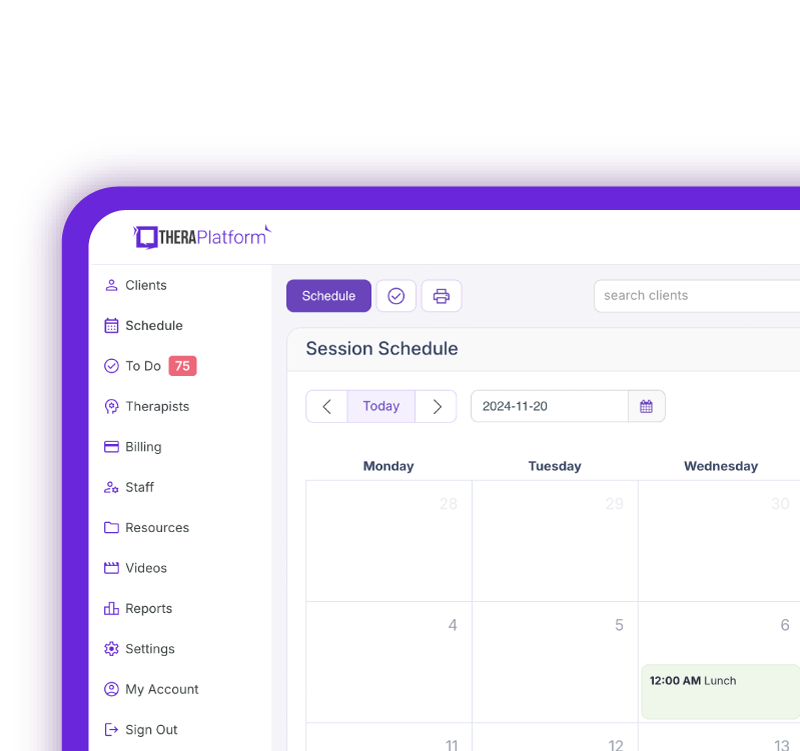
Modern EHR/practice management platforms (such as TheraPlatform) assist greatly with documentation by providing HIPAA‑compliant, integrated systems for note entry, storage, scheduling, and billing.
They allow therapists to:
- Use and customize templates (e.g., SOAP, DAP, and others) or build their own to streamline note writing and ensure consistency.
- Link notes to treatment plans, goals, and session history so client progress is easily tracked over time.
- Utilize e-fax and secure document sharing via client portal to safely exchange information with clients or other providers while maintaining confidentiality.
- Leverage dictation and telehealth transcription, which can automatically convert sessions into therapy or assessment notes, saving time and reducing manual entry.
- Take advantage of AI features that streamline documentation by automatically populating intake form data into assessment templates and generating complete therapy and assessment notes from the information you provide, all with a single click.
Watch this video to learn how to save time on therapy notes
Meanwhile, AI‑assisted note tools are emerging which can further help clinicians by:
- Automatically transcribing session audio (if permitted) and highlighting key moments (e.g. emotional shifts, major themes).
- Suggesting draft notes or filling in objective or assessment sections based on observed data, freeing up clinicians’ time.
- Supporting consistency and reducing missing components in notes, which helps from both clinical, legal, and insurance perspectives.
Together, structured SOAP‑type notes, good EHR platforms, and smart AI tools support better therapeutic outcomes, more efficient workflows, and stronger accountability.
Streamline your practice with One EHR
- Scheduling
- Flexible notes
- Template library
- Billing & payments
- Insurance claims
- Client portal
- Telehealth
- E-fax
Resources for speech therapists
TheraPlatform is an all-in-one EHR, practice management, and teletherapy software with AI-powered notes built for therapists to help them save time on admin tasks. It offers a 30-day risk-free trial with no credit card required and supports different industries and sizes of practices, including speech-language pathologists in group and solo practices.
More resources
- Therapy resources and worksheets
- Therapy private practice courses
- Ultimate teletherapy ebook
- The Ultimate Insurance Billing Guide for Therapists
- The Ultimate Guide to Starting a Private Therapy Practice
- Insurance billing 101
- Practice management tools
Free video classes
- Free on-demand insurance billing for therapist course
- Free mini video lessons to enhance your private practice
- 9 Admin tasks to automate in your private practice
References
Carr, P., Moser, D., Williamson, S., Robinson, G., & Kintz, S. (2022). Improving functional communication outcomes in post-stroke aphasia via telepractice: An alternative service delivery model for underserved populations. International Journal of Telerehabilitation, 14(2), e6531. https://pmc.ncbi.nlm.nih.gov/articles/PMC10681046/
Coan-Brill, J., Teachman, G., Costigan, F. A., Pham, T., & Cunningham, B. J. (2025). Exploring augmentative & alternative communication assessment practices for children with limited functional speech & motor skills: a scoping review utilizing the Participation Model of AAC. Disability and Rehabilitation: Assistive Technology, 1-24. https://doi.org/10.1080/17483107.2025.2454253.
Koopmans, C., Sakash, A., Soriano, J., Long, H. L., & Hustad, K. C. (2022). Functional communication abilities in youth with cerebral palsy: Association with impairment profiles and school-based therapy goals. Language, Speech, and Hearing Services in Schools, 53(1), 88-103. https://pubs.asha.org/doi/abs/10.1044/2021_LSHSS-21-00064.
FAQs about functional communication goals
What is functional communication in speech therapy?
Functional communication is the ability to send and receive messages that serve a practical purpose in daily life, using speech, AAC, gestures, or other communication methods.
How are functional communication goals different from traditional speech goals?
Functional goals focus on why and how a client communicates in real-world situations, rather than targeting isolated skills like articulation or vocabulary in a clinical setting alone.
Can functional communication goals be used with nonverbal clients?
Yes. Functional communication goals often involve AAC systems such as gestures, picture exchange, or speech-generating devices to support meaningful communication.