Telehealth group therapy codes

Two telehealth group therapy codes were recently added as insurance companies continue to expand the number of remote services they will reimburse. For 2026, two existing group mental health interventions are now covered for telehealth by the Centers for Medicare and Medicaid Services (CMS): Multiple-family group psychotherapy and group behavioral counseling for obesity. This guide will explain these mental health interventions and their use for telehealth.
Summary
- CMS expanded telehealth coverage for 2026 to include Multiple-Family Group Psychotherapy (CPT 90849) and Group Behavioral Counseling for Obesity (HCPCS G0473), each with distinct documentation and eligibility rules. Enrolling in an insurance billing course for therapists can help providers enhance their knowledge.
- Multiple-family group psychotherapy requires rigorous documentation, including individual progress notes, treatment-plan justification, and evidence of cross-family interaction to support reimbursement.
- Group behavioral counseling for obesity is a preventive Medicare benefit, not psychotherapy, with strict caps on session length, participant numbers, provider qualifications, and annual visit limits.
- Telehealth delivery adds compliance considerations, including HIPAA-secure platforms, appropriate POS codes, modifiers, and verification of payer-specific coverage. Using an EHR like TheraPlatform ensures your telehealth sessions are secure.
→ Enroll in My Free, On-Demand Insurance Billing for Therapists Course
Multiple-Family Group Psychotherapy (CPT Code: 90849)
What is Multiple-Family Group Psychotherapy?
Multiple-family group psychotherapy is a blending of group and family psychotherapy. It occurs when families from different households attend group therapy together. It is typically used when families are dealing with a common difficulty, such as someone with substance abuse or chronic mental illness, but can technically be used for any problem.
Sessions are at least 60 minutes and led by a mental health professional.
Streamline your insurance billing with One EHR
- Claim batching
- Auto claims
- Automated EOB & ERA
- Real-time claim validation
- Real-time claim tracking
- Aging and other reports

How is it different from standard group and family therapy?
Standard group therapy (CPT code 90853) consists of individuals who are placed with other members in a group for a common reason. Family therapy (CPT code 90847), in contrast, is when more than one member of a family is placed together in a therapy setting.
Tips for utilizing the telehealth group therapy code 90849
Multiple-Family Group Psychotherapy is rarely done, so therapists will need to be meticulous with their documentation if they want reimbursement. As a starter, attendance and time of the session need to be strictly documented.
Don’t let the number of participants get too unwieldy. When dealing with multiple families, it might be easy to want to include a lot of people. Although psychotherapy groups can contain up to 15 people and still be effective, most professionals believe that an optimal number of group members is closer to seven or eight.
Each member of the group—even those from the same family—requires a separate file and individual progress notes for each session. The SOAP note format is a helpful template to cover your bases and maintain consistency.
Therapists need to provide the rationale in individual treatment plans for doing this type of therapy instead of more conventional family or group psychotherapy.
Progress notes should highlight cross-family interaction to support clinical relevance.
Practice Management + EHR + Telehealth
Manage more in less time in your practice with TheraPlatform
Telehealth considerations
Multiple-Family Group Psychotherapy can provide several logistical challenges for teletherapy. First and foremost, how do you conduct virtual therapy for multiple family members who live in the same house? Each member should have an equal presence in therapy, and this may require multiple screens to connect to a virtual therapy platform. Having one family member on screen while others lurk in the background is not optimal.
A HIPAA-compliant secure teletherapy platform, such as Theraplatform, is required to allow multiple family members to participate at the same time.
Although CMS says it will cover this type of therapy, group members should confirm telehealth coverage with their particular insurance company. Even Medicare has been known to reject coverage if it does not feel it is justified.
Unlike other medical services, mental health has no telehealth exceptions for location. This means you can receive service from anywhere, even locations that are not underserved for mental health.
Group Behavioral Counseling for Obesity (HCPCS Code: G0473)
What is Group Behavioral Counseling for Obesity?
Group behavioral counseling for obesity is a little bit different than traditional therapy provided by a mental health professional. It is a preventive benefit of Medicare's Intensive Behavioral Therapy (IBT) for Obesity program. It has very specific requirements that must be followed for reimbursement:
- Unlike many groups, the number of participants is capped at 2–10 people.
- Participants must be referred by their primary care physician and have a body mass index (BMI) of 30 or greater.
- Sessions are only 30 minutes.
You may notice that this intervention has an HCPCS code rather than a CPT code. That is because this is viewed as a counseling tool for behavior change rather than psychotherapy.
Who can provide Group Behavioral Counseling for Obesity?
The service is not usually provided by a mental health professional. It is furnished by a qualified primary care provider, such as an internal medicine physician, a nurse practitioner (NP), a physician assistant (PA), or a clinical nurse specialist. Other professionals, such as a registered dietician, could also administer the counseling as long as they are under the direct supervision of a qualified provider, as detailed in Medicare’s “incident to” provision.
What is the content of the counseling sessions?
Sessions typically cover meal planning, healthy eating, exercise, and stress management, using the "Five As" (Ask, Assess, Advise, Agree, Assist/Arrange) technique. This technique was adapted from smoking cessation treatment and uses motivational interviewing principles:
- Ask: Seek permission to discuss weight, establish a non-judgmental and collaborative tone, and gauge readiness for change.
- Assess: Assess the client’s current health status (e.g., BMI), the effects of weight on their lifestyle and psychological status, as well as the root causes of obesity.
- Advise: Give clear, specific, and personalized behavior change advice, including information about the benefits and harm of being overweight.
- Agree: Collaboratively select appropriate treatment goals and methods based on the client’s willingness to change their current behavior.
- Assist/Arrange: Using behavior change techniques, aid the client in achieving goals by acquiring skills, confidence, and social support for behavior change, supplemented with follow-up treatments when appropriate.
Free Resources for Therapists
Click below and help yourself to peer-created resources:

Tips for using telehealth group therapy code HCPCS G0473
Providers must record time, participants, and group goals for each session.
Treatment plan goals and progress notes must be linked to behavioral weight loss outcomes.
Medicare will cover this type of counseling up to 22 times in a 12-month period. However, a reassessment at six months is required, and beneficiaries must lose at least 3 kg to qualify for the next six months.
Because it is a Medicare benefit, it is not covered by private insurance; other insurance companies may provide their own similar weight management services.
Telehealth considerations
Although approved by CMS for telehealth, Medicare clients should still confirm coverage because of the many requirements that need to be met for approval.
Each group member must have dependable wifi and a secure HIPAA-approved platform, such as Theraplatform, for receiving counseling services. Additionally, counseling is more effective in a quiet environment free of interruption.
As a telehealth service, providers must include a place of service (POS) code when billing. POS 10 is used when the client is in their home, and POS 02 is used for another remote location. The 95 modifier for telehealth also applies.
If a provider is under the supervision of a qualified professional, they must have access to that supervisor during the session. This used to mean that the supervisor needed to be physically nearby, but with the approval of G0473 for telehealth, this requirement becomes more complicated. It is recommended that a supervisor be reachable at all times during the session if they are not physically in the same area as the provider.
Practice Management + EHR + Telehealth
Manage more in less time in your practice with TheraPlatform
How EHR and practice management software can save you time with insurance billing for therapists
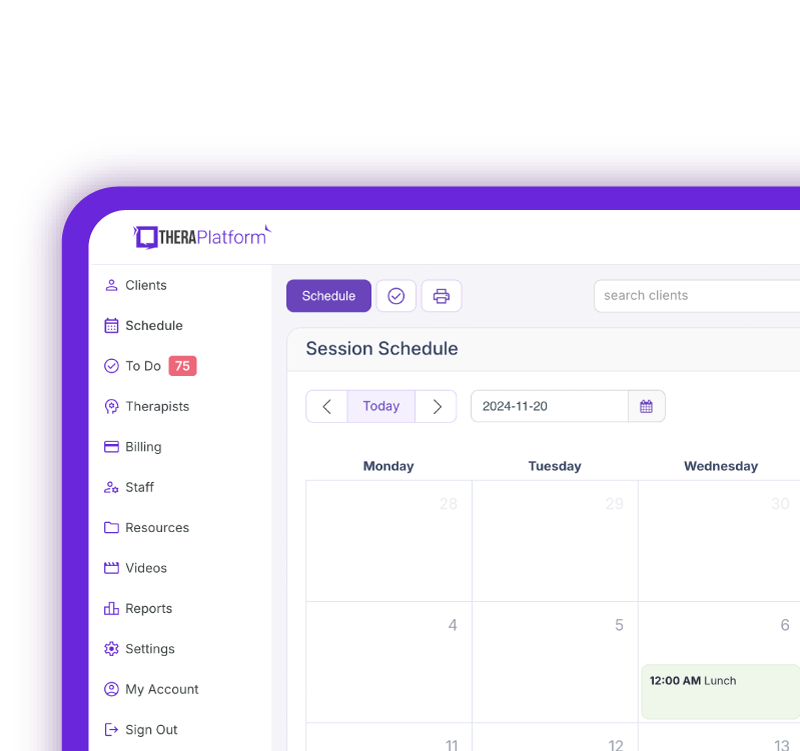
EHRs with integrated billing software and clearing houses, such as TheraPlatform, offer therapists significant advantages in creating an efficient insurance billing process. The key is minimizing the amount of time dedicated to developing, sending, and tracking medical claims through features such as automation and batching.
Watch this video to see how TheraPlatform’s EHR saves time on insurance billing
What are automation and batching?
- Automation refers to setting up software to perform tasks with limited human interaction.
- Batching or performing administrative tasks in blocks of time at once allows you to perform a task from a single entry point with less clicking.
Which billing and medical claim tasks can be automated and batched through billing software?
- Invoices: Create multiple invoices for multiple clients with a click or two of a button or set up auto-invoice creation, and the software will automatically create invoices for you at the preferred time. You can even have the system automatically send invoices to your clients.
- Credit card processing: Charge multiple clients with a click of a button or set up auto credit card billing, and the billing software will automatically charge the card (easier than swiping!)
- Email payment reminders: Never manually send another reminder email for payment again, or skip this altogether by enabling auto credit card charges.
- Automated claim creation and submission: Batch multiple claims with one button click or turn auto claim creation and submission on.
- Live claim validation: The system reviews each claim to catch any human errors before submission, saving you time and reducing rejected claims.
- Automated payment posting: Streamline posting procedures for paid medical claims with ERA. When insurance offers ERA, all their payments will post automatically on TheraPlatform's EHR.
- Tracking: Track payment and profits, including aging invoices, overdue invoices, transactions, billed services, service providers
Utilizing billing software integrated with an EHR and practice management software can make storing and sharing billing and insurance easy and save providers time when it comes to insurance billing for therapists.
Streamline your practice with One EHR
- Scheduling
- Flexible notes
- Template library
- Billing & payments
- Insurance claims
- Client portal
- Telehealth
- E-fax
Resources for mental health therapists
Theraplatform is an all-in-one EHR, practice management and teletherapy solution with AI-powered notes and Wiley Treatment Planners that allow you to focus more on patient care. With a 30-day free trial, you have the opportunity to experience Theraplatform for yourself with no credit card required. Cancel anytime. They also support different industries including mental and behavioral health therapists in group practices and solo practices.
More resources
- Therapy resources and worksheets
- Therapy private practice courses
- Ultimate teletherapy ebook
- The Ultimate Insurance Billing Guide for Therapists
- The Ultimate Guide to Starting a Private Therapy Practice
- Insurance billing 101
- Practice management tools
Free video classes
- Free on-demand insurance billing for therapist course
- Free mini video lessons to enhance your private practice
- 9 Admin tasks to automate in your private practice
References
Biggs, K., Hind, D., Gossage-Worrall, R., Sprange, K., White, D., Wright, J., Chatters, R., Berry, K., Papaioannou, D., Bradburn, M., Walters, S. J., & Cooper, C. (2020, January 29). Challenges in the design, planning and implementation of trials evaluating group interventions. Trials, 21(1), 116. https://doi.org/10.1186/s13063-019-3807-4
Centers for Medicare and Medicaid Services (2022, September 22). The “incident to” provision of Medicare. https://cgsmedicare.com/partb/mr/pdf/incident_to_provision_factsheet.pdf
Centers for Medicare and Medicaid Services (2025, December). Medicare Learning Network Booklet. Teleheatlh and remote monitoring. https://www.cms.gov/files/document/mln901705-telehealth-remote-monitoring.pdf
Medicare.gov. Obesity behavioral therapy. https://www.medicare.gov/coverage/obesity-behavioral-therapy
Vallis, M., Piccinini-Vallis, H., Sharma, A. M., & Freedhoff, Y. (2013). Clinical review: modified 5 As: minimal intervention for obesity counseling in primary care. Canadian family physician, 59(1), 27–31. https://pmc.ncbi.nlm.nih.gov/articles/PMC3555649
FAQS about new telehealth codes for mental health
What is CPT code 90849 used for in telehealth?
CPT 90849 is used for multiple-family group psychotherapy, where families from different households participate together in a structured group session led by a mental health professional.
Is group behavioral counseling for obesity considered psychotherapy?
No. HCPCS code G0473 is a Medicare preventive benefit focused on behavioral change and weight management, not psychotherapy, and is typically delivered by qualified primary care providers.
Are these services covered by all insurers via telehealth?
CMS approves both services for telehealth, but coverage can vary by payer, and beneficiaries should always confirm eligibility and documentation requirements with their insurance provider.