CPT Code lookup

CPT code lookup and navigating billing codes can be one of the more daunting parts of running a mental health practice. Accurate use of Current Procedural Terminology (CPT) codes is essential for ensuring reimbursement, maintaining compliance, and streamlining documentation for licensed therapists, counselors, psychologists, and psychiatrists.
Summary
- Accurate CPT code use is critical for reimbursement, compliance, and reducing denied claims—especially for time-based psychotherapy and evaluation services.
- Helpful CPT lookup tools include AMA and CMS websites, EHR systems with built-in libraries, and resources from professional associations like APA and NASW.
- Commonly used codes in mental health include 90832–90837 for psychotherapy, 90791/90792 for evaluations, and add-on codes like +90785 for interactive complexity.
- Challenges include insurance variability, code updates, and lack of training, which can lead to underbilling or misuse, making ongoing education and periodic audits essential. Enrolling in an insurance billing course for therapists can help providers enhance their knowledge.
- By leveraging an EHR like TheraPlatform for efficient documentation and claim submission, therapists can tackle billing with ease.
→ Enroll in My Free, On-Demand Insurance Billing for Therapists Course
Whether in private practice or part of a larger organization, understanding CPT code lookup and interpreting and using codes effectively can make a big difference in administrative efficiency and financial sustainability.
CPT code lookup
CPT code lookup is available in many forms. Some tools may be more helpful than others, depending on your workflow and the complexity of the services you bill for.
Streamline your insurance billing with One EHR
- Claim batching
- Auto claims
- Automated EOB & ERA
- Real-time claim validation
- Real-time claim tracking
- Aging and other reports

Online resources for CPT code lookup
- AMA CPT Website: The American Medical Association is the official source for CPT codes. They offer an online store where providers can purchase the most up-to-date CPT codebooks and digital tools.
- CMS (Centers for Medicare & Medicaid Services): CMS offers downloadable files and lookup tools to help you find covered codes and understand reimbursement rates.
- Medicare Physician Fee Schedule (MPFS): A valuable tool for determining the reimbursement amounts assigned to each CPT code for Medicare patients.
Professional Associations for CPT code lookup
Professional organizations such as the American Psychological Association (APA), the National Association of Social Workers (NASW), and the American Counseling Association (ACA) regularly publish guidance and code summaries tailored to mental health practitioners. These associations also provide webinars, training, and member-only toolkits, including CPT billing information.
Practice management and EHR Software for CPT code lookup
Many Electronic Health Record (EHR) systems have built-in CPT code libraries that automatically suggest appropriate billing codes based on session type or service notes. Tools like TheraPlatform can improve accuracy and reduce the need to lookup codes manually.
Standard CPT codes for mental health providers
While dozens of CPT codes could apply to behavioral health services, most mental health professionals regularly use a core set of codes. These codes are categorized by service type, including psychotherapy, assessments, and add-on services.
Code (Psychotherapy services) | Description |
|---|---|
90832 | Psychotherapy, 30 minutes with patient (16-37 Minutes) — Typically used for shorter therapy sessions, often in follow-up appointments or when time is limited. |
90834 | Psychotherapy, 45 minutes (38-52 minutes)— The most commonly used code for standard outpatient therapy sessions. |
90837 | Psychotherapy, 60 minutes (53+ minutes) — Used for longer, more in-depth sessions, often when addressing complex trauma or crises. |
Family therapy without the patient present—This is used for sessions focused on family dynamics, education, or support without the identified client in attendance. | |
Family therapy with the patient present- This involves therapeutic work with the client and one or more family members in the room. | |
90853 | Group psychotherapy — Used for sessions involving multiple clients participating in a shared therapeutic process, often focused on specific topics like grief, DBT, or relapse prevention. |
Code (Psychiatric Diagnostic Evaluation) | |
Initial diagnostic evaluation (without medical services) — Typically used by psychologists, therapists, or clinical social workers to assess mental health history, symptoms, and formulate a preliminary diagnosis. | |
90792 | Initial evaluation with medical services — Similar to 90791 but includes a medical component, such as medication assessment, and is usually billed by psychiatrists or psychiatric nurse practitioners. |
Add-On and Interactive Complexity Codes | |
Interactive complexity — Used when additional factors complicate communication, such as the involvement of a legal guardian, language interpreter, or when working with children with developmental or cognitive issues. | |
+99354 / +99355 | Prolonged services codes — Add-on codes used when face-to-face time with the client extends beyond the typical session duration (e.g., an additional 30–60 minutes for intensive work). |
Assessment and Testing Codes | |
96130–96133 | Psychological testing codes — Used for administering, scoring, and interpreting psychological tests, such as IQ assessments or personality inventories, typically by a psychologist. |
96136–96139 | Neuropsychological testing codes — Used for testing brain function and cognitive abilities, often in cases involving head trauma, dementia, or learning disabilities. |
Brief emotional/behavioral assessment — Covers quick screening tools like the PHQ-9 for depression or GAD-7 for anxiety, often administered during intake or follow-up appointments. |
Best practices for CPT code use
Accurate CPT code lookup and usage are essential for proper reimbursement and to protect providers from audits, denied claims, or allegations of fraud. Following these best practices can support both clinical integrity and financial sustainability.
Match codes to documentation
Your clinical documentation must justify the CPT code you bill. For example, if you bill 90837 for a 60-minute psychotherapy session, your note should include the time spent (start and end times), the therapeutic interventions used (e.g., CBT, EMDR), and the session's content or focus. Avoid vague language—specific, detailed notes reduce the risk of audits and denied claims.
Understand time requirements
Many psychotherapy CPT codes are time-based, and using them correctly means adhering to the minimum time thresholds. For example, 90834 applies to sessions lasting 38–52 minutes, while 90837 requires 53 minutes or more. If a session ends early, using the lower time-based code is safer to avoid downcoding by the payer or rejected claims.
Stay informed on insurance variability
Coverage for CPT codes can vary widely between insurance companies. Some insurers may limit the use of 90837 for specific diagnoses or require prior authorization for psychological testing codes like 96130. Others may not reimburse brief assessment codes like 96127. Stay current on payer policies by regularly reviewing provider manuals and communicating with billing departments or clearinghouses.
Use add-on codes appropriately
Add-on codes such as +90785 (interactive complexity) or +99354 (prolonged services) should only be used when the session meets the criteria. For example, 90785 may apply when working with a child with significant communication challenges requiring frequent caregiver input. These codes must be justified in documentation to avoid overbilling or triggering payer scrutiny.
Audit your billing periodically
Regular internal or third-party audits help catch billing inconsistencies before they become larger issues. Review a sample of your billed sessions, ensuring CPT codes match the documentation and meet payer rules. Audits also help identify patterns of underbilling or overuse of higher-reimbursement codes.
Practice Management + EHR + Telehealth
Manage more in less time in your practice with TheraPlatform
Challenges in CPT code lookup and use
Despite the availability of resources and tools, mental health providers continue to face several common challenges regarding CPT code lookup and billing. These issues can impact reimbursement, compliance, and overall practice efficiency.
Code changes and updates
The American Medical Association reviews and revises CPT codes regularly. A code that was reimbursable last year might now require a modifier, be sunsetted, or be replaced by a more specific code. Staying current with annual updates—especially those affecting behavioral health—is essential to avoid claiming denials or underutilizing new billing opportunities.
Complex insurance requirements
Every payer—including commercial insurers, Medicaid, and Medicare—can impose different requirements on how and when CPT codes are used. These variations include needing specific modifiers (like GT for telehealth), prior authorizations for extended sessions, or limits on how frequently codes like 90837 or 96130 can be billed. This inconsistency makes it difficult to apply a one-size-fits-all approach and often requires individualized tracking for each payer.
Lack of training in billing
Most clinicians receive minimal formal education on billing and coding, leading to uncertainty about how to apply codes accurately. Providers may unintentionally underbill (e.g., using 90834 when 90837 is appropriate) or overbill without a strong billing foundation, increasing the risk of audits or delayed payments. Ongoing training and support are often necessary to build confidence and accuracy in coding practices.
Interactive complexity confusion
Codes like +90785 (interactive complexity) are frequently underused due to confusion about their criteria. Providers may not realize that they apply in cases involving children with autism, clients with cognitive impairments, or sessions requiring interpretation services or coordination with guardians. Because the guidelines are nuanced, many clinicians err on the side of caution and skip the code, even when it is appropriate and reimbursable.
Understanding CPT code lookup and effectively using CPT codes are vital to running a sustainable mental health practice. Providers have many tools to stay informed and accurate, from online databases and EHR software to relying on professional associations. By knowing the most commonly used mental health codes, applying them correctly, and avoiding common pitfalls, clinicians can ensure timely reimbursement and reduce administrative headaches.
Despite some challenges—including insurance variability and limited training—developing CPT code literacy is a skill that pays off in the long run. Regularly updating your knowledge and using supportive resources will help you stay compliant, efficient, and financially secure.
Practice Management + EHR + Telehealth
Manage more in less time in your practice with TheraPlatform
How EHR and practice management software can save you time with insurance billing for therapists
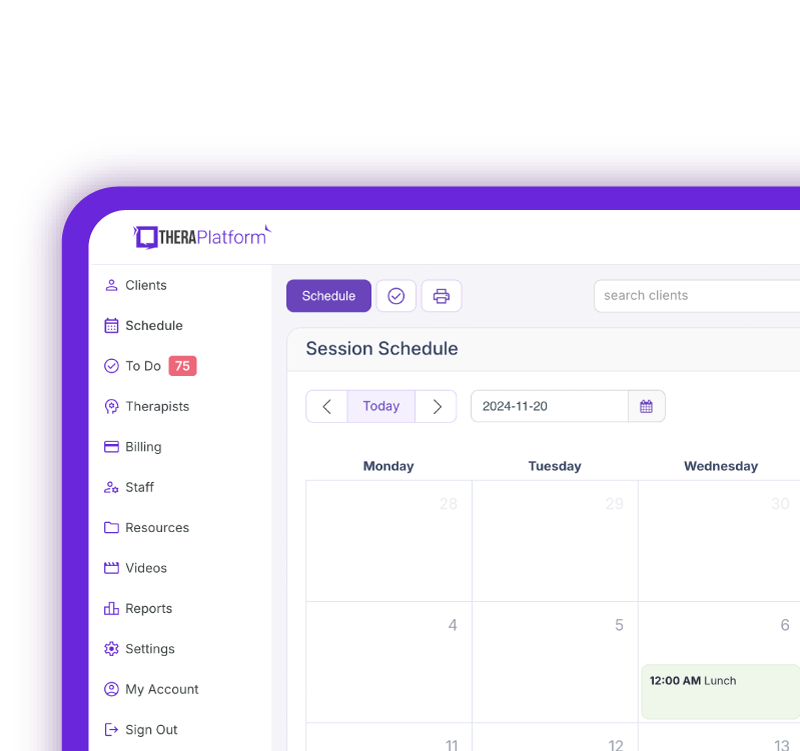
EHRs with integrated billing software and clearing houses, such as TheraPlatform, offer therapists significant advantages in creating an efficient insurance billing process. The key is minimizing the amount of time dedicated to developing, sending, and tracking medical claims through features such as automation and batching.
Watch this video to see how TheraPlatform’s EHR saves time on insurance billing
What are automation and batching?
- Automation refers to setting up software to perform tasks with limited human interaction.
- Batching or performing administrative tasks in blocks of time at once allows you to perform a task from a single entry point with less clicking.
Which billing and medical claim tasks can be automated and batched through billing software?
- Invoices: Create multiple invoices for multiple clients with a click or two of a button or set up auto-invoice creation, and the software will automatically create invoices for you at the preferred time. You can even have the system automatically send invoices to your clients.
- Credit card processing: Charge multiple clients with a click of a button or set up auto credit card billing, and the billing software will automatically charge the card (easier than swiping!)
- Email payment reminders: Never manually send another reminder email for payment again, or skip this altogether by enabling auto credit card charges.
- Automated claim creation and submission: Batch multiple claims with one button click or turn auto claim creation and submission on.
- Live claim validation: The system reviews each claim to catch any human errors before submission, saving you time and reducing rejected claims.
- Automated payment posting: Streamline posting procedures for paid medical claims with ERA. When insurance offers ERA, all their payments will post automatically on TheraPlatform's EHR.
- Tracking: Track payment and profits, including aging invoices, overdue invoices, transactions, billed services, service providers
Utilizing billing software integrated with an EHR and practice management software can make storing and sharing billing and insurance easy and save providers time when it comes to insurance billing for therapists.
Streamline your practice with One EHR
- Scheduling
- Flexible notes
- Template library
- Billing & payments
- Insurance claims
- Client portal
- Telehealth
- E-fax
Resources for mental health therapists
Theraplatform is an all-in-one EHR, practice management and teletherapy solution with AI-powered notes and Wiley Treatment Planners that allow you to focus more on patient care. With a 30-day free trial, you have the opportunity to experience Theraplatform for yourself with no credit card required. Cancel anytime. They also support different industries including mental and behavioral health therapists in group practices and solo practices.
More resources
- Therapy resources and worksheets
- Therapy private practice courses
- Ultimate teletherapy ebook
- The Ultimate Insurance Billing Guide for Therapists
- The Ultimate Guide to Starting a Private Therapy Practice
- Insurance billing 101
- Practice management tools
Free video classes
- Free on-demand insurance billing for therapist course
- Free mini video lessons to enhance your private practice
- 9 Admin tasks to automate in your private practice
References
American Counseling Association. (n.d.). American Counseling Association. https://www.counseling.org
American Medical Association. (n.d.). CPT® coding resources. https://www.ama-assn.org/practice-management/cpt/cpt-coding-resources
American Medical Association. (n.d.). CPT® overview and code approval. https://www.ama-assn.org/practice-management/cpt/cpt-overview-and-code-approval
American Medical Association. (n.d.). Behavioral health coding resource. https://www.ama-assn.org/system/files/behavioral-health-coding-resource.pdf
American Psychological Association. (2020, January). New CPT codes could increase reimbursement for health behavior services. Monitor on Psychology, 51(1). https://www.apa.org/monitor/2020/01/news-codes-reimbursement
CPT and Diagnostic Codes https://www.apaservices.org/practice/reimbursement/health-codes
Centers for Medicare & Medicaid Services. (n.d.). Medicare coverage database – Psychiatric diagnostic evaluation (L57480). https://www.cms.gov/medicare-coverage-database/view/article.aspx?articleId=57480
Centers for Medicare & Medicaid Services. (n.d.). Medicare physician fee schedule. https://www.cms.gov/medicare/payment/fee-schedules/physician
Maryland Department of Health. (n.d.). Common claim denials. https://health.maryland.gov
National Association of Social Workers. (n.d.). National Association of Social Workers. https://www.socialworkers.org
Substance Abuse and Mental Health Services Administration. (n.d.). Reimbursement resources. https://www.samhsa.gov
FAQs about CPT code look up for mental health therapists
What is CPT code lookup in mental health billing?
CPT code lookup is the process of identifying the correct Current Procedural Terminology codes for psychotherapy, evaluations, and assessments to ensure accurate reimbursement and compliance.
Where can mental health providers find reliable CPT codes?
Therapists can use resources like the AMA CPT website, CMS tools, professional associations (APA, NASW, ACA), and EHR systems with built-in CPT libraries.
What are the most commonly used CPT codes for mental health?
Common codes include 90832–90837 for psychotherapy, 90791/90792 for diagnostic evaluations, and add-on codes like +90785 for interactive complexity.