Modifier 22 for SLPs

Modifier 22 indicates increased procedural services when a procedure requires significantly more time, skill, or effort than typically required. Its purpose is to justify additional reimbursement for extraordinary circumstances in treatment.
Summary
- Modifier 22 is to indicate that a procedure required significantly more time, skill, or effort than typically required, justifying additional reimbursement for extraordinary circumstances.
- It should be applied when an SLP provides services that require exceptional care, such as treating complex speech disorders, managing swallowing issues, or using specialized techniques like AAC.
- Detailed notes are necessary, including time tracking and clinical justification for the increased effort. This supports the claim and helps prevent denials. By leveraging an EHR like TheraPlatform for efficient documentation and claim submission, therapists can tackle billing with ease.
- Use Modifier 22 sparingly, verify payer policies, and ensure proper documentation to avoid audits or claim denials. Enrolling in an insurance billing course for therapists can help providers enhance their knowledge.
→ Click here to enroll in our free on-demand Insurance Billing for Therapists video course [Enroll Now]
Speech-language pathologists (SLPs) often work with clients with complex needs, demanding more work to provide services than typically required.
When this occurs during a treatment session, the SLP should use a critical billing code modifier, Modifier 22.
Using the correct billing code and modifier is crucial for SLPs to ensure they receive the appropriate reimbursement for these enhanced services. Here are the need-to-know details about Modifier 22 for Speech-language pathologists.
Streamline your insurance billing with One EHR
- Claim batching
- Auto claims
- Automated EOB & ERA
- Real-time claim validation
- Real-time claim tracking
- Aging and other reports

What is Modifier 22 used for?
Modifier 22 should be applied when the SLP provides a service that requires exceptional care. Applicable scenarios include:
- Complex cases requiring extensive, complex therapy (e.g., severe speech disorders or multiple comorbidities).
- Challenging cases that go beyond standard practice.
- Situations that necessitate the SLP to use highly specialized techniques beyond those used in typical practice.
Examples in speech therapy
These are some common scenarios in which the SLP may apply Modifier 22:
- Treatment for a nonverbal child with severe autism: This clinical service may demand more of the SLP’s time.
- The therapist may implement specialized techniques, such as augmentative alternative communication (AAC), and may need to address behavioral challenges.
- This service may include extensive collaboration with caregivers on effective intervention strategies and recommendations.
- Managing complex swallowing disorders: Dysphagia treatment may involve extensive caregiver education or interdisciplinary collaboration.
- Addressing speech and language disorders in medically complex children: Treating children with medical disorders such as Cerebral Palsy, a cleft palate, or cognitive deficits can be more challenging and involved. SLPs are required to use unique, specialized techniques for these therapy sessions.
- Utilizing specialized treatment techniques: When treating children who have unique difficulties, such as Motor Speech Impairments (e.g., Apraxia), SLPs are required to employ highly skilled therapy techniques that may warrant the use of Modifier 22.
Watch this video to discover how TheraPlatform’s EHR can streamline your billing
Documentation requirements for Modifier 22
When applying Modifier 22 to clinical documentation and billing, speech therapists must provide comprehensive, accurate documentation. This documentation supports the claim, avoiding reimbursement denials.
Detailed notes
Include a clear explanation of why the procedure was more complex. SLPs should include important, pertinent information in their treatment notes to support the use of Modifier 22, including specific challenges addressed, the extra time provided beyond the length of a typical session, and specialized techniques incorporated to address the client’s unique needs.
Time tracking
Record the additional time spent compared to a typical session. For example, the therapist may document that a session required an extra 30 minutes due to the need to trial multiple AAC devices.
Clinical justification
Provide evidence that the extra effort was necessary and directly related to patient care. Document any specialized techniques utilized, such as PROMPT for a child with a motor speech disorder.
Practice Management + EHR + Telehealth
Manage more in less time in your practice with TheraPlatform
Billing and reimbursement for Modifier 22
Claim Submission for Modifier 22
To use Modifier 22 successfully in billing, SLPs should follow these steps:
- Attach Modifier 22 to the CPT code
- Provide detailed supporting documentation with the claim. The documentation should reflect the extensive, highly skilled services.
Insurance review for Modifier 22
Insurance providers often flag claims with Modifier 22 attached for closer review due to their higher reimbursement rate.
Be prepared for payers to request additional information or deny claims without proper justification. Some insurance companies may require a pre-authorization or may not recognize Modifier 22.
Best practices for using Modifier 22
- Use sparingly: Therapists should only use Modifier 22 in extraordinary situations to avoid scrutiny or audits triggered by overuse of the modifier.
- Verify payer policies: Before using Modifier 22, confirm that the insurance company recognizes the modifier. You should also gather a thorough understanding of their requirements for documentation. Recognize that policies can vary among different payers.
- Educate billing staff: Train administrative staff, including those handling billing, to identify appropriate cases for using Modifier 22. Compile supporting documentation that will be necessary to attach to the claim.
Proper use of Modifier 22 ensures fair compensation for SLPs when addressing complex cases requiring additional time or skill compared to typical, day-to-day treatment sessions.
Applying Modifier 22 allows speech therapists to provide skilled clinical service to clients with complex needs while maintaining compliance with billing regulations.
SLPs are critical in providing supporting documentation for Modifier 22 to attach to claims. They must accurately document and communicate the need for Modifier 22 to justify the enhanced services and ensure appropriate reimbursement.
This can positively contribute to a high level of client care and support the long-term financial viability of their practice.
Speech therapists can find further guidance on using Modifier 22 through resources such as:
- Centers for Medicare & Medicaid Services (CMS), which provides detailed rules for reimbursement.
- American Speech-Language-Hearing Association (ASHA) for updated billing policies for Speech Therapy.
- Insurance provider manuals and online resources. Here, SLPs can determine what policies the payer has surrounding Modifier 22.
- Professional billing consultants who can provide recommendations specific to billing for speech-language pathology services.
Practice Management + EHR + Telehealth
Manage more in less time in your practice with TheraPlatform
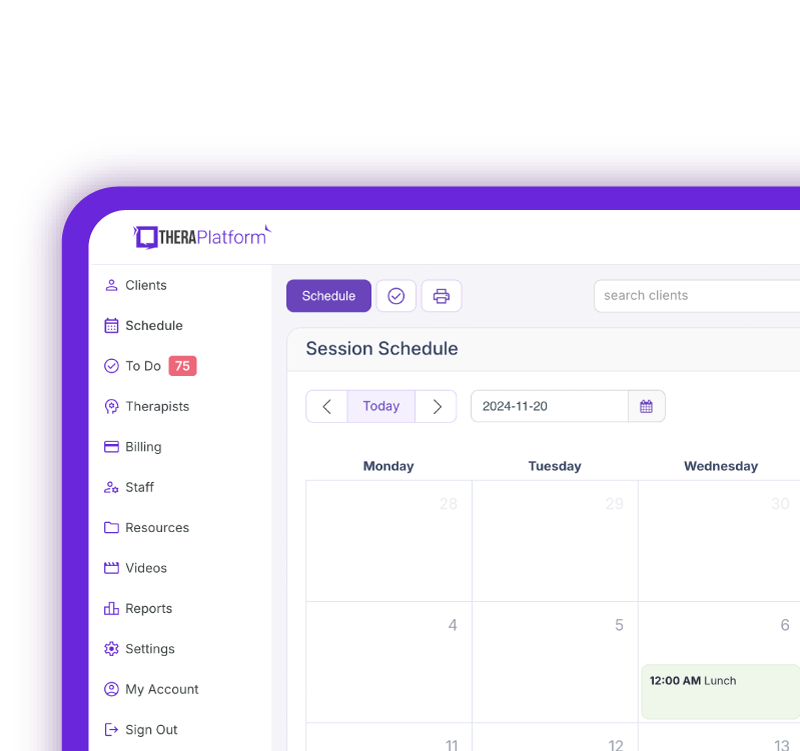
How EHR and practice management software can save speech therapists time with insurance billing for therapists
EHRs with integrated billing software and clearing houses, such as TheraPlatform, offer speech therapists significant advantages in creating an efficient insurance billing process. The key is minimizing the amount of time dedicated to developing, sending, and tracking medical claims through features such as automation and batching.
What are automation and batching?
- Automation refers to setting up software to perform tasks with limited human interaction.
- Batching or performing administrative tasks in blocks of time at once allows you to perform a task from a single entry point with less clicking.
Which billing and medical claim tasks can be automated and batched through billing software?
- Invoices: Create multiple invoices for multiple clients with a click or two of a button or set up auto-invoice creation, and the software will automatically create invoices for you at the preferred time. You can even have the system automatically send invoices to your clients.
- Credit card processing: Charge multiple clients with a click of a button or set up auto credit card billing, and the billing software will automatically charge the card (easier than swiping!)
- Email payment reminders: Never manually send another reminder email for payment again, or skip this altogether by enabling auto credit card charges.
- Automated claim creation and submission: Batch multiple claims with one button click or turn auto claim creation and submission on.
- Live claim validation: The system reviews each claim to catch any human errors before submission, saving you time and reducing rejected claims.
- Automated payment posting: Streamline posting procedures for paid medical claims with ERA. When insurance offers ERA, all their payments will post automatically on TheraPlatform's EHR.
- Tracking: Track payment and profits, including aging invoices, overdue invoices, transactions, billed services, service providers
Utilizing billing software integrated with an EHR and practice management software can make storing and sharing billing and insurance easy and save providers time when it comes to insurance billing for therapists.
Streamline your practice with One EHR
- Scheduling
- Flexible notes
- Template library
- Billing & payments
- Insurance claims
- Client portal
- Telehealth
- E-fax
Resources
TheraPlatform is an all-in-one EHR, practice management, and teletherapy software built for therapists to help them save time on admin tasks. It offers a 30-day risk-free trial with no credit card required and supports different industries and sizes of practices, including speech-language pathologists in group and solo practices.
More resources
- Therapy resources and worksheets
- Therapy private practice courses
- Ultimate teletherapy ebook
- The Ultimate Insurance Billing Guide for Therapists
- The Ultimate Guide to Starting a Private Therapy Practice
- Mental health credentialing
- Insurance billing 101
- Practice management tools
- Behavioral Health tools
Free video classes
- Free on-demand insurance billing for therapist course
- Free mini video lessons to enhance your private practice
- 9 Admin tasks to automate in your private practice
References
Burks, K., Shields, J., Evans, J., Plumley, J., Gerlach, J., & Flesher, S. (2022). A systematic review of outpatient billing practices. SAGE Open Medicine, 10, 20503121221099021. DOI: https://doi.org/10.1177/20503121221099021.
Lorah, E. R., Holyfield, C., Miller, J., Griffen, B., & Lindbloom, C. (2022). A systematic review of research comparing mobile technology speech-generating devices to other AAC modes with individuals with autism spectrum disorder. Journal of Developmental and Physical Disabilities, 34(2), 187-210. DOI:https://link.springer.com/article/10.1007/s10882-021-09803-y.
Yee, J., Smaoui, S., & Rogus-Pulia, N. (2024). Exercise-based dysphagia treatment: A proposed checklist. American Journal of Speech-Language Pathology, 33(5), 2185-2195. DOI: https://doi.org/10.1044/2024_AJSLP-22-00179
References
Burks, K., Shields, J., Evans, J., Plumley, J., Gerlach, J., & Flesher, S. (2022). A systematic review of outpatient billing practices. SAGE Open Medicine, 10, 20503121221099021. DOI: https://doi.org/10.1177/20503121221099021.
Lorah, E. R., Holyfield, C., Miller, J., Griffen, B., & Lindbloom, C. (2022). A systematic review of research comparing mobile technology speech-generating devices to other AAC modes with individuals with autism spectrum disorder. Journal of Developmental and Physical Disabilities, 34(2), 187-210. DOI: https://link.springer.com/article/10.1007/s10882-021-09803-y.
Yee, J., Smaoui, S., & Rogus-Pulia, N. (2024). Exercise-based dysphagia treatment: A proposed checklist. American Journal of Speech-Language Pathology, 33(5), 2185-2195. DOI: https://doi.org/10.1044/2024_AJSLP-22-00179
FAQs for Modifier 22 for SLPs
When should SLPs use Modifier 22?
Only for extraordinary cases that require much more time, skill, or effort than usual (e.g., severe speech disorders, complex swallowing issues, AAC use).
What documentation is needed?
Detailed notes showing why the service was complex, how much extra time was spent, and which specialized techniques were used.
Do all insurers accept Modifier 22?
No. Coverage varies, and some may require pre-authorization or deny claims without strong documentation.