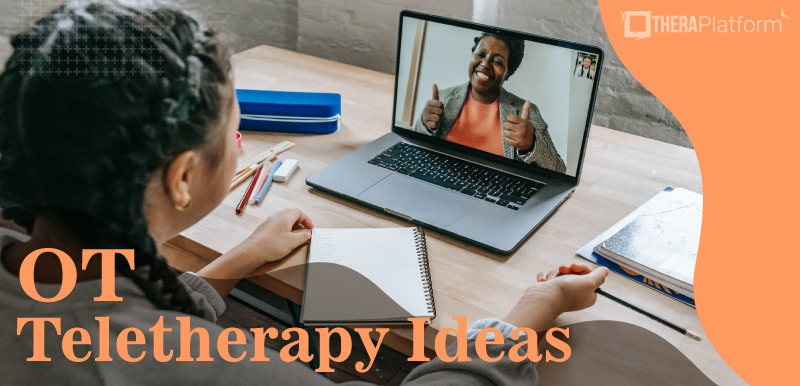
Handwriting Games

Handwriting games remain a cornerstone of pediatric occupational therapy. Even in today’s digital world, handwriting supports not only academic success but also fine motor development, visual-motor integration, executive functioning, and self-esteem.
Summary
- Handwriting games remain essential in pediatric OT, supporting academics, fine motor skills, and confidence, even in today’s digital world.
- Research shows telehealth is effective for handwriting interventions, with high satisfaction, strong attendance, and meaningful outcomes. Enroll in my free top-to-bottom teletherapy course now to learn more about this modality.
- Success depends on preparation, creativity, caregiver involvement, and using multisensory activities like Play-Doh, shaving cream, or drawing games.
- With thoughtful planning and rapport-building, teletherapy can match in-person sessions in helping children develop handwriting skills. An EHR can help therapists organize activities and homework.
→ Click Here to Enroll in My Free On-Demand Top to Bottom Teletherapy Video Course [Enroll Now]
A child who struggles with writing often struggles in other learning areas, which can create frustration and avoidance behaviors. That’s why occupational therapists continue to prioritize handwriting interventions, both in clinics and through telehealth.
Is telehealth effective for developing handwriting skills?
Telehealth is often misunderstood, with many parents and professionals questioning whether online occupational therapy can truly be effective. In reality, research shows that telehealth works remarkably well.
Today’s children are naturally comfortable with technology, and when therapy sessions are thoughtfully designed and engaging, children can become absorbed in the activities rather than the difficulties.
Research supports this: one 2022 study found that “the feasibility of the telehealth service delivery was confirmed with reported participant satisfaction, high attendance, and minimal accommodations required to translate the Handwriting Without Tears® program to telehealth.”
Similarly, a 2025 study reported that “fine motor skills training through telerehabilitation may be effective in improving the handwriting performance of children with ADHD.”
Together, this evidence demonstrates that with the right approach, teletherapy is not only practical, but also capable of delivering meaningful results in children’s handwriting development.
Streamline your practice with One EHR
- Scheduling
- Flexible notes
- Template library
- Billing & payments
- Insurance claims
- Client portal
- Telehealth
- E-fax

Tips for teletherapy success with handwriting games
Several key factors shape the success of teletherapy. Among the most important are the therapist’s ability to build a strong rapport, the design and setup of each session, and the child’s own motivation.
When these elements are paired with creativity, encouragement, and simple, accessible tools, handwriting progress in a virtual setting can be just as effective as progress made in person.
As one study noted, “therapists used a combination of child, therapist, and service-related factors to individually tailor a combination of intervention techniques drawn from different theoretical approaches.”
Practice Management + EHR + Telehealth
Manage more in less time in your practice with TheraPlatform
Teletherapy considerations for handwriting games
Before diving into handwriting activities, OTs need to set the stage. Successful teletherapy sessions depend on preparation, creativity, and adaptability.
Essential tools for handwriting games using teletherapy
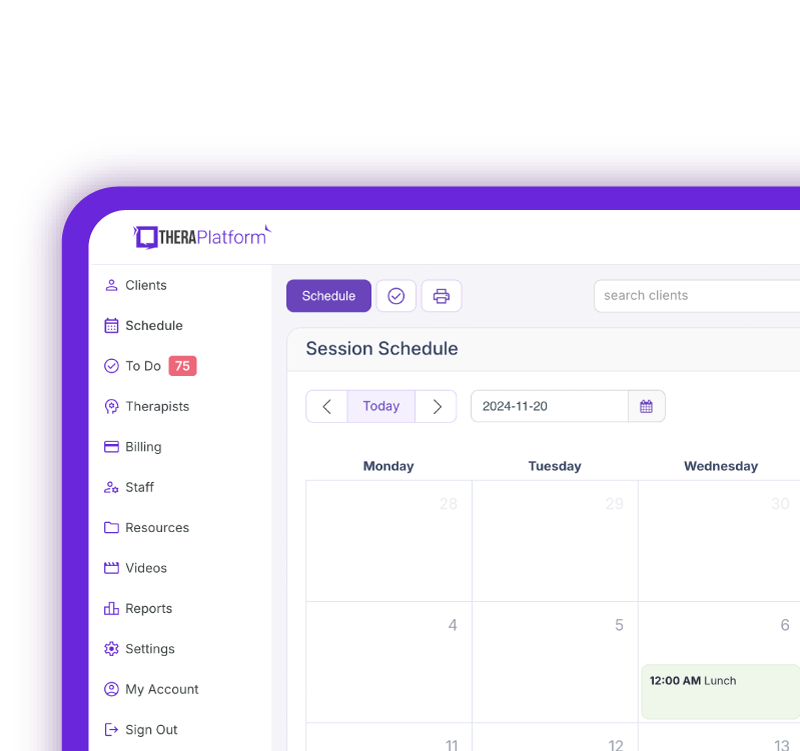
- Secure platform: Programs like TheraPlatform offer HIPAA compliance, screen-sharing, whiteboards, and resource uploads all in one place.
- Document camera or smartphone setup: Positioning a camera overhead allows therapists to model writing clearly. A smartphone can easily double as a document camera when angled correctly.
- Shared whiteboard tools: Zoom whiteboard, Google Jamboard, or TheraPlatform’s built-in whiteboard allow collaborative practice.
Therapist mindset
- Flexibility is non-negotiable. Internet connections drop, pens run dry, and kids lose focus.
- Therapists who approach sessions with a playful, adaptive mindset can turn setbacks into opportunities for creativity.
Caregiver involvement
- For younger children, the presence of a caregiver ensures smoother sessions.
- They can assist with camera setup, gather materials, or provide gentle redirection.
- Encourage families to be partners rather than passive observers to strengthen outcomes.
Use a multisensory approach
Handwriting sticks best when kids can use more than just their eyes and hands. When they get to see it, say it, feel it, and move with it, their brains build stronger motor memories.
That’s why multisensory learning is a crucial component of handwriting therapy. Even over telehealth, it’s easy to bring this to life with simple, hands-on activities right at home.
Here are some simple, engaging material options:
- Play-Doh: Roll into snakes for letter formation
- Shaving cream: Spread on a tray and write with fingers
- Hair gel bags: Seal colored gel in a Ziploc for mess-free tracing
- Salt, flour, rice, or sand tray: Provide tactile feedback for letter formation
- Wikki Stix: Bend into shapes or letters
- Food-Based writing: Use pudding, yogurt, or applesauce for a fun sensory twist. Parents can prepare materials in advance, making the session interactive and hands-on despite the distance.
Handwriting games
Role reversal: Let the client be the teacher
A great way to reinforce learning is to let the child become the teacher. For example, if they’re practicing keeping letters on the baseline, intentionally make a few mistakes and let them guide you to fix them. If spacing between words is the focus, have them show you the correct strategies.
Teaching back helps strengthen their own understanding, builds confidence, and gives them a sense of ownership over their learning. Plus, kids absolutely love being the teacher, especially when it’s their turn to correct an adult.
Use a document camera: A document camera is beneficial for teaching handwriting. During your teletherapy session, a regular web camera is positioned to capture the faces and upper bodies of both the therapist and client.
A document camera is a second camera that you aim at the table or materials that you or your clients are using. When you are teaching handwriting, it is especially helpful if you can demonstrate the sequence and placement of letters on paper.
TheraPlatform allows you to connect a document camera to your live session for demonstration purposes. There are several document cameras available on the market, but you can also use a simple setup by connecting your cell phone to the session.
Free Resources for Therapists
Click below and help yourself to peer-created resources:

Visual-Motor Integration Game: “Let’s Draw!”
Drawing strengthens visual-motor integration, spatial awareness, and pre-writing skills. It also makes sessions playful and motivating.
Below are a few prompts to engage your client in drawing.
- Level 1: Basic shapes (circle, triangle, square).
- Level 2: Stick figures, animals, houses.
- Level 3: Complex characters, favorite cartoons, or home scenes.
Tools: Whiteboard apps, paper and pencil, or YouTube draw-alongs (Art for Kids Hub is a favorite).
Therapist tip: Use warm-up activities, such as wheelbarrow walks, crawling, tracing, or drawing basic shapes and various lines, which can be an effective method for fine motor control and easing children into sessions.
Motivation boosters: Writing games and prompts
Handwriting doesn’t have to feel like work. Turning skill development into handwriting games helps children stay engaged and practice longer.
Word Association Game
- No-prep activity where each person says or writes a related word
- Add a twist: timed rounds, rhyme chains, or themed categories
A–Z Challenge
- Write words for each letter of the alphabet
- Personalize themes that are meaningful to the client (food, sports, movies, characters)
- Stretch across multiple sessions for continuity
Story Cubes
- Use physical dice or online versions
- Roll to generate ideas for short stories, sentences, or silly scenarios
Silly Picture Prompt
- Share absurd or funny images
- Ask clients to write a sentence, paragraph, or short story
- Add “bonus challenges” like including three adjectives or using a question mark
These activities integrate handwriting practice with creativity, making therapy sessions feel less like drills and more like handwriting games and play.
Watch a quick preview of your free on demand Telehealth training for therapists now
Clinical tips for success in handwriting therapy
- Developmentally appropriate sessions: Younger children may only tolerate short bursts of writing.
- Scaffold tasks: Start with a warm-up (drawing, sensory play), move to targeted skill-building (letter formation, spacing), and finish with application (story writing).
- Balance fine motor and visual-perceptual work: Handwriting isn’t only about letters; it’s about coordination, endurance, and attention.
- Track progress: Use shared logs, child-friendly self-assessments, or parent feedback to document growth.
Therapist tech toolbox for handwriting
Digital tools can elevate teletherapy sessions.
Some the best teletherapy platforms include:
- Kami: For annotating worksheets.
- Zoom Whiteboard or Google Jamboard: Collaborative drawing and writing.
- YouTube Channels: Art for Kids Hub or Draw So Cute for guided drawing.
- TheraPlatform features:
- Shared whiteboard
- Resource uploads
- Secure client portal for document sharing of worksheets or parent communication. When combined, these tools make therapy interactive, efficient, and personalized.
- Doxy.me: A cost-effective platform with a HIPAA-compliant free plan, offering secure video calls and virtual waiting rooms, ideal for providers seeking a basic teletherapy solution.
- GoToMeeting: An affordable HIPAA-compliant video platform with unlimited meetings and cloud recording, best for providers who want simple, reliable teletherapy sessions.
- VSee: A HIPAA-compliant platform with a free version and advanced options like medical device streaming and remote patient monitoring, catering to both therapy and medical use.
Handwriting games are still a cornerstone of pediatric occupational therapy and they can thrive in a teletherapy setting. With the right mix of multisensory strategies, child-led teaching, playful activities, and tech tools, OTs can recreate the richness of in-person sessions while adding unique benefits that online platforms offer.
Think of it as a simple recipe for success:
- Engagement through interactive games and prompts
- Scaffolding with warm-ups, skill practice, and real-world application
- Creativity and flexibility in choosing tools and activities
When planned thoughtfully, teletherapy can be just as effective and in some cases even more engaging for children. By blending interactive tools, multisensory activities, and a structured session flow, therapists foster not only skill development but also confidence and motivation.
The most important ingredients remain the same: the therapist’s ability to build a strong rapport, adapt sessions to the child’s individual needs, and nurture their intrinsic motivation.
When these elements align, interventions like handwriting games can be delivered through teletherapy and achieve meaningful, measurable progress that stands shoulder to shoulder with traditional in-clinic therapy.
Practice Management + EHR + Telehealth
Manage more in less time in your practice with TheraPlatform
Choosing the best HIPAA-compliant teletherapy platform
Telehealth use has skyrocketed since the pandemic, with teletherapy emerging as a trusted, convenient, and secure alternative to in-person care for both children and adults. Therapists and clients report high satisfaction, and teletherapy now accounts for 13–17% of U.S. healthcare visits.
To protect privacy, providers must use HIPAA-compliant video platforms. The top platforms not only secure sessions with encryption but also support scheduling, billing, documentation, and client portals to streamline practice management.
The best teletherapy platforms go beyond video conferencing. By combining compliance, reliability, stable video, resources, games and practice management tools, they help therapists deliver care that’s safe, effective, and adaptable to modern client needs.
Marketing is also another aspect of owning a practice that can be conducted through a secure HIPAA-compliant platform as you can communicate with existing clients via chat, email and more.
Why therapists choose TheraPlatform as their teletherapy platform
Whether for solo practice or larger clinics, therapists choose TheraPlatform for its blend of usability, flexibility, and robust telehealth tools.
Watch this video to discover how TheraPlatform elevates Telehealth sessions
Here are top reasons why therapists choose TheraPlatform for teletherapy:
- Efficiency and convenience: Everything down to payments, scheduling, documentation, and insurance claims is managed in one integrated platform, saving time and reducing friction.
- Security and compliance: TheraPlatform is fully HIPAA and PIPEDA compliant, with encrypted video sessions, secure data storage, and 24/7 monitoring for peace of mind.
- Engagement tools: Built-in interactive features like whiteboards, games, media sharing, screen annotation, and therapy-specific “apps” enhance client engagement especially useful in pediatric and speech therapy.
- Client-centered functionality: The secure client portal empowers clients to book sessions, complete forms, submit documents, and make payments, reducing admin work for the therapist.
- Customization and flexibility: Therapists can create and customize templates for notes, treatment plans, and intake forms allowing them to tailor workflows to their practice style.
- All-in-one practice management: Combines telehealth, EHR, billing, insurance, scheduling, and documentation, eliminating the need for multiple tools or software.
- Therapy-specific design: Unlike generic telehealth platforms, TheraPlatform is purpose-built for mental health, speech therapy, OT, PT, and more with features tailored to each specialty.
- Professional credibility: Recording features, branded portals, and compliance tools help therapists present a more professional, trustworthy experience to clients.
- Positive user experience: Therapists appreciate having everything in one place and often report a smoother workflow, fewer tech issues, and faster onboarding.
What therapists are saying about TheraPlatform telehealth
Therapists praise TheraPlatform for its ease of use, seamless scheduling, and built-in billing tools like superbills. They value the platform’s features including intuitive charting, customizable notes, and interactive telehealth tools as well as the responsive support team, which listens to feedback and implements updates.
Many highlight that the platform offers the best of all worlds, combining excellent video conferencing with resource sharing and an engaging, client-centered teletherapy experience.
"There's seriously no better platform out there! Easy to use … syncs to your personal schedule, provides superbills …"- Coastlinespeechtherapy (Source)
“It is not just the platform, it is the team behind TheraPlatform, always willing to help and receptive to feedback to bring updates requests to live,” Orly, Smarty Therapy PC (Source)
"The video conferencing is excellent and the ability to share resources and the interactive screen make Telehealth a rich experience."- Kathy J. (Source)
"TheraPlatform has been the best of all worlds! … intuitive charting, in-system billing, customizable notes …"-Kendrah B. (Source)
Streamline your practice with One EHR
- Scheduling
- Flexible notes
- Template library
- Billing & payments
- Insurance claims
- Client portal
- Telehealth
- E-fax
Resources
TheraPlatform is an all-in-one EHR, practice management, and teletherapy software built for therapists to help them save time on admin tasks. It offers a 30-day risk-free trial with no credit card required and supports different industries and sizes of practices, including occupational therapists in group and solo practices.
More resources
- Top-to-bottom approach to launching teletherapy on-demand video academy
- Teletherapy worksheets
- Teletherapy blog
- Online therapy games
References
- Bray, L. M. P., & Skubik-Peplaski, C. (2022). Handwriting without tears® via Telehealth Delivery: A case study of feasibility and effectiveness for handwriting and spelling outcomes. Journal of Occupational Therapy, Schools, & Early Intervention, 18(1), 141–161. https://doi.org/10.1080/19411243.2022.2114570
- Copley, J., Nelson, A., Turpin, M., Underwood, K., & Flanigan, K. (2008). Factors Influencing Therapists’ Interventions for Children with Learning Difficulties. Canadian Journal of Occupational Therapy, 75(2), 105–113. https://doi.org/10.1177/000841740807500206
- Kaplan Kılıç, B., Bumin, G., & Öğütlü, H. (2025). Effect of telerehabilitation on handwriting performance in children with attention deficit hyperactivity disorder: Randomized controlled trial. Child: Care, Health and Development, 51(2). https://doi.org/10.1111/cch.70055
FAQs about handwriting games
Why are handwriting games important in occupational therapy?
They build fine motor skills, visual-motor integration, executive function, and confidence which are key foundations for academic success.
Can telehealth be effective for handwriting interventions?
Yes. Research shows high satisfaction, strong attendance, and meaningful outcomes when handwriting therapy is delivered through telehealth.
What tools make handwriting games engaging online?
Multisensory materials like Play-Doh, shaving cream, and sand trays, plus digital tools like whiteboards, document cameras, and drawing apps keep sessions interactive and fun.