How to reduce OT documentation time with an EHR

An occupational therapy EHR can streamline the documentation process with customizable templates, automated data entry, integrated assessments, and goal-tracking tools.
Rather than repeatedly searching through previous notes or manually comparing functional outcomes, therapists can access relevant clinical information in one place. AI-assisted documentation can further simplify note creation while allowing OTs to maintain clinical accuracy and oversight.
By connecting skilled interventions, functional outcomes, and treatment goals within a single system, the right occupational therapy EHR can help occupational therapists reduce documentation time, demonstrate medical necessity, and spend more time delivering individualized, occupation-focused care.
Key takeaways
- Occupational therapy EHR software can reduce repetitive documentation through reusable templates, auto-populated fields, and integrated client records.
- AI-assisted documentation can help OTs draft notes, summarize assessments, and document clinical observations, but clinician review remains essential.
- Integrated goal tracking and assessments make it easier to connect skilled interventions to functional outcomes and monitor client progress.
- When evaluating an EHR, OTs should test actual documentation workflows to determine how much time the software could save.
→ Download My Free EHR (+practice management software) Buyer’s Guide for Therapists
Why does occupational therapy documentation take so much time?
While documentation is a necessary part of practicing occupational therapy, it seems to also be a time-consuming one.
Some of the reasons include:
- Repetitive data entry: Therapists often enter the same information across evaluations, treatment notes, and progress reports. Repeatedly documenting diagnosis, precautions, goals, and other relevant information can add unnecessary steps to the documentation process.
- Switching between systems: When scheduling, documentation, assessments, and billing are managed through separate systems, therapists may spend additional time locating information or transferring it between platforms.
- Tracking goals and progress manually: Monitoring progress is an important part of occupational therapy. Without an organized system, therapists may need to review previous notes and evaluations to locate baseline measurements, compare performance, and determine whether goals are being met.
- Completing notes after sessions: With back-to-back appointments and limited time between clients, documentation is often completed after treatment sessions. This can make it more difficult to recall specific observations, interventions, and client responses.
Streamline your practice with One EHR
- Scheduling
- Flexible notes
- Template library
- Billing & payments
- Insurance claims
- Client portal
- Telehealth
- E-fax

How an EHR can reduce documentation time
A well-designed EHR can reduce the time therapists spend on routine documentation while keeping key clinical information organized and accessible.
- Use reusable documentation templates: Templates provide a consistent structure for evaluations, daily notes, progress reports, and discharge summaries. Instead of starting from a blank page, therapists can use templates with sections for documenting skilled interventions, functional performance, and progress toward goals.
- For example, an OT working with a client on activities of daily living (ADLs) can use a structured template to document dressing performance, assistance levels, adaptive equipment, and skilled interventions without creating a new note from scratch.
- Auto-populate client information: Many EHR systems can automatically populate information such as client demographics, diagnoses, and appointment details into documentation, reducing the need to enter the same information repeatedly.
- Carry information forward between notes: Certain information, such as established goals, precautions, and relevant medical history, may remain consistent across visits. EHRs that allow information to carry forward between notes can help therapists avoid unnecessary re-entries while allowing them to update as needed.
- Keep treatment goals connected to documentation: When treatment goals are integrated into daily notes, therapists can easily document how interventions relate to functional outcomes and track progress over time.
- For example, an OT addressing fine motor coordination can document changes in grasp strength, dexterity, and task performance directly alongside established treatment goals, making it easier to monitor functional progress across sessions.
- Centralize clinical information: Having evaluations, treatment notes, assessment results, and treatment plans available in one location makes it easier to access relevant information without searching through multiple systems.
- Reduce duplicate data entry: When information is shared across different parts of the EHR, therapists can spend less time entering the same details into multiple forms.
Where an EHR can help OTs save documentation time
Occupational therapists complete multiple documentation tasks throughout the treatment process. The following examples show where an integrated EHR can help reduce repetitive work and streamline clinical documentation.
OT documentation task | Example in OT practice | How an EHR can help save time |
|---|---|---|
Preparing for a session | Reviewing previous ADL performance, assistance levels, and treatment goals | Provides quick access to relevant clinical information and previous notes without searching through separate records |
Completing daily treatment notes | Documenting dressing activities, fine motor exercises, cueing levels, and client responses | Uses structured templates, auto-populated information, and AI-assisted documentation to reduce manual entry |
Tracking functional progress | Comparing changes in upper-extremity function, self-care independence, or standardized assessment scores | Makes previous measurements and treatment goals accessible when documenting progress |
Completing OT evaluations | Reviewing intake information, occupational profiles, assessment results, and functional limitations | Connects intake information with evaluation templates to reduce duplicate data entry |
Preparing progress reports | Summarizing functional improvements, remaining limitations, and progress toward goals | Provides access to previous documentation and goal information to make reporting more efficient |
Finalizing clinical documentation | Reviewing, editing, signing, and completing treatment notes | Supports electronic signatures, organized documentation workflows, and AI-generated drafts for clinician review |
Completing administrative follow-up | Coordinating completed visits with scheduling and billing | Connects clinical documentation with practice management workflows to reduce repeated administrative steps |
For example, an OT documenting a dressing intervention may need to record the client's level of assistance, adaptive techniques used, response to treatment, and progress toward functional goals. An EHR that makes previous goals and performance data readily available can reduce the time spent searching for information and allow the therapist to focus on documenting the current session.
How AI can reduce OT documentation time
AI documentation tools can help occupational therapists spend less time writing notes by turning clinical observations, dictated information, or session details into structured drafts. Depending on the software, these tools may support daily treatment notes, evaluations, and assessment summaries.
OTs remain responsible for reviewing the documentation and ensuring it accurately reflects skilled interventions, client responses, and functional progress.
A 2025 study comparing AI-generated and therapist-written occupational therapy documentation (Lee & Park, 2025) found that AI-generated notes received higher quality ratings, while therapist-written documentation showed greater consistency among evaluators.
The American Occupational Therapy Association's 2025 policy on ethical AI use also emphasizes that AI should support, not replace, professional judgment. These findings reinforce the importance of OT review to ensure AI-generated documentation accurately reflects clinical findings, skilled interventions, and functional progress.
Practice Management + EHR + Telehealth
Manage more in less time in your practice with TheraPlatform
How integrated assessments streamline OT documentation
Occupational therapy evaluations often involve gathering information from several sources, including intake forms, caregiver interviews, clinical observations, and standardized assessments.
When assessment tools are integrated into the EHR, information can be organized and incorporated into the evaluation without requiring therapists to repeatedly enter the same details.
For example, information collected through digital intake forms, such as medical history, client concerns, and occupational priorities, may be available when completing an initial OT evaluation. Within an integrated EHR, therapists can use this information alongside assessment findings to document functional limitations, establish measurable goals, and develop an individualized plan of care without repeatedly entering the same details.
Watch this video to learn how to save time on therapy notes
How integrated workflows save time beyond writing notes
Documentation efficiency is not just about how quickly a therapist can complete a note. The steps involved before and after documentation can also contribute to the overall administrative workload.
Eliminating handoffs and duplicate entry between systems can also reduce administrative work.
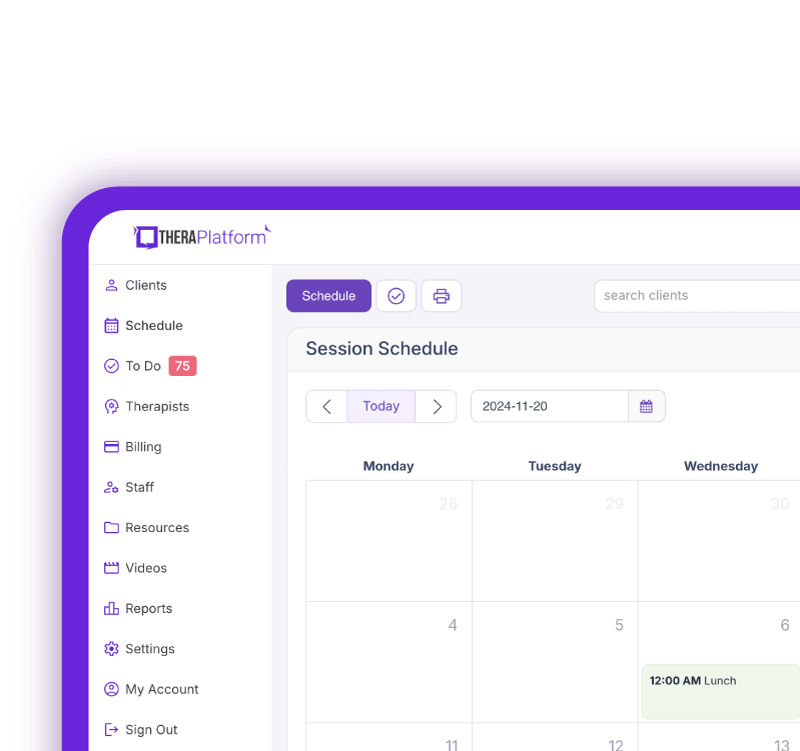
- Scheduling and documentation: When scheduling and documentation are connected, appointment information can automatically appear in the appropriate treatment note.
- Documentation and billing: Integrated billing features may allow information from completed notes to support charge entry and billing workflows, reducing the need to transfer information between systems.
- Client Intake and evaluations: Digital intake forms can make relevant client information available before the initial evaluation, helping therapists prepare for the session and reducing duplicate entry.
- Teletherapy and session notes: An EHR with integrated teletherapy can allow therapists to access treatment plans, review goals, and complete session documentation within the same platform.
Practice Management + EHR + Telehealth
Manage more in less time in your practice with TheraPlatform
Can an EHR eliminate documentation time?
Even with templates, automation, and AI-assisted tools, documentation still requires the therapist's clinical judgment. The goal is not to eliminate documentation, but to reduce the repetitive administrative workload, so therapists can spend more time focusing on client care.
Free Resources for Therapists
Click below and help yourself to peer-created resources:

How can OTs test whether an EHR saves documentation time?
Rather than evaluating features individually, test how long it takes to complete a realistic OT documentation task.
For example, use a fictional client scenario involving an adult working on upper-body dressing and fine motor coordination.
- Start a treatment note: Record how long it takes to locate the client chart and open the appropriate template.
- Review relevant information: Check how easily you can access established treatment goals and previous session findings.
- Document the session: Enter the skilled interventions, functional performance, assistance levels, and client response.
- Complete and review the note: If AI assistance is available, include the time required to review and correct its output.
- Finalize documentation: Count the additional steps needed to sign the note and complete related administrative tasks.
Compare the total time and number of steps with your current documentation process.
An EHR that improves efficiency should reduce unnecessary work without compromising accuracy, clinical reasoning, or individualized documentation.
For a broader software evaluation, see How to Evaluate Occupational Therapy Documentation Features.
Choosing an EHR that gives OTs more time for clinical care
An EHR should do more than provide a place to write and store treatment notes. It should support the different parts of the occupational therapy process, from intake and evaluation to treatment planning, progress monitoring, and billing.
Features such as customizable templates, integrated assessments, automated data entry, and AI-assisted documentation can help reduce the administrative work that often takes time away from clinical responsibilities.
Overall, an EHR that fits the needs of occupational therapists can make documentation more manageable while allowing clinicians to focus their time and attention on providing meaningful and individualized care.
Streamline your practice with One EHR
- Scheduling
- Flexible notes
- Template library
- Billing & payments
- Insurance claims
- Client portal
- Telehealth
- E-fax
Resources for occupational therapists
TheraPlatform is an all-in-one EHR, practice management, and teletherapy software built with AI-powered notes for therapists to help them save time on admin tasks. It offers a 30-day risk-free trial with no credit card required and supports different industries and sizes of practices, including occupational therapists in group and solo practices.
More resources
- Therapy resources and worksheets
- Therapy private practice courses
- Ultimate teletherapy ebook
- The Ultimate Insurance Billing Guide for Therapists
- The Ultimate Guide to Starting a Private Therapy Practice
- Insurance billing 101
- Practice management tools
Free video classes
- Free on-demand insurance billing for therapist course
- Free mini video lessons to enhance your private practice
- 9 Admin tasks to automate in your private practice
References
American Occupational Therapy Association. (2025). Ethical use of artificial intelligence (AI) (Policy E.19). https://www.aota.org/-/media/corporate/files/aboutaota/officialdocs/policies/e19-ethical-use-of-artificial-intelligence-ai-2025.pdf
Lee, S.-A., & Park, J.-H. (2025). Artificial intelligence in occupational therapy documentation: Chatbot vs. occupational therapists. DIGITAL HEALTH, 11. https://doi.org/10.1177/20552076251386657
FAQs about how an EHR can save occupational therapists time on documentation
How can an EHR reduce documentation time for occupational therapists?
An occupational therapy EHR can save time by automating repetitive data entry, providing customizable note templates, integrating assessments, and connecting treatment goals with documentation. These features help OTs complete notes more efficiently while maintaining accurate clinical records.
Can AI help occupational therapists complete documentation faster?
Yes. AI-assisted documentation tools can help OTs draft treatment notes, organize clinical observations, and summarize assessment findings. Therapists must still review and finalize all documentation to ensure clinical accuracy.
What should OTs look for in documentation software?
Occupational therapists should look for customizable templates, integrated assessments, goal tracking, AI-assisted documentation, and automated data entry. Software that connects documentation with scheduling and billing can also reduce administrative work.