
Essential EHR features for physical therapy practices

Committing to a physical therapy electronic health record (EHR) system can feel a lot like purchasing a car. You’ve got a lot of options, but narrowing down which one works best for you or your family takes a lot of thought.
A strong physical therapy EHR can significantly enhance the workflow and profitability of a physical therapy practice, but, given the number of choices available, it is important to consider what makes an EHR especially suited to physical therapy.
Summary
- Look for an EHR designed with physical therapy workflows in mind. PT practices have specific needs, including recurring appointments, detailed documentation, outcome tracking, billing and claims management, and, in some cases, teletherapy.
- Scheduling and documentation features can reduce administrative work. Recurring appointments, self-scheduling, automated reminders, customizable note templates, and AI-assisted documentation can help streamline everyday workflows.
- Integrated billing, teletherapy, and client portals keep more of the patient journey in one system. Useful capabilities include electronic claims, eligibility verification, ERA/EOB management, secure video, and patient self-service tools.
Streamline your practice with One EHR
- Scheduling
- Flexible notes
- Template library
- Billing & payments
- Insurance claims
- Client portal
- Telehealth
- E-fax

EHR vs EMR
EHR and EMR are sometimes used interchangeably, although EHR generally refers to a more comprehensive digital health record designed to support information sharing and broader clinical and practice-management workflows.
When comparing physical therapy software, focus less on the terminology and more on whether the system supports the clinical and administrative workflows your practice needs.
For example, while a small or single-provider practice may choose to use a physical therapy EMR for simplicity, a multi-provider or multisite physical therapy practice will be well-served by the expanded features offered by an EHR.
The remainder of this article will help clinicians understand the best physical therapy EHR features that will suit their practice.
EHRs for physical therapists
Practice management and EHR software exist for all types of health and medical practices. Some systems are built to work with many different types of providers, but in doing so, they may lack some of the features that optimize the system for one specific provider type.
Physical therapists, for example, often give detailed home exercise programs and appreciate a way to create and disseminate the program as well as track their clients' participation in their HEP. A dermatology practice, on the other hand, likely doesn’t need this type of feature.
When searching online for physical therapy EHR features, it is helpful to consider what makes a physical therapy practice unique from other practice types and look for EHR vendors that build their systems specifically for physical therapists.
This crucial first step will significantly narrow your search results and allow a more useful compare-and-contrast process based on your practice needs.
What should physical therapists look for in an EHR?
Physical therapists should look beyond general EHR features such as scheduling, billing, and note storage. A strong PT EHR should support the way physical therapists actually evaluate patients, establish a plan of care, measure change over multiple visits, document skilled intervention, manage insurance requirements, and demonstrate progress toward functional goals.
For example, PT documentation often requires much more than a narrative SOAP note. Therapists may need to record the range of motion, strength, gait, balance, functional mobility, special tests, standardized outcome measures, treatment interventions, assistance levels, and measurable goals—and then compare those findings over the course of an episode of care.
According to the American Physical Therapy Association (APTA), PT documentation should include appropriate tests and measures and compare current findings with previous findings to help demonstrate patient progress.
Billing workflows can also be more complex. Depending on the payer and services provided, PT practices may need to manage timed and untimed CPT codes, units, authorizations, visit limits, plan-of-care requirements, and progress or recertification deadlines.
When evaluating physical therapy EHR software, consider how well the system supports the entire PT episode of care, from intake and initial evaluation through treatment, progress reporting, and discharge.
Essential physical therapy EHR features
Feature | What PT practices should look for | Why it matters in physical therapy |
PT evaluations and documentation | Customizable PT evaluation, daily treatment, progress, recertification and discharge templates; specialty-specific templates for orthopedic, neurological, pediatric, vestibular, pelvic health and other PT services | PT documentation varies significantly by diagnosis, specialty and stage of care. Structured templates can reduce repetitive documentation while allowing therapists to capture clinically relevant findings |
Objective measurement tracking | Structured fields for ROM, strength, balance, gait, functional mobility, special tests and other measurable findings, with the ability to compare results over time | PTs frequently need to demonstrate measurable functional change rather than simply document symptoms or treatment provided |
Goals and plan-of-care tracking | Short- and long-term goals, baseline status, target measures, progress updates and plan-of-care dates | Keeps treatment tied to functional goals and makes progress reports and reassessments easier to complete |
Standardized outcome measures | Digital outcome measures, automatic scoring when available, previous-score comparison and visual progress tracking | Measures such as the LEFS, DASH/QuickDASH, Oswestry, Berg Balance Scale and other condition-specific tools can help quantify functional change over an episode of care |
Scheduling for recurring care | Recurring appointments, multiple visits per week, therapist and location availability, waitlists, self-scheduling or appointment requests, automated reminders and cancellation management | PT plans of care commonly involve repeated visits over several weeks or months, making efficient recurring scheduling particularly important |
Insurance authorization and visit tracking | Authorization dates, approved visits, visits used and remaining, expiration dates and alerts | Helps reduce the risk of providing treatment beyond an authorization or missing payer requirements |
PT billing and claims management | CPT codes, units, timed and untimed services, electronic claims, eligibility verification, ERA/EOB processing, claim tracking and denial management | PT billing often involves multiple services during a single visit and requires close coordination between documentation and charges |
Home exercise programs | Ability to create or share HEPs, provide instructions or videos, update exercises and document patient education | Home programs are frequently an important component of PT treatment and support carryover between visits |
Progress and discharge reporting | Easy comparison of evaluation findings, goals and outcome measures; progress-note and discharge workflows | Allows therapists to show what has changed since the evaluation and support decisions to continue, modify or discharge care |
Patient intake and digital forms | Medical history, injury information, body-region or condition-specific questionnaires, consent forms and patient-reported outcome measures that can flow into the chart | Reduces duplicate data entry and gives the therapist relevant information before the initial evaluation |
Integrated telehealth | Secure video, screen sharing, exercise demonstration and documentation within the same patient record | Supports virtual follow-up, exercise instruction and other appropriate PT services without requiring a separate system |
Patient portal and communication | Secure messaging, forms, scheduling, document sharing, questionnaires and HEP access | Gives patients a centralized way to participate in their care between visits |
Reporting and practice analytics | Therapist productivity, visits, cancellations, authorizations, claims, revenue and service-line reporting | Helps PT practice owners understand both clinical operations and financial performance |
Security and team access | HIPAA-compliant safeguards, role-based permissions, audit controls and secure communication | Protects patient information while allowing clinicians, front-office staff and billing teams appropriate access |
Which physical therapy EHR features are most helpful?
The most useful EHR features for a physical therapy practice are the ones that reduce work throughout the entire episode of care—not simply during documentation.
Scheduling
Physical therapy scheduling presents some challenges that are less pronounced in specialties where patients are seen only occasionally. A PT plan of care may involve two or three visits per week for several weeks, making recurring scheduling particularly important.
Helpful scheduling features include recurring appointments, therapist and location availability, appointment requests or self-scheduling, automated reminders, cancellation and rescheduling options, and waitlist management.
Practices offering telehealth should also consider whether appointment times and reminders automatically adjust to the patient's time zone.
PT documentation
Documentation is one of the most important areas to evaluate when choosing a physical therapy EHR.
PT documentation should support more than a generic SOAP note. Depending on the therapist's specialty, an initial evaluation may include:
- Range of motion
- Manual muscle testing or other strength measures
- Posture
- Gait
- Balance
- Functional mobility
- Neurological findings
- Palpation
- Joint mobility
- Special tests
- Standardized outcome measures
- Functional limitations
- Short- and long-term goals
A useful PT EHR should allow therapists to document these findings efficiently without forcing every patient into the same evaluation format.
Look for customizable templates that support initial evaluations, daily treatment notes, progress reports, reassessments, recertifications, and discharge summaries. Practices with multiple PT specialties may also benefit from templates designed for orthopedic, neurological, pediatric, vestibular, pelvic health, lymphedema or other areas of physical therapy.
Another consideration is whether information documented during the evaluation—such as goals, precautions, diagnoses or baseline measurements—can be carried forward appropriately into future notes instead of requiring therapists to repeatedly enter the same information.
AI-assisted documentation can further reduce the documentation burden. When comparing AI capabilities, PT practices should consider whether the technology understands rehabilitation documentation rather than simply generating a generic clinical note.
For example, useful AI tools may help organize information from a PT session into structured documentation, summarize relevant information before a visit, or transfer information collected during intake into appropriate evaluation fields. The clinician should still review and approve the documentation before it becomes part of the medical record.
APTA has also published guidance on AI-enabled ambient scribe technology in physical therapy documentation, including considerations related to documentation responsibilities, privacy, safety, and ethical use.
Goals, outcome measures, and progress tracking
Physical therapy is inherently measurement-driven. An EHR should make it easy to establish a baseline during the evaluation and determine whether the patient is progressing over time.
Look for the ability to document measurable goals and track objective findings such as ROM, strength, walking tolerance, balance, functional mobility or standardized outcome scores.
Ideally, therapists should be able to review previous measurements without searching through multiple old notes.
This becomes particularly useful when completing a progress report or discharge summary because the therapist can clearly compare:
Evaluation status → current status → goal status
rather than reconstructing the patient's progress manually.
Billing, CPT codes, and insurance requirements
Physical therapy billing can be more complex than simply attaching one service code to an appointment.
A single PT visit may include several interventions, such as therapeutic exercise, therapeutic activity, neuromuscular re-education or manual therapy. Some services are time-based, making accurate documentation of treatment time, units, and charges especially important.
A billing and claims system designed for PT practices should make it easy to connect the services documented during the visit with the corresponding charges.
Helpful capabilities may include:
- CPT code and unit entry
- Timed and untimed service tracking
- Electronic claim submission
- Eligibility verification
- ERA and EOB processing
- Claim status tracking
- Denial management
- Patient responsibility tracking
- Insurance authorization tracking
Practices should also consider whether the system can track authorized visits, visits used, and remaining visits, particularly when treating patients whose insurance plans limit the number of therapy visits.
Keeping clinical documentation, authorization information, and billing within the same system can reduce duplicate entry and make it easier for therapists, front-office staff, and billers to work from the same patient record.
Practice Management + EHR + Telehealth
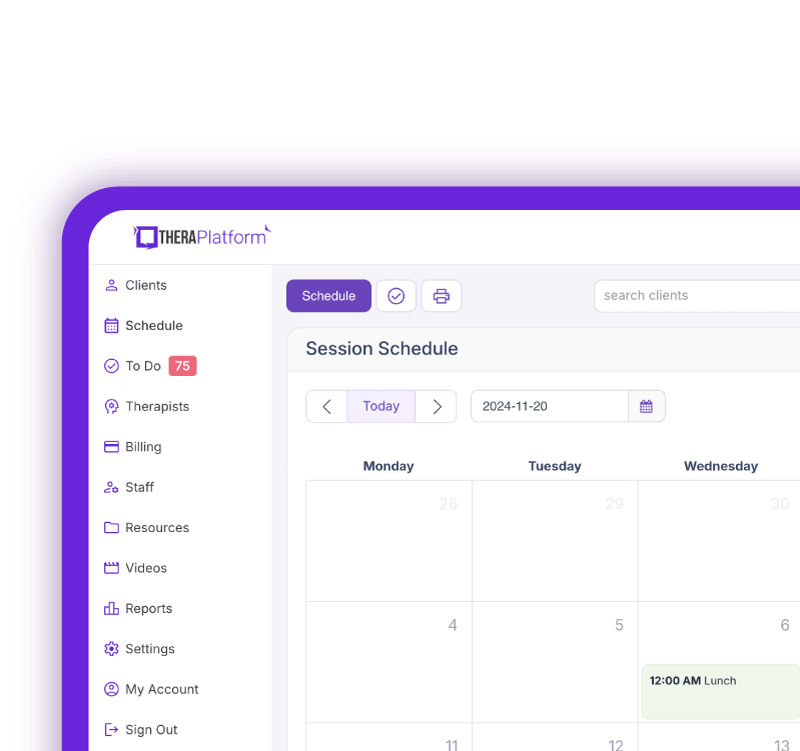
Manage more in less time in your practice with TheraPlatform
Practice management, reporting, and security features
Beyond clinical documentation and billing, physical therapy practices should also consider how well an EHR supports the operational side of the practice.
Reporting and analytics can help practice owners monitor areas such as clinician productivity, visit volume, cancellations, claims, revenue, and service performance. Customizable reports can make it easier to identify trends and make informed staffing, scheduling, and financial decisions.
Practices that depend heavily on referrals should also consider how the EHR handles referral information and associated documents. For insurance-based practices, visibility into authorization status, visits used and remaining, and other payer-related information can also help staff manage the patient episode of care more efficiently.
Security should be evaluated separately from convenience features. Ask vendors about HIPAA compliance and security measures, including encryption, role-based access controls, audit capabilities, data backups, and how patient information is protected.
Group and multidisciplinary practices may also benefit from secure internal communication tools that allow clinicians and staff to collaborate about patient care without exposing internal messages to patients.
When comparing systems, consider whether the EHR provides the operational visibility your practice needs today and whether it can continue to support additional clinicians, locations, or services as the practice grows.
Free Resources for Therapists
Click below and help yourself to peer-created resources:

Physical therapy EHR features that can scale with your practice
Implementing a new EHR can be a big task for practices and providers. Choosing the best physical therapy Electronic Health Records features for your practice means being able to grow while saving you time and money.
Questions to ask when comparing physical therapy EHRs
- Can PT documentation templates be customized?
- Can goals and outcome measures be tracked across visits?
- Does the system support recurring appointments?
- Can billing and claims be managed within the EHR?
- Can clients complete intake forms and questionnaires digitally?
- Does it support home exercise programs or integrate with HEP tools?
- Can I see progress visually over an episode of care?
- Does the system support solo and group PT practices?
- What features cost extra?
Streamline your practice with One EHR
- Scheduling
- Flexible notes
- Template library
- Billing & payments
- Insurance claims
- Client portal
- Telehealth
- E-fax
Resources for physical therapists
TheraPlatform is an all-in-one EHR, practice management, and teletherapy software with AI-powered notes built for therapists to help them save time on admin tasks. It offers a 30-day risk-free trial with no credit card required and supports different industries and sizes of practices, including physical therapists in group and solo practices.
More resources
- Therapy resources and worksheets
- Therapy private practice courses
- Ultimate teletherapy ebook
- The Ultimate Insurance Billing Guide for Therapists
- The Ultimate Guide to Starting a Private Therapy Practice
- Insurance billing 101
- Practice management tools
Free video classes
- Free on-demand insurance billing for therapist course
- Free mini video lessons to enhance your private practice
- 9 Admin tasks to automate in your private practice
FAQs about physical therapy EHR features
What EHR features are most important for physical therapists?
Key features include scheduling, customizable documentation, billing and claims management, client portals, outcome tracking, teletherapy, reporting and strong security measures.
Why should physical therapists consider a PT-focused EHR?
A PT-focused EHR is more likely to support workflows and tools specific to physical therapy rather than requiring clinicians to adapt a general medical system to their needs.
Can an EHR help physical therapists track patient outcomes?
Yes. Some EHRs can digitize, score and visually track outcome measures over time, helping therapists see progress and support decisions about the plan of care.