
Best physical therapy Electronic Health Records features

Committing to a physical therapy electronic health record (EHR) system can feel a lot like purchasing a car. You’ve got a lot of options, but narrowing down which one works best for you or your family takes a lot of thought.
A strong physical therapy EHR can significantly enhance the workflow and profitability of a physical therapy practice, but, given the number of choices available, it is important to consider what makes an EHR especially suited to physical therapy.
Summary
- Look for an EHR designed with physical therapy workflows in mind. PT practices have specific needs, including recurring appointments, detailed documentation, outcome tracking, billing and claims management, and, in some cases, teletherapy.
- Scheduling and documentation features can reduce administrative work. Recurring appointments, self-scheduling, automated reminders, customizable note templates, and AI-assisted documentation can help streamline everyday workflows.
- Integrated billing, teletherapy, and client portals keep more of the patient journey in one system. Useful capabilities include electronic claims, eligibility verification, ERA/EOB management, secure video, and patient self-service tools.
Streamline your practice with One EHR
- Scheduling
- Flexible notes
- Template library
- Billing & payments
- Insurance claims
- Client portal
- Telehealth
- E-fax

EHR vs EMR
An EMR (electronic medical record) is a digital version of a patient’s paper chart. It exists and is accessible only within your practice. An EHR, on the other hand, is a digitized version of a patient’s medical record that typically includes tests, notes, and records from other providers to create a more comprehensive picture of the patient’s health and healthcare.
It also includes other features like a patient portal and messaging systems to allow patients to communicate with their care team.
While a small or single-provider practice may choose to use a physical therapy EMR for simplicity, a multi-provider or multisite physical therapy practice will be well-served by the expanded features offered by an EHR.
The remainder of this article will help clinicians understand the best physical therapy EHR features that will suit their practice.
EHRs for physical therapists
Practice management and EHR software exist for all types of health and medical practices. Some systems are built to work with many different types of providers but in doing so, they may lack some of the features that optimize the system for one specific provider type.
Physical therapists, for example, often give detailed home exercise programs and appreciate a way to create and disseminate the program as well as track their patients' participation in their HEP. A dermatology practice, on the other hand, likely doesn’t need this type of feature.
When searching online for physical therapy EHR features, it is helpful to consider what makes a physical therapy practice unique from other practice types and look for EHR vendors that build their systems specifically for physical therapists.
This crucial first step will significantly narrow your search results and allow a more useful compare-and-contrast process based on your practice needs.
Physical therapy Electronic Health Records features
Feature | What to look for | Why it matters |
|---|---|---|
Scheduling | Recurring appointments, self-scheduling, reminders, cancellations and rescheduling | Saves staff time and can help reduce no-shows |
Documentation | Customizable evaluation, progress and treatment note templates; AI-assisted capabilities | Supports efficient, accurate documentation |
Billing and claims | Electronic claims, eligibility verification, ERA/EOB management, claims tracking and denial management | Keeps clinical and financial workflows connected |
Integrated teletherapy | Secure video, screen sharing, interactive tools and teletherapy documentation | Supports secure delivery of virtual PT services |
Client portal | Messaging, scheduling, forms, questionnaires and access to documents | Gives patients convenient self-service options |
Outcomes and assessments | Digital assessments, scoring, analysis and visual progress tracking | Helps clinicians monitor progress and support plans of care |
Reporting and analytics | Financial, productivity, claims and service reporting | Provides insight into practice performance |
Security and collaboration | HIPAA compliance, encryption, access controls and secure provider messaging | Helps protect patient information and support team communication |
Which physical therapy Electronic Health Records features are most helpful? Considering all the steps in the patient journey from referral management to discharge will help you identify EHR features that work best for physical therapists.
Let’s outline some helpful ones:
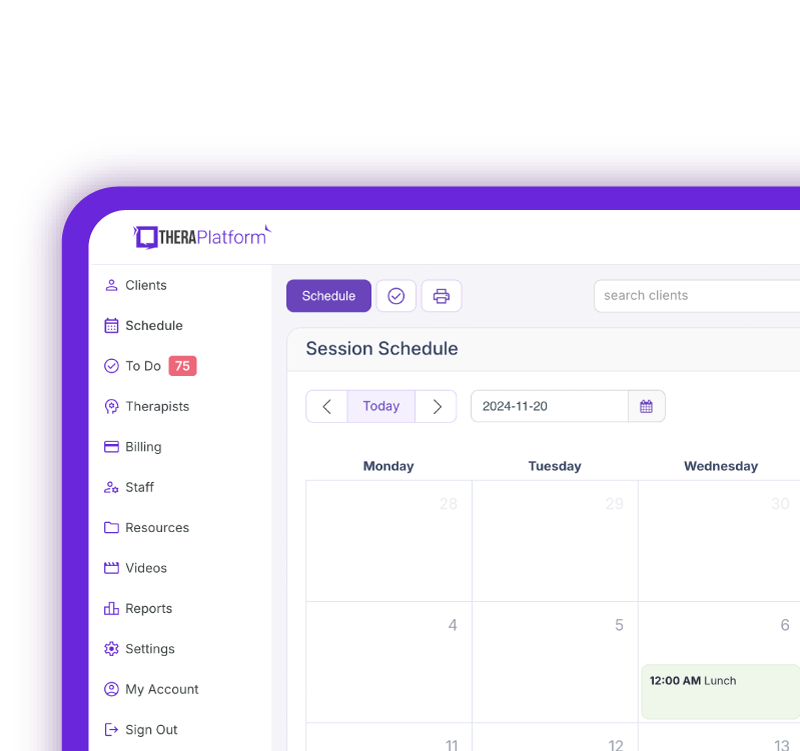
Scheduling: Helpful scheduling features can be a huge time-saver for therapists and admin staff and enhance the user experience for clients. A PT-focused EHR system should have the capacity to schedule multiple and repeating appointments. Self-scheduling or appointment requests through the patient portal can also save time for busy therapists and support staff.
Scheduling features should also include automatic appointment reminders, cancellation, and rescheduling options. These features help reduce no-shows and minimize workload for admin staff or therapists. Additionally, if your practice provides teletherapy, an often-forgotten feature is the ability to automatically set appointment times and reminders to the client’s time zone.
Documentation: A great physical therapy EHR feature for your practice is documentation. I tcan help meet legal standards, streamline documentation efficiency, and support timely and accurate reimbursement from payers.
Some examples of features to look out for include evaluation, progress, and treatment note templates. Ideally, these templates are customizable because even within the larger field of physical therapy, therapists both within and between niches and practice types can have very different documentation styles and elements.
AI-assisted documentation compatibility is also important to consider. Many health and medical practices are beginning to incorporate AI tools to reduce the burden of documentation while preserving accuracy. Even if you aren’t sure you are ready to use AI, an EHR system equipped with AI capabilities or compatibility will allow you access to them in the future.
Billing and claims management: Whether you handle billing and claims in-house or contract them out, you want to be able to track and manage claims and billing as part of your EHR system. Managing two incompatible software systems creates an extra and unnecessary step. A comprehensive physical therapy EHR system with practice management capabilities integrates all aspects of the patient journey under one umbrella.
Examples of helpful features to manage claims and billing include the ability to submit claims electronically, perform eligibility verification, manage ERAs and EOBs, track claims, and manage denials.
Practice Management + EHR + Telehealth
Manage more in less time in your practice with TheraPlatform
Integrated teletherapy capabilities: Many physical therapists are expanding their reach by offering teletherapy. Teletherapy must adhere to the same privacy and security standards that in-person therapy does, with an extra requirement of video security. This can pose a unique challenge for providers. The easiest way to tackle this problem is to use an EHR system that includes integrated teletherapy features such as secure video platforms, screen sharing capabilities, interactive tools, and teletherapy-specific documentation templates.
Client portals: A client portal is a great way to centralize many of the tools and documents that patients need to access. When patients can message staff and providers, see their schedules, request or cancel appointments, print out their own treatment notes and submit outcome measures, intake forms and questionnaires all in one place, time is saved.
No one is immune to the frustration and burden of playing phone tag and handling small tasks that patients would often prefer to handle at their own convenience. A client portal is a must-have.
Outcome and assessment tools: Digitizing outcome measures and assessment tools is a great way to minimize paper storage and keep track of patient progress. Even more helpful is when your physical therapy EHR system scores, analyzes, and visually tracks changes in these measures and assessments over time.
How helpful would it be to see a graph of changes on the patient’s Berg Balance Scale, Oswestry, or Patient Specific Functional Scale over the course of their care?
Seeing trends over time is helpful for therapists and patients and can be used to justify next steps in the plan of care to both patients and payers.
Free Resources for Therapists
Click below and help yourself to peer-created resources:

Other helpful physical therapy EHR features
On the back end, physical therapy practices should look for EHR features that allow for reporting and practice analytics, customizable financial reports, clinician productivity summaries, claims, and service reporting.
While these features may not seem like the most important parts of day-to-day PT practice, they play an essential role in financial success for the business. Automating them not only saves time but makes it more likely they will be considered in important practice decisions.
Whichever physical therapy EHR features or system you choose, be sure to ask about its security and HIPAA-compliance measures, access controls, and data encryption. Data privacy is more important than ever, and your EHR system should be taking this very seriously.
Finally, if you are a group practice, a secure messaging feature between providers, which is not viewable by patients, can be a helpful tool. This feature enhances patient care and collaboration between the same and different provider types.
Physical therapy Electronic Health Records features that grow with your practice
Implementing a new EHR can be a big task for practices and providers. Choosing the best physical therapy Electronic Health Records features for your practice means being able to grow while saving you time and money.
Streamline your practice with One EHR
- Scheduling
- Flexible notes
- Template library
- Billing & payments
- Insurance claims
- Client portal
- Telehealth
- E-fax
Resources for physical therapists
TheraPlatform is an all-in-one EHR, practice management, and teletherapy software with AI-powered notes built for therapists to help them save time on admin tasks. It offers a 30-day risk-free trial with no credit card required and supports different industries and sizes of practices, including physical therapists in group and solo practices.
More resources
- Therapy resources and worksheets
- Therapy private practice courses
- Ultimate teletherapy ebook
- The Ultimate Insurance Billing Guide for Therapists
- The Ultimate Guide to Starting a Private Therapy Practice
- Insurance billing 101
- Practice management tools
Free video classes
- Free on-demand insurance billing for therapist course
- Free mini video lessons to enhance your private practice
- 9 Admin tasks to automate in your private practice
FAQs about physical therapy EHR features
What EHR features are most important for physical therapists?
Key features include scheduling, customizable documentation, billing and claims management, client portals, outcome tracking, teletherapy, reporting and strong security measures.
Why should physical therapists consider a PT-focused EHR?
A PT-focused EHR is more likely to support workflows and tools specific to physical therapy rather than requiring clinicians to adapt a general medical system to their needs.
Can an EHR help physical therapists track patient outcomes?
Yes. Some EHRs can digitize, score and visually track outcome measures over time, helping therapists see progress and support decisions about the plan of care.