
Essential features of a speech therapy EHR

A speech therapy EHR can help speech-language pathologists (SLPs) manage documentation, scheduling, progress monitoring, billing, caregiver communication, and insurance requirements alongside direct patient care.
A study by the American Speech-Language-Hearing Association (ASHA) showed that an SLP’s perception of this workload manageability is the most significant predictor of their stress and burnout levels, underscoring the importance of systems that support efficient clinical and administrative workflows.
Summary
- The right EHR should match an SLP’s workflow. Features such as recurring scheduling, speech therapy documentation templates, goal tracking, assessment tools, and teletherapy can better support the way SLPs deliver care.
- Automation can reduce repetitive administrative work. Digital intake, automated reminders, documentation templates, and integrated billing can help SLPs spend less time on manual tasks.
- Integrated tools can keep clinical and administrative work connected. Bringing documentation, billing, teletherapy, client communication, and progress tracking into one system can reduce the need to move between separate platforms.
- Consider future needs as well as current ones. Solo SLPs may prioritize simplicity, while growing practices may need multiple-provider scheduling, reporting, permissions, and multidisciplinary support.
Streamline your practice with One EHR
- Scheduling
- Flexible notes
- Template library
- Billing & payments
- Insurance claims
- Client portal
- Telehealth
- E-fax

Using an EHR that has features specifically designed for SLPs can bring many of a therapist’s tasks together, supporting efficient practice management and high-quality client care.
What is a speech therapy EHR?
A speech therapy EHR, sometimes also referred to as a speech therapy EMR, is a specialized software platform designed specifically to manage clinical and administrative information associated with speech-language pathology services. Depending on the specific system, an EHR may manage clinical documentation, scheduling, billing, teletherapy, and client communication.
EHR features for SLP-focused practices differ from general practice software. General medical EHRs may not always reflect the recurring appointments, longitudinal goal tracking, and other workflows common in speech therapy.
On the other hand, EHR features for speech therapists may be built around recurring appointments, individualized goals, data collection over time, standardized assessments, progress reports, and long-term plans of care. This can make it easier for SLPs to manage these workflows.
Essential EHR features for speech therapy practices
EHR feature | What to look for | How it can help SLPs |
|---|---|---|
Scheduling | Recurring appointments, reminders, easy rescheduling, time-zone support | Reduces repetitive phone tag and email and helps manage ongoing therapy |
Documentation | SLP-specific and customizable templates, treatment plans, AI-assisted documentation | Streamlines notes and connects documentation with treatment goals |
Insurance Billing | Electronic claims, eligibility verification, ERA/EOB management, claim tracking | Reduces manual billing work and helps practices manage reimbursement |
Non-insurance billing | Electronic invoices, credit card processing, stored payment methods, receipts, payment reminders | Simplifies private-pay billing and helps practices collect and track client payments |
Teletherapy | HIPAA-compliant video, screen sharing, interactive tools | Keeps virtual care and clinical workflows in one platform |
Client portal | Digital forms, secure messaging, document sharing | Simplifies intake and communication with clients and families |
Assessments and outcomes | Digital assessments, goal tracking, progress monitoring, data collection | Helps connect session-level data with broader treatment outcomes |
Reporting | Financial, productivity, claims and service reports | Provides greater visibility into practice performance |
Security | Access controls, encryption, activity logs | Helps safeguard PHI and support HIPAA compliance |
Scheduling and automated reminders
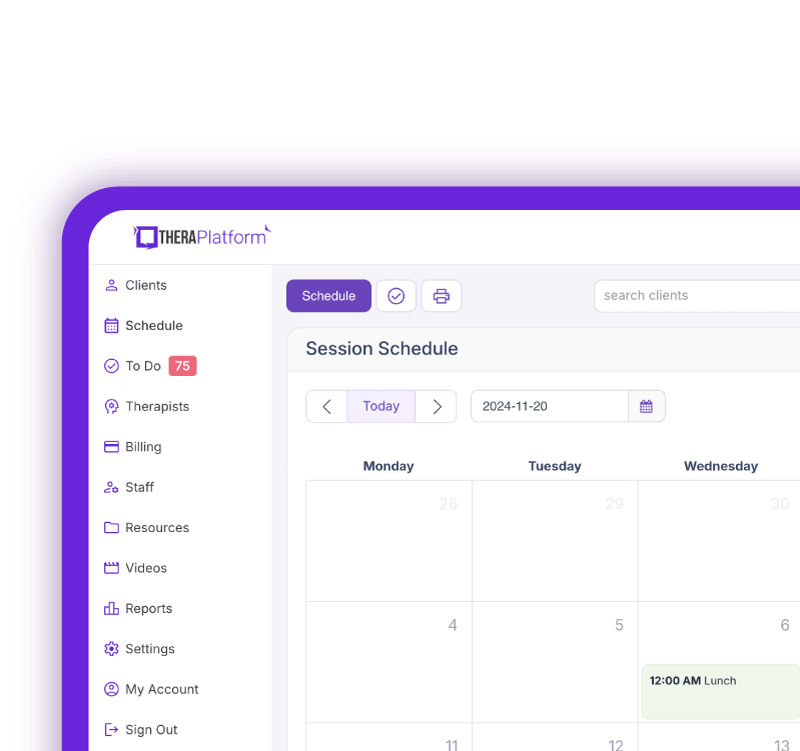
Recurring appointments: Clients often attend speech therapy weekly over an extended period. SLPs can use recurring scheduling to establish a treatment schedule without having to manually add new appointments after each visit.
Cancellations and rescheduling: Automated appointment reminders via email and text can reduce no-show rates. With a simplified cancellation system, clients have the ability to easily reschedule an appointment. Open spots can be quickly refilled through automated waitlist notifications.
Client time zones for teletherapy: SLPs providing teletherapy across different states avoid confusion by using dynamic scheduling tools that automatically display the client’s local time zone for sessions.
Practice Management + EHR + Telehealth
Manage more in less time in your practice with TheraPlatform
Speech therapy documentation
Therapy-specific documentation tools are among the most important EHR features for SLPs. According to ASHA, “Documentation is a critical vehicle for conveying essential clinical information.”
Evaluation and treatment note templates: Templates designed for speech therapy can help clinicians document areas such as receptive and expressive language, articulation and phonology, fluency, voice, AAC, cognition, feeding and swallowing, and functional communication more consistently.
Customizable templates: Documentation needs can vary considerably between an AAC evaluation, articulation treatment, language intervention, fluency therapy, feeding treatment, and other SLP services. Customizable templates allow practices to adapt documentation to the population, setting, and type of care provided.
Treatment plans, goals, and progress notes: SLPs often track multiple short- and long-term goals over time. Goal-tracking tools can help connect session-level data, cueing or assistance levels, accuracy or performance measures, and progress toward the treatment plan.
AI-assisted documentation: When used appropriately, AI-assisted documentation can help organize session information or generate draft notes for clinician review. This may be particularly useful for recurring treatment visits where clinicians document goal performance, interventions, response to treatment, and progress over time.
Speech therapy insurance billing and claims management
Electronic claims: Electronic claim generation and submission save time on manual data entry and support more efficient claims submission.
Eligibility verification: Check clients’ coverage in real time before therapy begins to help identify potential coverage issues and reduce unexpected claim denials.
ERA/EOB management: Electronic remittance advice (ERA) or explanation of benefits (EOB) tools can help practices reconcile insurance payments with client accounts and claims.
Claim tracking and denial management: These tools help practices identify rejected or unpaid claims, easily determine what corrections or follow-up is needed, and prevent duplicate data entry.
Non-insurance billing for SLP practices
For private-pay services, an EHR can also simplify billing without involving insurance. Features such as electronic invoices, integrated credit card processing, stored payment methods, receipts, and automated payment reminders can make it easier to collect and track client payments.
For practices that accept both insurance and private pay, keeping these payment workflows within the same system can also reduce administrative work.
Integrated teletherapy for speech therapy
Secure video: HIPAA-compliant, high-definition video connections eliminate the need for third-party video subscriptions.
Screen sharing and interactive tools: SLPs can keep both pediatric and adult clients actively engaged in teletherapy sessions with shared screen permissions, built-in digital whiteboards, and interactive therapy apps.
Teletherapy documentation: Integrated systems let clinicians continue to view client video feed while documenting session notes side-by-side.
Free Resources for Therapists
Click below and help yourself to peer-created resources:

Speech therapy client portal and digital intake
Online forms: Digital intake can allow clients and caregivers to complete consent forms, medical and developmental histories, communication concerns, prior evaluation information, and other intake documents before the initial evaluation.
Secure messaging: Secure messaging can support communication with clients and caregivers between visits, including questions about progress, carryover strategies, home practice, or changes in communication needs.
Document sharing: A secure client portal can give SLPs a way to share evaluation reports, progress reports, PDFs, worksheets, home practice activities, communication strategies, AAC-related materials, and other clinical documents with clients and families.
Outcome and assessment tools for SLPs
Digital assessments: Some EHRs build standardized informal screeners and rating scales directly into the client’s chart. Clinicians can use digital assessment tools to administer and score assessments electronically, then document results within the client’s EHR.
Progress tracking: Speech therapy is highly data-driven, and EHR features for SLPs that support data collection, goal tracking, digital assessments, and progress monitoring are helpful. These tools help SLPs connect individual sessions to broader treatment outcomes.
Data collection: Clinicians can benefit from tools like built-in trial counters to log correct versus incorrect productions during sessions in real time.
Speech therapy reporting and practice analytics
Financial reports: With practice analytics, information already stored in an EHR can be transformed into useful reports. Financial reports give insight into revenue and outstanding payments.
Clinician productivity: Productivity reports help monitor completed visits, cancellation rates, and total billable units across clinical staff schedules.
Claims and service reporting: Track reimbursement rates by payer and identify common rejection codes to support the financial health of your practice.
Security and HIPAA compliance for speech therapy
Access controls: Protecting client Protected Health Information (PHI) is critical. With role-based permissions, clinicians, administrative staff, and billing specialists are restricted to accessing only the data that is necessary for their roles.
Data encryption: To comply with HIPAA regulations, security should be built into the EHR platform with end-to-end encryption for data both in transit and at rest.
Audit/security considerations: Track who accessed, updated, or exported client records with detailed activity logs to provide peace of mind during compliance audits.
EHR features for solo SLPs vs. group practices
A solo practitioner may need one simple system that offers scheduling, documentation, billing, and teletherapy.
Expanding practices, however, may prioritize additional EHR features for speech therapy group practices, such as multiple provider calendars, clinician productivity reports, role-based permissions, and support for multidisciplinary teams (including SLPs, OTs, PTs, and behavioral health providers).
Starting with an EHR that accommodates the needs of both individual and team workflows can eliminate the need to change systems as a practice grows.
Which EHR features can save SLPs the most time?
Features that often provide the greatest time savings are those that reduce repetitive administrative work. This includes:
Templates to streamline documentation: SLP-specific templates, integrated goal tracking, and auto-populated active goals can reduce repetitive entry when clinicians complete treatment notes, progress reports, and other documentation.
AI-assisted documentation and assessments: AI tools can help organize session information and generate draft treatment or progress notes for clinician review. Some systems, such as TheraPlatform, can also use information collected through digital intake forms to help populate relevant assessment fields, reducing duplicate data entry during evaluations.
Digital intake processing: Online history forms, consent forms, and other intake documents can flow directly into the client record, while electronic signatures reduce paper-based administrative work.
Automated scheduling: Recurring appointments, automated confirmations, reminders, and rescheduling tools can reduce repetitive scheduling tasks and staff follow-up.
Automated billing: Automated invoicing, payment reminders, superbills, payment processing, and balance tracking can reduce manual billing work and help practices stay on top of client balances.
Automated insurance workflows: Electronic claim submission, eligibility verification, ERA processing, claim tracking, and authorization management can reduce the amount of manual work required for insurance-based speech therapy practices.
Questions to ask when comparing EHR features for speech therapy
Key questions SLPs should ask when considering an EHR system include:
- How well does the system fit my everyday clinical workflow?
- Can documentation templates be customized?
- Do goals and data carry across sessions?
- Are recurring appointments easy to manage?
- Can billing and claims be integrated?
- Is a HIPAA-compliant teletherapy platform built in?
- Can families securely complete forms and communicate with the practice?
- Does the system support speech therapy assessments, data collection, and goal tracking?
Choosing EHR features for speech therapy practices that can scale as you grow
When considering the future of their practices, clinicians should also consider whether the platform would be able to accommodate additional clinicians, locations, or disciplines if their needs change over time.
A useful EHR for speech therapists is much more than a place to store records. The right system should adapt as your clinical needs change. Although a solo practitioner might start as only accepting private pay, they may want to expand to insurance billing in the future.
The right EHR features for a speech therapy practice can streamline your workflow so you can focus on what matters most - delivering high-quality care to clients. With tools like automated scheduling, specialized documentation templates, and built-in billing, an EHR designed for therapists can support practices now and as they grow.
Streamline your practice with One EHR
- Scheduling
- Flexible notes
- Template library
- Billing & payments
- Insurance claims
- Client portal
- Telehealth
- E-fax
Resources for speech therapists
TheraPlatform is an all-in-one EHR, practice management, and teletherapy software with AI-powered notes built for therapists to help them save time on admin tasks. It offers a 30-day risk-free trial with no credit card required and supports different industries and sizes of practices, including speech-language pathologists in group and solo practices.
More resources
- Therapy resources and worksheets
- Therapy private practice courses
- Ultimate teletherapy ebook
- The Ultimate Insurance Billing Guide for Therapists
- The Ultimate Guide to Starting a Private Therapy Practice
- Insurance billing 101
- Practice management tools
Free video classes
- Free on-demand insurance billing for therapist course
- Free mini video lessons to enhance your private practice
- 9 Admin tasks to automate in your private practice
References
Marante, L., Hall-Mills, S., & Farquharson, K. (2023). School-based speech-language pathologists' stress and burnout: A cross-sectional survey at the height of the COVID-19 pandemic. Language, Speech, and Hearing Services in Schools, 54(2), 456-471. DOI: https://doi.org/10.1044/2022_LSHSS-22-000
Waken, R. J., Lou, S. S., Hofford, M., Eiden, E., Burk, C., Kim, S., ... & Kannampallil, T. (2026). Longitudinal effects of ambient AI scribe use on documentation burden and financial productivity: A quasi-experimental study. medRxiv, 2026-01. https://www.medrxiv.org/content/10.64898/2026.01.12.26343538v4
Odeh, A., Abdelfattah, E., & Salameh, W. (2024). Privacy-preserving data sharing in telehealth services. Applied Sciences, 14(23), 10808. DOI: https://doi.org/10.3390/app142310808
FAQs about the essential EHR features for a speech therapy practice
What features should SLPs look for in an EHR?
Look for speech therapy documentation, recurring scheduling, billing and claims management, teletherapy, digital intake, progress tracking, reporting and HIPAA-compliant security features.
How can an EHR save speech therapists time?
Features such as documentation templates, digital intake, recurring scheduling and automated reminders can reduce repetitive administrative tasks.
Can the same EHR work for solo SLPs and group practices?
Yes. Look for a system that can support individual workflows now while accommodating additional clinicians, locations or disciplines as the practice grows.