G31.84 ICD-10 code for speech language pathologists

G31.84, the ICD-10-CM code for Mild Cognitive Impairment, is used when working with adults with cognitive-communication difficulties that affect attention, memory, executive functioning, and daily communication.
Knowing how to appropriately use G31.84 when documenting and billing speech therapy sessions is essential for SLPs treating cognitive-communication disorders. This guide explains all the need-to-know details surrounding using this code when treating mild cognitive impairment in your clinical practice.
Summary
- G31.84 defines Mild Cognitive Impairment (MCI) and is commonly used when SLPs treat cognitive-communication deficits affecting memory, attention, and executive functioning.
- SLPs do not diagnose MCI, but they play a key role in assessing and treating functional communication challenges tied to the condition.
- Strong documentation is essential—clinicians must clearly demonstrate functional impact and medical necessity to avoid claim denials. Using an EHR like TheraPlatform can significantly streamline tasks like automated invoicing, claim creation, and payment tracking, documentation, scheduling, and client communication.
- Accurate billing requires pairing G31.84 with appropriate CPT codes (e.g., 97129, 97130, G0515) and following payer-specific guidelines. Enrolling in an insurance billing course for therapists can help providers enhance their knowledge.
→ Enroll in My Free, On-Demand Insurance Billing for Therapists Course
What is ICD-10 Code G31.84?
G31.84 is the ICD-10-CM diagnostic code that is used to classify Mild Cognitive Impairment (MCI). In order to use this code appropriately, therapists must first understand what MCI is.
MCI refers to a measurable decline in cognitive abilities that is greater than what would be expected for normal aging, but does not interfere significantly with daily independence.
Streamline your insurance billing with One EHR
- Claim batching
- Auto claims
- Automated EOB & ERA
- Real-time claim validation
- Real-time claim tracking
- Aging and other reports

MCI is associated with noticeable difficulties in areas such as:
- Attention
- Memory
- Problem solving
- Language
- Executive functioning
MCI vs. Dementia
The changes associated with MCI do not typically meet the criteria for dementia, in which cognitive impairments have a significant disruption on the individual’s daily independent functioning. Dementia is associated with a moderate to severe decline in cognitive skills, compared to a mild decline seen in those with MCI.
MCI vs. normal aging
Some cognitive changes are typical with normal aging. Older adults may take longer to recall names, or misplace items here and there. However, individuals with MCI consistently show measurable deficits on cognitive testing. They often have notable functional challenges performing activities independently.
Who can diagnose G31.84?
A diagnosis of G31.84 Mild Cognitive Impairment is typically made by a neurologist, primary care physician, geriatrician, or neuropsychologist. While SLPs do not diagnose MCI, they may conduct cognitive-communication assessments and treat the deficits associated with MCI.
Practice Management + EHR + Telehealth
Manage more in less time in your practice with TheraPlatform
How G31.84 applies to speech-language pathology
Individuals with MCI frequently experience cognitive-communication deficits that fall within the scope of speech-language pathology.
Cognitive-communication areas impacted
Areas commonly addressed by SLPs include:
- Attention: Reduced ability to focus(sustained attention) or divide attention between multiple tasks.
- Working and short-term memory: Difficulty retaining new information.
- Executive functioning: Struggles with planning, organizing, and problem-solving.
- Language: Mild word-finding difficulties, trouble with processing, and engaging in complex conversations.
These challenges may affect the individual’s ability to participate in everyday tasks like following conversations, managing appointments, completing work tasks, or organizing personal responsibilities.
Functional challenges addressed in therapy
Speech therapy for individuals with Mild Cognitive Impairment often focuses on functional outcomes, for example:
- Improving organization of daily routines
- Use of external memory supports (reminder apps, calendars, sticky notes)
- Enhancing problem-solving strategies
- Developing compensatory strategies for cognitive challenges
- Enhancing conversation skills
Therapy goals are typically compensatory and preventative, focusing on helping individuals maintain their independence and delaying functional cognitive decline.
SLP scope of practice
It’s important to remember that SLPs do not diagnose the underlying ICD-10 G31.84 (Mild Cognitive Impairment). SLPs do, however, diagnose and treat the cognitive-communication deficit that may result from the neurological impairment.
Free Resources for Therapists
Click below and help yourself to peer-created resources:

Documentation tips for G31.84
Thorough, effective documentation is crucial when treating individuals with MCI because payer scrutiny can be high. SLPs must clearly document functional impact and medical necessity, as cognitive impairments can appear subtle.
Emphasize functional impact
Documentation should reflect the real-world limitations that result from the individual’s cognitive deficits, such as:
- Missed appointments as a result of memory impairment
- Difficulty managing medications
- Reduced ability to complete work tasks or participate in conversations
- Challenges with following multi-step instructions
- Emphasizing functional impacts like these can help justify therapy services to payers.
Tie goals to independence and participation
Rather than isolated cognitive drills, goals should show insurance providers that therapy is reflecting priorities like preventing decline, ensuring safety, or maintaining independence.
Therapy goals may focus on helping the individual establish reliable compensatory strategies (e.g., use of digital reminder systems, calendars, and organizing weekly schedules).
SOAP note considerations
Structure cognitive-communication documentation by using the SOAP note format:
Subjective (S): Include the client or caregiver’s report of everyday difficulties (e.g., Client reports she forgot about 3 doctor’s appointments last month.)
Objective (O): Report concrete data on the client’s accuracy when using compensatory strategies (e.g., Client recalled 2/5 names of items after a 15-minute delay at baseline. This improved to 5/5 items when using a written note-taking strategy). Note standardized test scores when applicable.
Assessment (A): Using clinical reasoning, connect the objective data to the functional impact. Emphasize the need for skilled therapy intervention (e.g., to increase independence, rather than having a caregiver reminding them).
For example, Client demonstrates a mild memory impairment, which impacts her ability to recall daily appointments. She responds well to external memory supports such as written reminders and digital alarms.
Plan (P): Continue outlining a targeted therapy plan with cognitive strategies that target cognitive skills such as memory and task organization. Modify goals as the client progresses.
Billing speech therapy with G31.84
Accurate billing is essential for reimbursement of specialized therapy services. Although G31.84 acts as the client’s primary medical diagnosis, it must be paired with the correct speech-language treatment diagnoses and their corresponding procedural codes.
Common SLP CPT codes billed alongside G31.84 | Description |
|---|---|
Evaluation of speech, language, voice, communication, and auditory processing | |
Standardized cognitive performance testing (per hour); Used for the initial comprehensive evaluation | |
97127 | Cognitive therapeutic intervention, per day (often used by commercial payers). |
G0515 | Cognitive skills development (often required by Medicare Part B instead of 97127; always check the current CMS fees schedule and guidelines) |
Cognitive function intervention, initial 15 minutes | |
97130 | Each additional 15 minutes of cognitive therapy |
Treatment of speech, language, voice, communication, and/or auditory processing disorder (used if the MCI primarily affects language/communication skills, such as word-finding abilities). |
Importance of payer-specific policies
Coverage for cognitive therapy is notoriously variable between payers. Clinicians should review:
- Private insurance requirements
- Current Medicare policies
- Documentation requirements and expectations
- Coverage rules for telehealth
SLPs can reduce the risk of claim denials by ensuring the diagnosis code aligns with payer requirements.
Common mistakes to avoid
To prevent claim denials and ensure clients receive the treatment they need, avoid these common documentation pitfalls when working with the G31.84 diagnosis code:
Insufficient functional documentation: Don’t just describe test scores or cognitive exercises. To demonstrate medical necessity, clearly describe how cognitive deficits affect the client’s daily life.
Confusing MCI with dementia codes: Using incorrect ICD-10 codes can lead to billing inaccuracies, documentation conflicts, and denials. MCI should not be coded as dementia unless the client meets the diagnostic criteria for dementia.
Weak objective data or unclear goals: Avoid vague goals like, “Client will improve memory.” Objective data should include measurable outcomes, including accuracy percentages, cueing level required, and performance across sessions. Clear data helps track the client’s progress over time and can support the need for continued therapy.
Telehealth and G31.84
When telehealth is appropriate
Telepractice is an appropriate option for individuals with MCI who can follow directions with minimal support and have reliable internet access. This can be a convenient service delivery model for clients who could benefit from generalizing therapy strategies in their home environment (i.e., during real-life tasks like using digital calendars).
Documentation and coverage considerations
Clinicians should confirm payer coverage for telehealth. The telehealth platform, client location, and consent (as required) should be documented. The correct Place of Service (POS) codes and any required telehealth modifiers (such as modifier 95) must be included in documentation. Using a secure, HIPAA-compliant platform can help support both efficient documentation and compliance.
Practice Management + EHR + Telehealth
Manage more in less time in your practice with TheraPlatform
How EHR and practice management software can save you time with insurance billing for therapists
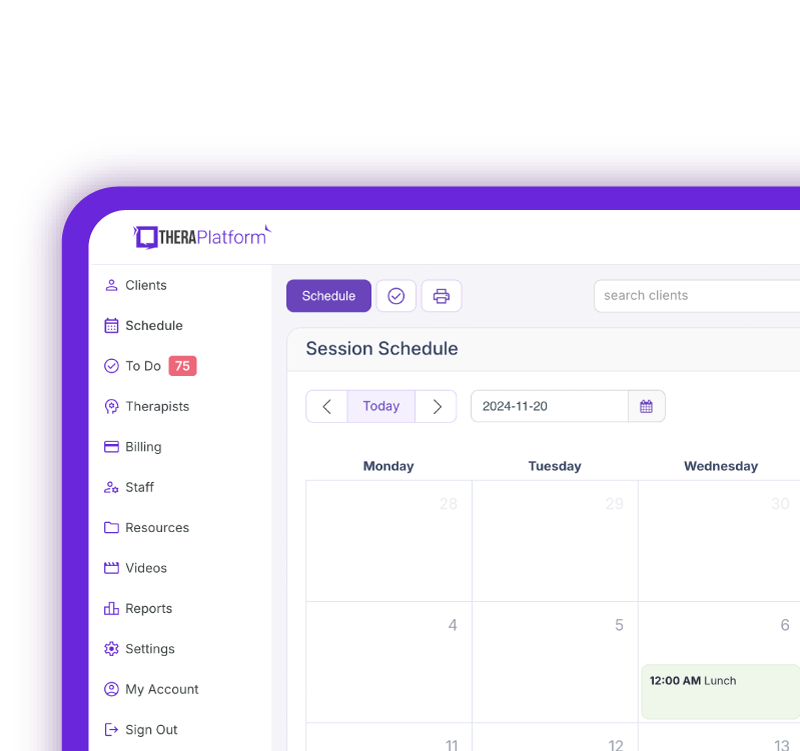
EHRs with integrated billing software and clearing houses, such as TheraPlatform, offer therapists significant advantages in creating an efficient insurance billing process. The key is minimizing the amount of time dedicated to developing, sending, and tracking medical claims through features such as automation and batching.
Watch this video to see how TheraPlatform’s EHR saves time on insurance billing
What are automation and batching?
- Automation refers to setting up software to perform tasks with limited human interaction.
- Batching or performing administrative tasks in blocks of time at once allows you to perform a task from a single entry point with less clicking.
Which billing and medical claim tasks can be automated and batched through billing software?
- Invoices: Create multiple invoices for multiple clients with a click or two of a button or set up auto-invoice creation, and the software will automatically create invoices for you at the preferred time. You can even have the system automatically send invoices to your clients.
- Credit card processing: Charge multiple clients with a click of a button or set up auto credit card billing, and the billing software will automatically charge the card (easier than swiping!)
- Email payment reminders: Never manually send another reminder email for payment again, or skip this altogether by enabling auto credit card charges.
- Automated claim creation and submission: Batch multiple claims with one button click or turn auto claim creation and submission on.
- Live claim validation: The system reviews each claim to catch any human errors before submission, saving you time and reducing rejected claims.
- Automated payment posting: Streamline posting procedures for paid medical claims with ERA. When insurance offers ERA, all their payments will post automatically on TheraPlatform's EHR.
- Tracking: Track payment and profits, including aging invoices, overdue invoices, transactions, billed services, service providers
Utilizing billing software integrated with an EHR and practice management software can make storing and sharing billing and insurance easy and save providers time when it comes to insurance billing for therapists.
Streamline your practice with One EHR
- Scheduling
- Flexible notes
- Template library
- Billing & payments
- Insurance claims
- Client portal
- Telehealth
- E-fax
Resources for speech therapists
TheraPlatform is an all-in-one EHR, practice management, and teletherapy software with AI-powered notes built for therapists to help them save time on admin tasks. It offers a 30-day risk-free trial with no credit card required and supports different industries and sizes of practices, including speech-language pathologists in group and solo practices.
More resources
- Therapy resources and worksheets
- Therapy private practice courses
- Ultimate teletherapy ebook
- The Ultimate Insurance Billing Guide for Therapists
- The Ultimate Guide to Starting a Private Therapy Practice
- Insurance billing 101
- Practice management tools
Free video classes
- Free on-demand insurance billing for therapist course
- Free mini video lessons to enhance your private practice
- 9 Admin tasks to automate in your private practice
References
Corbo, I., & Casagrande, M. (2022). Higher-level executive functions in healthy elderly and mild cognitive impairment: a systematic review. Journal of clinical medicine, 11(5), 1204. https://www.mdpi.com/2077-0383/11/5/1204
Dörr, F., Holle, D., Morouj, B., Obermüller, D., Sommer, S., Wübbeler, M., & Bilda, K. (2025). Speech-language therapy and occupational therapy for patients with mild cognitive impairment and dementia: a retrospective cohort study using German health claims data. BMC Health Services Research, 25(1), 1026. https://link.springer.com/article/10.1186/s12913-025-13149-y
Lanzi, A. M., Saylor, A. K., & Cohen, M. L. (2022). Survey results of speech-language pathologists working with cognitive-communication disorders: Improving practices for mild cognitive impairment and early-stage dementia from Alzheimer's disease. American Journal of Speech-Language Pathology, 31(4), 1653-1671. https://doi.org/10.1044/2022_AJSLP-21-00266
FAQs about the G31.84 ICD 10 code for speech-language pathologists
Can SLPs diagnose ICD-10 code G31.84?
No. G31.84 is diagnosed by physicians or qualified specialists, but SLPs can evaluate and treat the resulting cognitive-communication impairments.
What CPT codes are commonly used with G31.84?
Common codes include 97129/97130 (cognitive therapy), G0515 (Medicare), 96125 (cognitive testing), and 92507 (speech-language treatment when applicable).
What should documentation include for G31.84?
Documentation should highlight functional limitations, measurable progress, use of compensatory strategies, and clear links to daily independence and safety.