
Autism ICD 10

The Autism ICD 10 code, F84.0, is used for the diagnosis and billing of Autism Spectrum Disorder (ASD), a developmental disability caused by brain differences.
Proper diagnosis and classification of autism spectrum disorders using the Autism ICD 10 code are critical for medical documentation, therapeutic interventions, and insurance claims and reimbursement purposes.
Accurate identification also ensures that clients receive appropriate support tailored to their unique needs, promoting better long-term outcomes.
A well-documented diagnosis can also facilitate access to specialized educational and community resources.
Summary
- Autism Spectrum Disorder (ASD) is primarily coded as F84.0, with related conditions like Asperger's syndrome (F84.5) and PDD-NOS (F84.9) also included for diagnostic specificity. Accurate coding supports insurance reimbursement and treatment planning.
- A diagnosis of ASD requires persistent social communication deficits and restricted, repetitive behaviors, with symptoms typically evident in early development.
- Therapists must ensure detailed, accurate documentation—including standardized assessments, SMART goals, and clinical reasoning—to justify therapy and support reimbursement. Enrolling in an insurance billing course for therapists can help providers enhance their knowledge.
- Therapists typically face hurdles like insurance limitations, the use of outdated or incorrect codes, and claim denials, making ongoing education and careful documentation essential for compliance and care delivery.
- By leveraging an EHR like TheraPlatform for efficient documentation and claim submission, therapists can maintain accurate records.
→ Click here to enroll in our free on-demand Insurance Billing for Therapists video course [Enroll Now]
What is Autism Spectrum Disorder?
Autism Spectrum Disorder is a developmental and neurological disorder that affects how people interact with others, communicate, learn, and behave. Symptoms generally appear in the first two years of life although diagnosis can occur at any age.
Autism is unique in that each individual experiences it differently, with varying strengths, challenges, and support needs. Some people with autism can speak, while some autistic individuals are nonverbal or minimally verbal and communicate in other ways. Some may demonstrate intellectual disabilities, while others do not.
Streamline your insurance billing with One EHR
- Claim batching
- Auto claims
- Automated EOB & ERA
- Real-time claim validation
- Real-time claim tracking
- Aging and other reports

Key symptoms and diagnostic criteria
The American Psychiatric Association's Diagnostic and Statistical Manual 5th Edition (DSM-5) is a guideline that provides standardized criteria to diagnose ASD. "To meet diagnostic criteria for ASD according to DSM-5, a child must have persistent deficits in each of three areas of social communication and interaction plus at least two of four types of restricted, repetitive behaviors."
Deficits in social communication and interaction
- Difficulties with reciprocal social interaction, social-emotional reciprocity, maintaining conversation, and understanding non-verbal cues
- Challenges with non-verbal communication, lack of facial expressions
- Challenges with relationships, specifically developing, maintaining, and understanding relationships. Examples include making friends, sharing in play
Restricted, repetitive patterns of behavior, interests or activities
- Stereotyped movements, such as lining up toys, or speech, such as echolalia
- Inability to be flexible with routines. Extreme distress in small changes, rigid thinking, or rigid eating patterns
- Hyperfixation on unusual objects
- Hyper or hypo reactivity to sensory input
It is important to note that these symptoms must be present in early developmental periods. However, as individuals age and life's demands grow, the signs of autism may become more noticeable due to a reduced capacity to manage increasing challenges.
Furthermore, it is important to note that these symptoms may cause clinically significant social or occupational impairment.
Watch this video to discover TheraPlatform’s EHR benefits for your practice
Autism ICD 10 codes
The following Autism ICD 10 codes can be used when working with clients with autism.
F84.0 – Autism Spectrum Disorder
- F84.0 is the Autism ICD 10 code and marked by impaired or abnormal development in social communication and interaction with a restricted repertoire of activity and interest.
- Utilized for healthcare billing purposes, specifically for occupational, speech, and behavioral therapists.
F84.5 – Asperger's Syndrome
- Asperger's syndrome was previously recognized as a separate diagnosis, but it is now included in the DSM-5 and has its unique ICD-10 code (F84.5).
- It is most often diagnosed in the pediatric years in which the child displays impaired social interaction and repetitive, stereotyped patterns of behavior. However, the individual displays no language delays or cognitive development, which differentiates Asperger syndrome from autism.
F84.9 – Pervasive Developmental Disorder, unspecified (PDD-NOS)
- PDD-NOS (ICD-10-F84.9) is utilized when an individual displays symptoms of a developmental disorder but does not meet the criteria for ASD or Asperger's syndrome.
- This term is characterized by severe and profound impairment in social interaction, communication, and the presence of stereotyped behaviors, interests, and activities usually first diagnosed in children before age 4.
- Symptoms may include using and understanding language; difficulty relating to people, objects, and events; unusual play with objects or toys, difficulty with routine changes or familiar surroundings, and repetitive body movements or behavior patterns.
Documentation tips for the Autism ICD 10 code
Ensuring accurate documentation using the proper Autism ICD 10 code is essential for proper billing and reimbursement.
Requirements include patient information, comprehensive medical and therapeutic history, assessment findings, analytic clinical decision-making, and a well-established treatment plan.
Some general pitfalls to avoid during documentation for the Autism ICD 10 code include not having enough documentation information, having clerical errors such as typos, utilizing incorrect codes, and incorrect billing information.
Therapists should ensure that the medical records justify the necessity of treatments for ASD patients. Some essential guidelines are as follows:
- Utilize the most recent Austim ICD 10 code; do not use out-dated codes
- Utilize the correct diagnosis code, and avoid using unspecified codes unless clinically necessary
- Provide comprehensive and detailed evaluation, assessments, notes, and progress notes
- Utilize standardized assessment measures and set SMART goals to assess and track progress
- Document and link how symptoms and deficits impact daily life and functioning for the individual.
- Provide clinical expertise and reasoning for why therapy is justified and necessary
- Utilize additional codes if necessary for co-morbidities or co-occurring conditions such as anxiety, depression, and/or ADHD.
Challenges with using the Autism ICD 10 code
As therapists, you often face common coding and billing challenges. However, your expertise and dedication can effectively address these issues.
By prioritizing meticulous documentation, choosing accurate codes, verifying coverage details, and obtaining necessary pre-authorizations, you can navigate these challenges with confidence and competence.
Remember, accurate billing and coding of Autism Spectrum Disorders (ASD) is not just a task, but a crucial aspect of diagnosis, treatment planning, and insurance reimbursement.
Your work in differentiating and categorizing autism-related conditions based on the signs and symptoms the individual presents with is of utmost importance. It ensures adequate coverage and access to autism-related services.
Practice Management + EHR + Telehealth
Manage more in less time in your practice with TheraPlatform
How EHR and practice management software can save you time with insurance billing for therapists
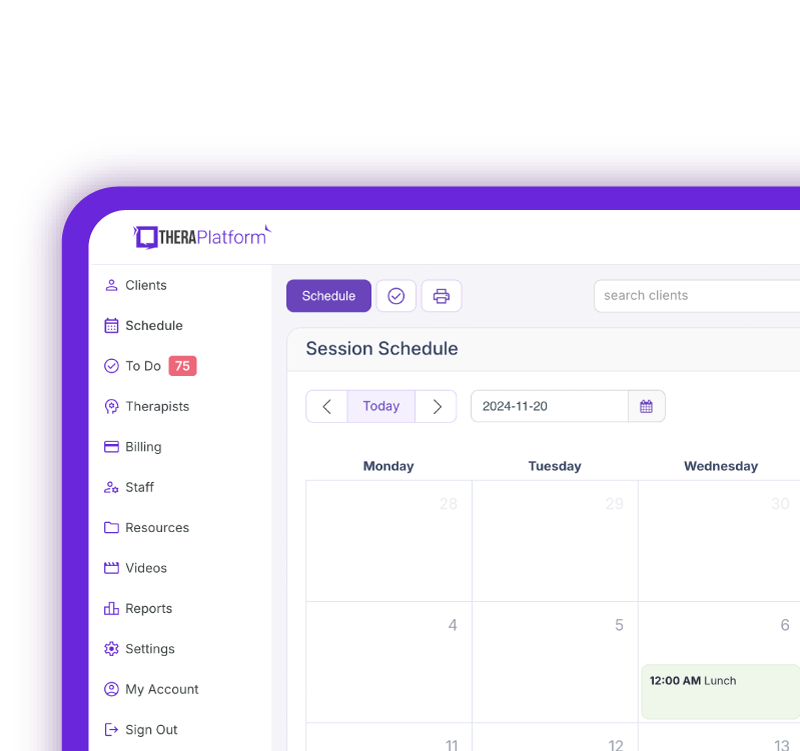
EHRs with integrated billing software and clearing houses, such as TheraPlatform, offer therapists significant advantages in creating an efficient insurance billing process. The key is minimizing the amount of time dedicated to developing, sending, and tracking medical claims through features such as automation and batching.
What are automation and batching?
- Automation refers to setting up software to perform tasks with limited human interaction.
- Batching or performing administrative tasks in blocks of time at once allows you to perform a task from a single entry point with less clicking.
Which billing and medical claim tasks can be automated and batched through billing software?
- Invoices: Create multiple invoices for multiple clients with a click or two of a button or set up auto-invoice creation, and the software will automatically create invoices for you at the preferred time. You can even have the system automatically send invoices to your clients.
- Credit card processing: Charge multiple clients with a click of a button or set up auto credit card billing, and the billing software will automatically charge the card (easier than swiping!)
- Email payment reminders: Never manually send another reminder email for payment again, or skip this altogether by enabling auto credit card charges.
- Automated claim creation and submission: Batch multiple claims with one button click or turn auto claim creation and submission on.
- Live claim validation: The system reviews each claim to catch any human errors before submission, saving you time and reducing rejected claims.
- Automated payment posting: Streamline posting procedures for paid medical claims with ERA. When insurance offers ERA, all their payments will post automatically on TheraPlatform's EHR.
- Tracking: Track payment and profits, including aging invoices, overdue invoices, transactions, billed services, service providers
Utilizing billing software integrated with an EHR and practice management software can make storing and sharing billing and insurance easy and save providers time when it comes to insurance billing for therapists.
Streamline your practice with One EHR
- Scheduling
- Flexible notes
- Template library
- Billing & payments
- Insurance claims
- Client portal
- Telehealth
- E-fax
Resources
TheraPlatform is an all-in-one EHR, practice management, and teletherapy software built for therapists to help them save time on admin tasks. It offers a 30-day risk-free trial with no credit card required and supports different industries and sizes of practices, including occupational therapists in group and solo practices.
More resources
- Therapy resources and worksheets
- Therapy private practice courses
- Ultimate teletherapy ebook
- The Ultimate Insurance Billing Guide for Therapists
- The Ultimate Guide to Starting a Private Therapy Practice
- Mental health credentialing
- Insurance billing 101
- Practice management tools
- Behavioral Health tools
Free video classes
- Free on-demand insurance billing for therapist course
- Free mini video lessons to enhance your private practice
- 9 Admin tasks to automate in your private practice
References
2025 ICD-10-CM Diagnosis Code F84.0: Autistic Disorder. https://www.icd10data.com/ICD10CM/Codes/F01-F99/F80-F89/F84-/F84.0 2. 2025 ICD-10-CM diagnosis code F84.5:
Asperger’s syndrome. https://www.icd10data.com/ICD10CM/Codes/F01-F99/F80-F89/F84-/F84.5
2025 ICD-10-CM diagnosis code F84.9: Pervasive Developmental Disorder, unspecified. https://www.icd10data.com/ICD10CM/Codes/F01-F99/F80-F89/F84-/F84.9
Autism Spectrum Disorder (ASD). Autism Speaks. https://www.autismspeaks.org/what-autism
Centers for Disease Control and Prevention. About Autism Spectrum Disorder. Centers for Disease Control and Prevention. https://www.cdc.gov/autism/about/index.html
Centers for Disease Control and Prevention. Clinical Testing and Diagnosis for Autism Spectrum Disorder. Centers for Disease Control and Prevention. https://www.cdc.gov/autism/hcp/diagnosis/index.html
U.S. Department of Health and Human Services. Autism Spectrum Disorder. National Institute of Mental Health. https://www.nimh.nih.gov/health/topics/autism-spectrum-disorders-asd#:~:text=Autism% 20spectrum%20disorder%20is%20a,first%20two%20years%20of%20life
FAQs about the Autism ICD 10 code
What ICD-10 code should I use for autism—and when do F84.5 or F84.9 apply?
Use F84.0 (Autism Spectrum Disorder) as the primary code when full ASD criteria are met. F84.5 (Asperger’s) may still appear in ICD-10-CM and legacy records, though DSM-5 folds it into ASD; F84.9 (PDD-NOS) is reserved for significant symptoms that don’t meet full ASD/Asperger’s criteria—avoid unspecified codes unless clinically necessary.
What documentation supports medical necessity and reimbursement for ASD services?
Include DSM-5–based findings (social-communication deficits and restricted/repetitive behaviors, evident early), standardized assessments, functional impact, and SMART goals tied to treatment. Ensure complete histories, clear clinical reasoning, progress notes aligned to the plan, and add codes for relevant co-occurring conditions (e.g., anxiety, ADHD) when appropriate.
What are common billing pitfalls—and how can an EHR help?
Frequent issues include outdated/incorrect codes, thin notes, typos, and missed pre-auth/coverage checks leading to denials. An EHR like TheraPlatform reduces risk and saves time with automation and batching (invoices/claims), real-time claim validation, ERA auto-posting, and integrated documentation that links assessments → treatment plans → notes.