Top 9 things all therapists should automate

Private practice management involves so much more than treating clients. To run your own practice, scheduling, onboarding, invoicing, and rescheduling all fall to you as a solo practitioner. And let’s not forget insurance billing with its required knowledge of eligibility, benefits, insurance claims, and potential appeals.
All of this - for each client - every time.
Key takeaways
- Automating repetitive administrative tasks like scheduling, intake, documentation, billing, and payments can save therapists hours each week while reducing burnout.
- The best automation tools streamline your workflow without replacing clinical judgment, empathy, or the therapeutic relationship.
- An all-in-one practice management platform can improve efficiency by bringing scheduling, telehealth, documentation, billing, and AI tools together in one place.
- Start by automating your most time-consuming administrative tasks, then gradually expand automation as your practice grows.
Streamline your practice with One EHR
- Scheduling
- Flexible notes
- Template library
- Billing & payments
- Insurance claims
- Client portal
- Telehealth
- E-fax

While this workload can seem unmanageable for providers to tackle daily, it doesn’t have to be difficult. You can still keep doing what you do best – which is helping others – while staying on top of practice management by automating administrative tasks. Private practice automation simplifies the repetitive, but necessary tasks like data entry or client scheduling.
Benefits of automating private practice administrative tasks
Automating private practice admin tasks offers many advantages to a busy provider working to deliver the best care to clients.
One immediate benefit is that you’ll be less dependent on paper. A paperless office means you’ll reduce costs on paper, printing, and storage – with a little nod to the environment to boot.
Besides saving on overhead costs, the benefits of automating your administrative includes:
- Saving time: Research published in the National Library of Medicine shows that psychiatrists spend about 20% of their time performing administrative tasks. 20%! Imagine what therapists and their clients could gain from another eight hours each week.
- Preventing burnout: Burnout is real among therapists. One study found that less paperwork, smaller caseloads, and more flexibility help prevent burnout among mental health therapists.
- Reducing human error: Even the most organized practices are susceptible to human error. It’s subject to speed, ambiguity of sources, human interpretation, and fluctuations. Having information automatically validated in real time through technology leads to cleaner data.
- Increasing productivity: Research by the American Physical Therapy Association showed that 65% of physical therapist respondents say more than 30 minutes of staff time is spent preparing an appeal for one claim. That’s an extra 30 minutes they could be spending on higher-value responsibilities that advance a business. It’s easy to see how removing repetitive tasks here can increase productivity.
- Improving regulatory compliance: Ensuring your private therapy practice is HIPAA compliant can be tough, and Protected Health Information (PHI) is subject to HIPAA standards. Using automation tools with bank-level security and electronic data storage can help ensure that PHI remains confidential and also makes data retention and retrieval easier. It can also keep you organized when it comes to state laws as well as professional guidelines.
- Improving standardization: One study by the American Physical Therapy Association showed that more than half of physical therapists surveyed say that standardization of documentation would ease administrative burden. Using an EHR with templated documentation that can be completed digitally and with ease can relieve that practice management burden.
- Laying the groundwork for audit trails: Everyone is subject to an audit. Having your paperwork in a single location that is easily accessible will make this stressful process a little easier.
Think of all the important work you could spend time on, such as responding to emergencies, researching emerging therapy trends, attending classes, expanding your practice, sharpening your practice management skills, and staying current on best therapy practices. Ultimately, all of this makes you a better therapist.
So what exactly are those administrative tasks that clinicians can automate? Let’s take a look at how automation can be used for each client session, as well as at the practice level.
Practice Management + EHR + Telehealth
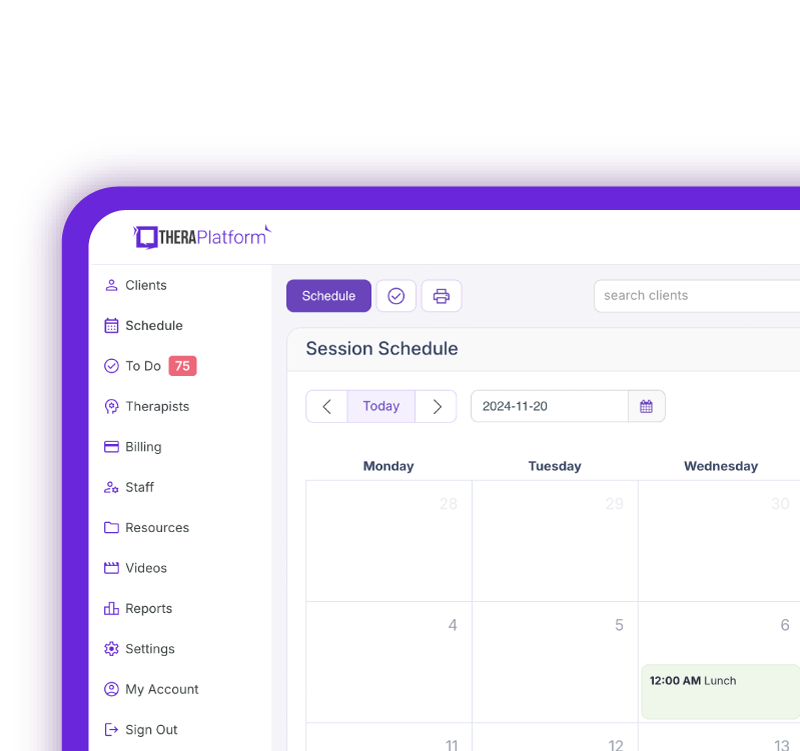
Manage more in less time in your practice with TheraPlatform
Automate the pre-session
Automating scheduling and intake helps clinicians streamline onboarding. Below are a few ideas on how automation can be used pre-session.
- Online scheduling: Leave the back and forth associated with scheduling behind. Embed a calendar widget on your site and empower your clients to self-serve based on a calendar that you manage.
- Appointment reminders: Reduce cancellations and no-shows with automated session reminders the day before an appointment.
- Intake: Of all the things you do, the various data and intake forms you need to juggle are one of the most confusing and time-consuming. Automation allows you to streamline the following intake tasks:
- Data collection from client identification, like driver's licenses and insurance cards, can be autopopulated into data fields, improving accuracy.
- Forms like Consent for services, notices of privacy, release of information, social media forms, etc., can be automated by letting users plug information into templates. Through a secure platform, you can even automate alerts to know which clients completed intake forms and which are still missing all, so no more chasing around hard copies.
- AI-assessments: Assessment starts at intake and works like this: Simply request your client complete demographic information, presenting concerns, and history questionnaires at their convenience. AI automatically populates the appropriate assessment fields, reducing manual data entry. After therapists enter their session input, AI organizes all inputs into a structured, clinically appropriate assessment that includes fields such as presenting problems that the therapist can review and edit.
- Outcome measures: Automatically send, score, and track standardized assessments so you can monitor client progress without extra administrative work. For example, EHRs like TheraPlatform provide mental health therapists an easy way to send and score common assessments like the PHQ-9 screener and the GAD-7.
Using automation during the session
- Notes: A big one! Use customizable templates during sessions to capture key details quickly and stay focused on your client. Think SOAP, DAP, BIRP, GIRP, SIRP, PIE, and PIRP notes, among others.
- Treatment planners: Easily manage goals and interventions using treatment planners that are supported by automation. Wiley Treatment Planner, which is integrated into TheraPlatform, allows therapists to select from prewritten goals, objectives, and interventions using prebuilt goals, objectives, and interventions with searchable menus. Just edit as needed to fit your client.
- Telehealth resources: Built-in timers or prompts can help keep sessions on schedule. One-click scheduling for follow-up appointments can be arranged before the session ends.
After the session
- AI documentation: AI-assisted notes can reduce the time spent writing progress notes while keeping therapists in control of the final documentation.
- Text-to-text AI enables clinicians to simply type a few sentences or keywords to summarize their session. AI then instantly generates the first draft of a structured clinical note that requires the clinical eye of a therapist.
- AI dictation notes is a voice-powered feature that lets clinicians speak into their computer mic, whether it’s a brief session summary or just a few key phrases. Within seconds, AI transforms the audio into a polished clinical note that's available for therapists to edit.
- Telehealth AI Notes generates a transcription from video or audio recordings of telehealth sessions. Clinicians can use AI to turn the transcription into a structured clinical note. Users have full control over all recordings and transcriptions and can delete them at any time.
- Credit card collection: Having a client's credit card on file is one of the best ways to receive timely payment, especially if you bill automatically.
- Claims submissions and claim validation: How many times have you submitted claims only to have to resubmit them later? Through automation (or an EHR), you can submit clean claims each time and get data validated in real time. You can even batch submit your claims.
- Payment collection: Save time by automating invoices, superbills, and payment reminders, and say goodbye to the awkwardness of the dreaded bill collector role forever.
- Follow-up emails: Consider automatically sending personalized post-session communications to reinforce treatment, improve engagement, and reduce administrative work.
Free Resources for Therapists
Click below and help yourself to peer-created resources:

Running your practice through automation
In addition to using automation for your sessions to help redirect your energies to your clients, you can also use automation to run your practice. Let's look at a few of the ways automation can be applied at an operational level
- Task management and to-dos: Stop sticking to-do Post-it notes on your computer monitor, or your desk, or a picture frame. (They fall off anyway.) Get the 30,000-foot view of what needs to be done in your day with automated reminders on what’s pending with a centralized and prioritized to-do list that could include missing notes, pending invoices, and claims updates.
- Billing: Speed up the payment cycle and reduce the administrative overhead associated with billing. Automated practice analytics and reporting help you and the client stay on track for the services they’ve received.
- Client portal: Clients can complete intake paperwork, sign consent forms, pay invoices, exchange secure messages, and join telehealth sessions without staff intervention.
Task | Automate? | Therapist review required? |
|---|---|---|
Appointment reminders | ✅ Always | No |
Intake forms | ✅ Always | No |
AI notes | ✅ Draft | Yes |
Treatment plans | ✅ Assist | Yes |
Insurance claims | ✅ Validate | Yes |
Payment reminders | ✅ Always | No |
Scheduling | ✅ Mostly | Occasionally |
Clinical decisions | ❌ Never | Always |
What not to automate in your practice
While automating certain private practice admin tasks can save time on the operational side of your business, there are places in a therapy practice that are off limits to automation. This includes the clinical side -- such as diagnoses, clinical judgment, risk assessment, informed consent conversations, crisis communication and situations, and the therapeutic alliance. This is where your expertise is. Let it shine!
Common mistakes when using automation in your therapy practice
Once therapists understand how much automation through an EHR can help them streamline operational tasks, it's easy to want to dive in deep. But some embrace automation a little too much.
Avoid these common mistakes when considering or implementing automation in your practice:
- Using too many tools: You don't need one tool for scheduling, another tool for AI notes, and another tool for telehealth. It results in too much toggling, can lead to poor automation workflows, and let's face it, it can add up pretty quickly. All-in-one EHRs like TheraPlatform provide practice management tools from a single software platform, making operations much easier.
- Forgetting HIPAA: It might be tempting to set up your email client to send out scheduled or automatic emails, but is that really HIPAA compliant? Probably not. Turn to those tools that call out they are HIPAA-compliant to keep your client data and your license safe.
- Not training staff: If you run a group practice, you know that getting everyone on the same page can be tricky. When implementing new software, create a roll-out schedule that includes training on the major components of automation in your new EHR, and take advantage of knowledge centers or tutorials that they can turn to again and again.
- Removing too much human interaction: This is so easy to do when automating your private therapy practice. The goal of automation is to reduce administrative work, not the empathy, trust, and personalized care that are central to effective therapy.
How to start automating your practice
Once you decide automation is right for your practice, it's hard to know where to start. The good news? You don't have to start implementing everything at once.
Start with the most repetitive tasks that consume the most of your time and build from there.
- Start with scheduling and reminders. Adding a widget to your website that allows clients to choose appointments based on your availability while reducing time spent on the phone, writing emails, and back-and-forth.
- Digitize paperwork: Converting intake forms and questionnaires will require a little organization upfront, but you'll see big gains in terms of accuracy, time savings, and organization.
- Automate billing and payments: Get your invoice reminders in place and credit cards on file. Like scheduling, it's a necessary task with each client, and you'll spend less time as a bill collector.
- Add AI-assisted documentation, or at least experiment with it. We've all written notes after hours and on weekends. Most AI notes allow you to review and edit notes before they're finalized, keeping you in control of the final output.
Automation isn't about replacing therapists, it's about replacing repetitive administrative work. Every hour saved on scheduling, documentation, billing, or paperwork is an hour that can be spent helping clients, growing your practice, or simply reducing burnout.
Streamline your practice with One EHR
- Scheduling
- Flexible notes
- Template library
- Billing & payments
- Insurance claims
- Client portal
- Telehealth
- E-fax
Resources
TheraPlatform is an all-in-one EHR, practice management, and teletherapy software with AI-powered notes built for therapists to help them save time on admin tasks. It offers a 30-day risk-free trial with no credit card required and supports mental and behavioral health, SLPs, OTs, and PTs in group and solo practices.
More resources
- Therapy resources and worksheets
- Therapy private practice courses
- Ultimate teletherapy ebook
- The Ultimate Insurance Billing Guide for Therapists
- The Ultimate Guide to Starting a Private Therapy Practice
- Insurance billing 101
- Practice management tools
Free video classes
- Free on-demand insurance billing for therapist course
- Free mini video lessons to enhance your private practice
- 9 Admin tasks to automate in your private practice
FAQs about automating your private practice with an EHR
What tasks can therapists automate in private practice?
Therapists can automate scheduling, appointment reminders, intake forms, documentation, billing, insurance claims, payments, and secure client communications.
Can automation help reduce therapist burnout?
Yes. By reducing repetitive administrative tasks like scheduling, paperwork, and billing, automation frees up time for client care and helps minimize administrative overload.
What should therapists avoid automating?
Automation should support—not replace—clinical judgment. Therapists should always retain responsibility for diagnoses, risk assessments, informed consent, crisis intervention, and the therapeutic relationship.