
The mental health therapist’s EHR checklist: What to know before you commit

Choosing the right electronic health record (EHR) can make a significant difference in how efficiently you manage your mental health practice.
Whether you're opening your first private practice or replacing an EHR you've outgrown, the process can feel overwhelming. There are plenty of options, all promising to simplify your practice, but not all are designed with mental health professionals in mind.
If you've worked in community mental health or integrated healthcare, you're probably familiar with navigating complicated records systems designed primarily for medical providers.
One of the benefits of private practice is having the ability to choose a system that fits the way you actually work. What should clinicians be looking for in an EHR?
Your EHR should make managing your practice easier, not create more administrative work. While every practice has different needs, there are a few important features worth considering before committing to a platform.
Key takeaways
- Identify your practice's must-have features. Prioritize mental health documentation, scheduling, billing, and supervision tools based on your clinical workflows and practice type.
- Verify features rather than relying on vendor descriptions. Test customizable notes, treatment planning, teletherapy, billing, and staff permissions during a demonstration or trial.
- Evaluate privacy, security, and long-term flexibility. Confirm HIPAA safeguards, psychotherapy note protections, AI data practices, and options for exporting records.
- Compare total costs before committing. Review subscription tiers, billing fees, add-ons, onboarding, and support to avoid unexpected expenses.
→ Download My Free EHR (+practice management software) Buyer’s Guide for Therapists
Start with your mental health practice's needs
Before comparing EHR platforms, consider how your mental health practice operates. Do you provide individual, couples, family, or group therapy? Do you accept insurance, private pay, or both? Are you managing a solo practice or supervising other clinicians? Identify your biggest administrative challenges, essential clinical workflows, and plans for growth. Understanding these needs will help you prioritize features, avoid unnecessary costs, and choose an EHR that fits your practice.
Essential vs. optional mental health EHR features
Practice type | Priority EHR features | Features to consider as needs grow |
|---|---|---|
Solo, private-pay therapist | Customizable progress notes, treatment plans, scheduling, secure client portal, invoicing, online payments, superbills | AI-assisted documentation, advanced reporting, automated workflows |
Solo therapist accepting insurance | Psychotherapy CPT code support, electronic claims, ERA processing, payment tracking, documentation, treatment planning | Eligibility verification, authorization tracking, claim follow-up tools |
Couples and family therapist | Flexible scheduling, documentation for multiple participants, appropriate access permissions, teletherapy | Group session management, specialized templates, advanced client communication tools |
Mental health group practice | Multi-clinician calendars, role-based access, supervision and co-signature workflows, billing, reporting | Advanced analytics, automated workflows, AI documentation, multi-location management |
Not every therapist needs the same features. What works for a solo private-pay practice may not be enough for an insurance-based clinician or a group practice.
For solo private-pay therapists, documentation, treatment planning, scheduling, secure payments, and a client portal are usually the priorities. AI notes, advanced reporting, and additional automation may be nice to have, but aren't always necessary.
If you're accepting insurance, billing features become more important. Electronic claims, ERA processing, payment tracking, and treatment planning should be priorities. Eligibility verification and automated billing reminders can also be helpful.
Streamline your practice with One EHR
- Scheduling
- Flexible notes
- Template library
- Billing & payments
- Insurance claims
- Client portal
- Telehealth
- E-fax

If you supervise clinicians or plan to expand, test whether the EHR supports multiple schedules, role-based permissions, documentation review, and co-signatures. Ask vendors to demonstrate these workflows and confirm whether additional clinicians or supervisory features require higher-priced plans.
To separate needs from wants, ask yourself: Would my practice experience significant administrative, clinical, or financial difficulties without this feature? If the answer is yes, consider it a must-have. If the feature primarily offers convenience or supports future growth, it may be optional.
Prioritize your must-haves when comparing EHR plans, but also consider whether optional features can be added later without switching platforms.
Look at it like this:
- Must-have: Necessary for your clinical, administrative, or billing workflows.
- Nice-to-have: Saves time or adds convenience but isn't essential.
- Future need: May become important as your practice grows.
What to verify about documentation, billing, security and more
Documentation
When evaluating a mental health EHR, test whether its documentation templates support your clinical workflows, including SOAP or DAP notes, biopsychosocial assessments, mental status examinations (MSEs), and customizable treatment plans. Check how easily you can access previous notes, update treatment goals, and document progress without duplicate data entry.
If you use assessments such as the PHQ-9, GAD-7, or Y-BOCS, verify whether they're built into the system, whether scores can be tracked over time, and whether additional fees apply. For AI-assisted documentation, ask how client data is stored, protected, and used, and whether the feature is optional.
According to the American Psychological Association's 2025 Guidelines on Measurement-Based Care, clinical data can help monitor treatment progress, improve communication, and inform treatment planning.
When evaluating an EHR, consider whether assessments such as the PHQ-9 and GAD-7 can be administered and tracked over time to support these clinical workflows.
Practice Management + EHR + Telehealth
Manage more in less time in your practice with TheraPlatform
Scheduling and teletherapy
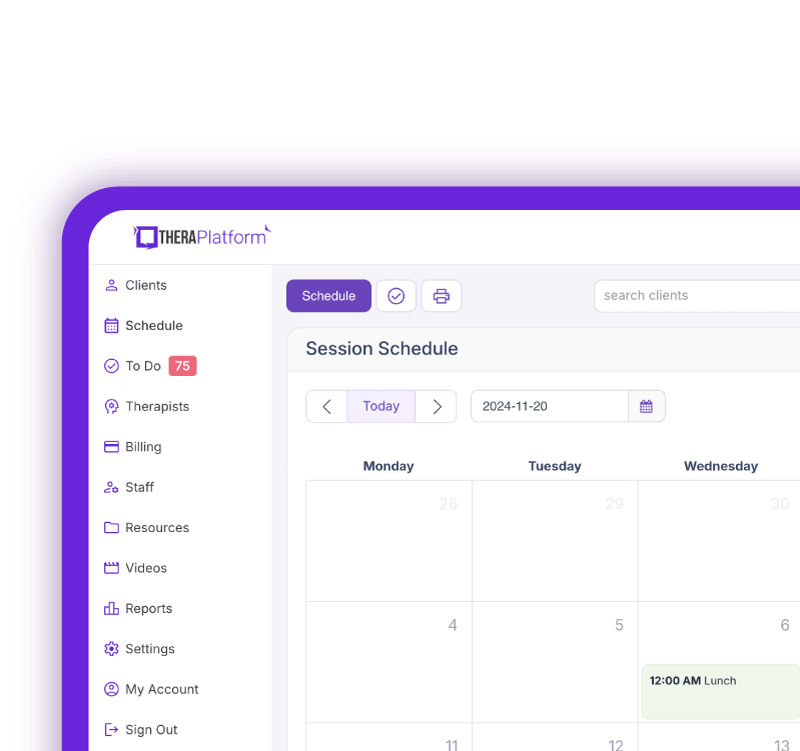
When evaluating an EHR, test how easily you can manage recurring appointments, cancellations, rescheduling, and automated reminders. If you offer couples, family, or group therapy, verify that scheduling and teletherapy support multiple participants while maintaining confidentiality and appropriate documentation. Also, check whether reminders can communicate cancellation policies consistently.
Billing
Your billing needs will depend on whether you accept insurance, private pay, or a combination of both. For insurance-based therapists, features like psychotherapy CPT code support, electronic claims, electronic remittance advice (ERA), and payment tracking are important.
Private-pay clinicians may be more interested in credit card processing, invoicing, and superbills.
When evaluating a mental health EHR, remember that claims software helps you submit and track insurance claims, while billing services may provide hands-on assistance with denials, appeals, payment follow-up, and collections—so verify exactly what's included.
Security
Protecting client information is nonnegotiable. Your EHR should have appropriate HIPAA safeguards, encryption, secure client portals, access permissions, and a Business Associate Agreement (BAA).
Psychotherapy notes also require special consideration. Under HIPAA, notes that meet the specific definition of psychotherapy notes and are maintained separately from the medical record receive additional protections.
According to the U.S. Department of Health and Human Services (HHS), psychotherapy notes that meet HIPAA's definition and are maintained separately from the medical record receive additional privacy protections. When evaluating an EHR, verify that it supports appropriate separation and access restrictions for these sensitive records.
Your EHR should allow for that separation and appropriate access restrictions. Electronic consent forms and secure record sharing are also helpful. Keep in mind that choosing a HIPAA-compliant platform doesn't automatically make your practice compliant. How you manage and access client information still matters.
Additionally, if the EHR offers AI-assisted documentation, ask whether client data is used to train AI models, where information is stored, who can access it, and how long recordings, transcripts, or generated notes are retained.
Confirm whether AI features are optional and whether the vendor uses third-party AI providers that may process client information.
Mental health EHR pricing: Hidden costs to check
When comparing EHR pricing, keep in mind that the advertised monthly subscription isn't always what you'll end up paying. A lower subscription price isn't necessarily a better deal if you're paying extra for essential features or spending more time managing the software.
Some platforms charge extra for insurance claims, payment processing, AI documentation, teletherapy, or additional clinicians. Before deciding, take a look at the total cost of the features you'll actually use.
Customer support matters too, especially if you're transitioning from another EHR. Find out what training, onboarding, and record migration assistance are available to avoid unexpected costs or disruptions when switching systems.
Red flags when choosing a mental health EHR
Some limitations aren't obvious during a software demonstration. Before committing, pay attention to:
- Limited documentation customization: Progress notes and treatment plans that can't be adapted to your clinical needs.
- Inadequate psychotherapy note protections: No clear way to maintain separately protected psychotherapy notes.
- Missing supervision workflows: No option for supervisors to review and co-sign documentation when required.
- Hidden billing fees: Additional charges for claims, ERA processing, eligibility checks, or payment transactions.
- Unclear AI privacy practices: Limited information about how client data is processed, stored, or used for AI training.
- Limited data portability: Difficulty exporting records or transferring information to another platform.
Free Resources for Therapists
Click below and help yourself to peer-created resources:

Mental health EHR checklist
Use this checklist to compare platforms and identify the features that matter most for your practice.
Clinical documentation
- SOAP, DAP, BIRP, and free-text progress notes
- Biopsychosocial assessments and MSEs
- Customizable treatment plans
- Secure psychotherapy note storage
- Optional AI-assisted documentation
Measurement-based care
- PHQ-9, GAD-7, and PCL-5 assessments
- Electronic assessments and progress tracking
Scheduling and teletherapy
- Recurring appointments and automated reminders
- Couples, family, and group scheduling
- Secure video conferencing
- Online intake and consent forms
Billing and payments
- Psychotherapy CPT codes and electronic claims
- ERA processing and payment tracking
- Copays, credit card processing, and superbills
- Transparent billing fees
Security and practice management
- HIPAA safeguards and a BAA
- Role-based permissions and secure record access
- Supervision review and co-signatures
- Multi-clinician scheduling and reporting
- Record export, onboarding, and customer support
Final considerations
You don't need the EHR with the most features or the highest subscription price. You need one that supports your clinical work, fits your budget, and doesn't create unnecessary administrative work.
Take the time to compare your options and test the features you'll use most often. The right system should make running your practice easier, not become another thing you have to manage.
You don't need the EHR with the most features or the highest subscription price. You need one that supports your clinical workflows, fits your budget, and reduces unnecessary administrative work.
Before committing, compare your options and test the features you'll use most often. Make sure your free trial includes the same subscription tier you intend to purchase, since features available during a trial may not be included in lower-priced plans.
Streamline your practice with One EHR
- Scheduling
- Flexible notes
- Template library
- Billing & payments
- Insurance claims
- Client portal
- Telehealth
- E-fax
Resources for mental health therapists
TheraPlatform's physical therapy EHR brings documentation, scheduling, private-pay and insurance billing, telehealth, and practice management tools into one platform, with optional AI-powered features built for therapists to help them save time on admin tasks.
It offers a 30-day risk-free trial with no credit card required and supports different industries and sizes of practices, including mental health therapists in group and solo practices.
More resources
- Therapy resources and worksheets
- Therapy private practice courses
- Ultimate teletherapy ebook
- The Ultimate Insurance Billing Guide for Therapists
- The Ultimate Guide to Starting a Private Therapy Practice
- Insurance billing 101
- Practice management tools
Free video classes
- Free on-demand insurance billing for therapists course
- Free mini video lessons to enhance your private practice
- 9 Admin tasks to automate in your private practice
References
American Psychological Association, APA Task Force on Professional Practice Guidelines on Measurement-Based Care. (2025). APA professional practice guidelines on measurement-based care. https://www.apa.org/about/policy/guidelines-measurement-based-care.pdf
U.S. Department of Health and Human Services. (n.d.). Does HIPAA provide extra protections for mental health information compared with other health information? https://www.hhs.gov/hipaa/for-professionals/faq/does-hipaa-provide-extra-protections-mental-health-information-compared-other-health.html
FAQs about what to know about mental health EHRs before your commit
How do I choose the right mental health EHR for my practice?
Start by identifying your essential clinical and administrative workflows, including documentation, billing, scheduling, and supervision. Compare platforms against those requirements and test key features before committing.
What hidden costs should I look for in a mental health EHR?
Check for additional fees for insurance claims, eligibility checks, payment processing, AI documentation, teletherapy, extra clinicians, and onboarding. Compare the total monthly cost rather than the advertised subscription price alone.
What should I test during a mental health EHR free trial?
Test the workflows you use most often, such as writing psychotherapy progress notes, scheduling recurring sessions, submitting claims, and managing client records. Confirm you're testing the subscription tier you intend to purchase.