
When to switch speech therapy EHRs

When is it time to switch your speech therapy EHR?
Is your speech therapy EHR saving you time or creating more work? If you're spending hours catching up on documentation, manually tracking treatment goals, or managing insurance authorizations in spreadsheets, your software may no longer meet your practice's needs.
Key takeaways
- Recurring workarounds may signal it's time to switch speech therapy EHRs. Repetitive data entry, inefficient documentation, and disconnected workflows can indicate that your software no longer meets your practice's needs.
- Billing and administrative inefficiencies can increase costs. Manual claims processing, limited reporting, and extra staff time may cost more than the EHR subscription itself.
- Not every speech therapy EHR frustration requires a new system. Before switching, ask your current vendor about available features, training, integrations, and upcoming improvements.
- Plan your transition carefully. Compare speech therapy vendors, evaluate data migration options, test essential workflows, and allow time for staff training before switching systems.
→ Download My Free EHR (+practice management software) Buyer’s Guide for Therapists
When should a speech therapy practice consider switching EHRs?
An EHR doesn't need to be completely broken to be the wrong fit. The needs of a practice change as caseloads increase, additional staff join, and services expand.
Rather than focusing on one frustrating feature, consider cumulative workflow friction – are extra clicks, redundant data entry, and manual workarounds slowly accumulating and draining energy over time?
Here are 10 signs your speech therapy practice may have outgrown its EHR, how to distinguish fixable frustrations from serious limitations, and what to look for when choosing new software.
Streamline your practice with One EHR
- Scheduling
- Flexible notes
- Template library
- Billing & payments
- Insurance claims
- Client portal
- Telehealth
- E-fax

10 signs your speech therapy practice has outgrown its EHR
1. Your team relies on too many workarounds
If your staff regularly uses spreadsheets, separate tracking documents, or manual reminders to complete everyday tasks, your EHR may be creating extra work. This misses the essential functionality of a speech therapy EHR and can increase the risk of errors.
2. You're entering the same information multiple times
A system lacks integrated data flow if it requires you to repeatedly type client information across intake, scheduling, documentation, billing, and payment systems.
3. SLP documentation takes longer than it should
Rigid templates, excessive clicks, and limited customization make documentation unnecessarily time-consuming. Lack of automation or AI-assisted documentation can mean clinicians are missing out on features that could help them complete notes more efficiently while maintaining accuracy.
An SLP treating a child with an articulation disorder may need to track sound accuracy, cueing levels, and progress across multiple sessions. If the EHR requires the clinician to search through previous notes and manually calculate progress for every report, it may be time to consider software with integrated goal tracking and more flexible documentation templates.
According to ASHA’s Documentation in Health Care practice guidance, “Succinctness and legibility are critical factors, as they allow those reading the documentation to locate and read key information easily and quickly.”
4. SLP billing requires too much manual work
Manual claim preparation, disconnected billing workflows, difficult payment posting, and limited automation can slow reimbursement. A software with integrated billing workflows and automated charge creation can help reduce repetitive tasks.
5. SLP billing problems are difficult to identify and resolve
Limited visibility of claim statuses, rejections, denials, and authorization requirements can make it difficult to address. Inadequate reporting can mean staff are later than necessary to identify and solve problems.
A speech therapy practice providing twice-weekly language therapy may need to monitor the number of visits remaining under each client's insurance authorization. If staff rely on spreadsheets to track approved sessions and expiration dates, the practice risks scheduling visits outside authorization limits.
A speech therapy EHR with built-in authorization tracking and scheduling integration can help reduce these manual processes.
6. Your EHR doesn't support the way your practice delivers care
Whether you provide in-person services, teletherapy, or hybrid care, your speech therapy EHR should adapt without forcing separate workarounds. Additional flexibility may be needed for practices with multiple disciplines, clinicians, or locations.
7. Your speech therapy practice has outgrown its scheduling tools
It can become complicated to manage recurring appointments, multiple clinicians, different locations, and client time zones. Scheduling tools with automated reminders and cancellation management can help simplify coordination.
8. You can't easily get the reports you need
Speech therapy practice owners need reporting tools that show more than revenue. Tracking clinician caseloads and appointment cancellations can help identify scheduling gaps, while monitoring outstanding claims and denied payments helps staff address billing problems sooner.
Reports on services provided, clinician productivity, and reimbursement trends can also help owners adjust staffing, improve cash flow, and determine when to expand their practice.
9. Your staff spends too much time on administrative tasks
Look for indications that your speech therapy EHR isn’t saving staff the time it should. Red flags include staff being responsible for manual data entry, claim follow-up, scheduling, payment collection, and documentation without the use of automated tools. When evaluating EHR costs, consider staff time lost weekly on administrative labor.
According to ASHA’s 2025 SLP Health Care Survey, 53% of surveyed SLPs identified administrative tasks as a barrier to providing optimal clinical care. A speech therapy EHR with the right tools can help address some of those challenges.
10. Your software isn't keeping up with your practice
If your software lacks meaningful automation, useful integrations, limited AI capabilities, or the ability to add clinicians and services, that could indicate that the product isn't evolving alongside your practice’s needs.
Frustrating vs. deal-breaking: How serious are your EHR problems?
EHR warning signs: Fixable frustration or reason to switch?
Speech therapy EHR challenge | Potentially fixable | When to consider switching |
|---|---|---|
SLP documentation | Evaluation and treatment note templates need customization | Templates don't support speech-language goals, cueing levels, accuracy data, or progress reporting |
Treatment goal tracking | Staff need training on existing goal-tracking tools | SLPs must manually search previous notes to measure progress or prepare reports |
Insurance authorizations | Authorization alerts or tracking settings need adjustment | The system can't adequately track approved visits, remaining sessions, or expiration dates |
Speech therapy billing | CPT codes, modifiers, or billing workflows need configuration | Recurring coding errors, manual claim entry, or limited claim tracking disrupt reimbursement |
Recurring appointments | Scheduling settings or reminders need adjustment | Managing ongoing therapy sessions, cancellations, and multiple clinicians requires manual workarounds |
Teletherapy | Existing video or screen-sharing tools need configuration | Separate platforms make it difficult to access client records or use interactive therapy activities |
Pediatric and caregiver workflows | Intake forms and caregiver communications need customization | The system can't adequately support caregiver forms, pediatric evaluations, or communication workflows |
Multidisciplinary practices | User permissions or workflows need adjustment | Software can't accommodate SLPs, OTs, PTs, and other clinicians within shared practice workflows |
Consider whether you’re experiencing some frustration with the current software versus deal-breaking issues, indicating it’s time to switch vendors.
A feature you don't like, a workflow that needs adjustment, or a problem the vendor can resolve may be frustrating, yet fixable issues.
If there are fundamental limitations, such as essential features that are unavailable or recurring inefficiencies that affect revenue and productivity, a different platform may be worth considering.
Calculate the hidden cost of staying with the wrong EHR
A speech therapy EHR cost extends beyond its subscription fee. Consider how your current software affects:
- Administrative time: Hours spent weekly on fixing billing errors and manual data entry.
- Billing inefficiencies: Manual billing and unresolved claims can result in delayed or missed payments.
- Disconnected software costs: Increased expenses can result from separate scheduling, billing, and telehealth platforms.
- Staff frustration and training: Complicated systems may require more extensive training.
- Lost opportunities to automate: Staff may spend time completing tasks that could be streamlined through automation.
Practice Management + EHR + Telehealth
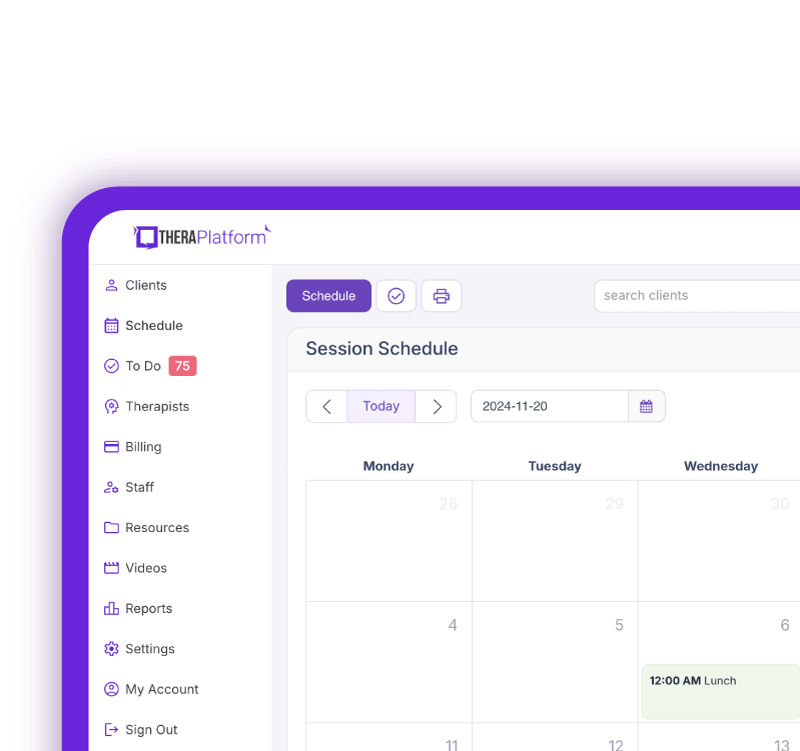
Manage more in less time in your practice with TheraPlatform
Before switching, talk to your current speech therapy EHR provider
Check in with the support team for your current vendor: Consider asking:
- Is the feature already available?
- Is there a better workflow?
- Is additional training needed?
- Is an update planned?
- Can the platform accommodate future growth for a speech therapy practice?
What to look for in your next speech therapy EHR
- Prioritize features that address your current challenges and support the long-term needs of your practice.
- Clinical documentation: Customizable speech-language evaluation templates, treatment notes, goal tracking, and progress reports that capture accuracy percentages, cueing levels, and client outcomes.
- Scheduling and client management: Recurring therapy appointments, flexible calendars, automated reminders, and centralized client and caregiver information.
- Billing and payments: Integrated insurance claims, speech therapy CPT codes and modifiers, authorization tracking, payment posting, and billing reports.
- Telehealth: Secure video sessions with interactive therapy tools, screen sharing, and activities that support speech and language interventions.
- Reporting: Clinical progress reports, goal achievement data, clinician productivity, outstanding claims, and practice revenue.
- Automation and AI: AI-assisted documentation, dictation, reusable templates, and automated workflows that reduce repetitive tasks while allowing SLPs to review and finalize clinical records.
Watch this video to learn how to save time on therapy notes
- Security and compliance: HIPAA-compliant workflows, secure storage of client records, role-based access, and safeguards for protected health information (PHI).
- Scalability: Support for growing SLP caseloads, additional clinicians, multiple locations, and multidisciplinary practices offering speech, occupational, and physical therapy.
Questions to ask before switching speech therapy EHRs
Digging into why you want to switch EHRs will help determine whether moving to a new vendor is necessary.
- Which current challenges must the new EHR solve? Are documentation, treatment goal tracking, insurance authorizations, scheduling, or billing creating unnecessary work?
- Which SLP-specific features are essential? Does the system support customizable evaluation templates, progress tracking, recurring appointments, teletherapy activities, and speech therapy billing?
- What will the total cost be? Are there additional fees for clinicians, AI documentation, insurance claims, teletherapy, or other features?
- How will existing client records be transferred? Can you migrate evaluations, treatment plans, progress notes, goals, insurance information, and billing records?
- How long will implementation take? Can the practice transition without disrupting recurring therapy appointments, documentation, or insurance billing?
- What training and support are provided? Will clinicians and administrative staff receive help configuring SLP documentation templates, billing workflows, and scheduling?
- Can you test actual speech therapy workflows before committing? Can you complete a sample treatment note, track articulation or language goals, schedule recurring sessions, and submit a test claim?
Free Resources for Therapists
Click below and help yourself to peer-created resources:

How to prepare for a speech therapy EHR switch
- Identify your requirements: List essential speech therapy EHR features, including customizable evaluation and treatment note templates, goal tracking, insurance authorization management, recurring scheduling, and billing.
- Evaluate and demo vendors: Compare 2–3 speech therapy EHR platforms. Request demonstrations of common SLP workflows, such as documenting articulation goals, generating progress reports, and managing insurance claims.
- Develop a data migration plan: Identify which client records need to be transferred, including evaluations, treatment plans, progress notes, goals, insurance authorizations, and billing histories. Confirm how data accuracy will be verified.
- Configure workflows and templates: Set up speech-language evaluation templates, treatment notes, goal tracking, recurring appointments, insurance billing, and teletherapy tools before launch.
- Train clinicians and administrative staff: Provide role-specific training on documenting therapy sessions, tracking client progress, managing authorizations, scheduling appointments, and processing claims.
- Test before going live: Verify that client records transferred correctly and test essential workflows, including documenting treatment sessions, updating goals, scheduling recurring visits, tracking authorizations, and preparing insurance claims.
When is the best time to switch speech therapy EHRs?
When it comes to changing systems, there may never be a “perfect” time. Consider renewal dates and contracts, avoiding especially disruptive practice periods when possible.
Allow time for migration, setup, and training with the new system to minimize disruption.
Is it time for a new EHR?
If the occasional frustration with a speech therapy EHR software has become a collection of recurring workarounds, manual processes, and inefficiencies, the cost of staying may deserve as much consideration as the cost of switching.
By choosing an EHR system that supports your current workflows and future growth, your therapy practice can operate more efficiently.
Streamline your practice with One EHR
- Scheduling
- Flexible notes
- Template library
- Billing & payments
- Insurance claims
- Client portal
- Telehealth
- E-fax
Resources for speech therapists
TheraPlatform is an all-in-one EHR, practice management, and teletherapy software with AI-powered notes built for therapists to help them save time on admin tasks. It offers a 30-day risk-free trial with no credit card required and supports different industries and sizes of practices, including speech-language pathologists in group and solo practices.
More resources
- Therapy resources and worksheets
- Therapy private practice courses
- Ultimate teletherapy ebook
- The Ultimate Insurance Billing Guide for Therapists
- The Ultimate Guide to Starting a Private Therapy Practice
- Insurance billing 101
- Practice management tools
Free video classes
- Free on-demand insurance billing for therapist course
- Free mini video lessons to enhance your private practice
- 9 Admin tasks to automate in your private practice
References
Ayabakan, S., Atasoy, H., & Pang, M. S. (2025). The Interplay Between Healthcare Information Technologies and Denied Claims. MIS Quarterly, 49(3), 1169-1184. https://doi.org/10.25300/MISQ/2024/17469
Ayer, M. (2023). Relieving administrative burden on clinical staff with streamlined workflows and speech-recognition software. British Journal of Nursing, 32(Sup16b), S1-S9. DOI: https://www.magonlinelibrary.com/doi/abs/10.12968/bjon.2023.32.Sup16b.S4?journalCode=bjon
Li, Y. H., Li, Y. L., Wei, M. Y., & Li, G. Y. (2024). Innovation and challenges of artificial intelligence technology in personalized healthcare. Scientific reports, 14(1), 18994. https://www.nature.com/articles/s41598-024-70073-7
FAQs about switching speech therapy EHRs
How do I know when it's time to switch EHR systems?
Consider switching when recurring workarounds, inefficient documentation, billing problems, or missing features consistently affect productivity, revenue, or client care—and your current vendor cannot adequately resolve them.
How difficult is it to switch EHR systems?
The complexity depends on practice size, data volume, and the new software's migration capabilities. Planning, vendor support, staff training, and testing essential workflows can help minimize disruptions.
Can client records be transferred to a new EHR?
Many EHR vendors support data exports or migration assistance, but transferable records and formats vary. Ask about clinical notes, client demographics, billing records, attachments, migration costs, and how transferred information will be verified.