
Therapy business support services

Therapy business support services like lawyers and accountants are essential to growing a thriving private or group practice. In addition to providing legal and financial advice, they can help alleviate the constant juggling of tasks beyond clinical work that contribute to the risk of burnout, administrative errors, and potential liability issues.
Summary
- Professional support services reduce burnout by taking administrative, legal, and financial burdens off therapists, allowing them to focus on client care. Download my free private practice worksheets.
- Legal and financial experts protect your practice from compliance risks, tax mistakes, and operational liabilities that can jeopardize your license and reputation.
- Administrative and tech support improve efficiency, streamline practice operations, and maintain continuity for telehealth and EHR-based care. Using EHR systems, such as TheraPlatform, can help therapists manage the administrative side of their practices.
- Building a trusted support network is essential, not optional—especially for growing practices and group clinics.
Streamline your practice with One EHR
- Scheduling
- Flexible notes
- Template library
- Billing & payments
- Insurance claims
- Client portal
- Telehealth
- E-fax

National research studies have shown that 50% of providers reported feeling burned out over the past year, with administrative work being a significant factor.
The good news? Private practice owners can avoid these issues by building a professional support network around their practice. By working smarter, not just harder, you can boost efficiency, maintain legal safety, and safeguard your mental wellness.
Watch this video to discover TheraPlatform’s EHR benefits for your practice
Legal support for your therapy business
Why legal support matters in private practice
A web of regulations surrounds every private therapy practice. Legal support can ensure your business remains in compliance, avoiding future crises that can result in costly lawsuits, risks to your professional license, and damaged client trust.
Types of legal experts to consider for your therapy business
- Employment lawyer: Determines whether clinicians or administrative staff are classified as contractors or employees, navigates labor laws, and can assist with proper onboarding procedures.
- Business attorney: Assists with state licensing requirements, establishing the legal structure of the practice (forming an LLC or S-corp), and creating clear practice agreements.
- Trademark and copyright attorney: Protects your brand and digital resources from misuse.
As private practice owners, Tamala Close and Britney Desir say in the ASHA Leader, "Always make sure you stay protected and minimize professional and physical risk."
Practice Management + EHR + Telehealth
Manage more in less time in your practice with TheraPlatform
Financial and bookkeeping support for your therapy business
Bookkeeper vs. accountant: What's the difference?
A bookkeeper manages daily expenses, including tracking income, fees, and invoices. An accountant or CPA (Certified Public Accountant) interprets those numbers when it's time for quarterly or annual tax filings. CPAs offer high-level financial planning advice that can minimize audit risks.
Especially if you expand your practice or add employees, hiring a CPA or tax specialist can save your practice a significant amount of money by offering suggestions for healthcare-specific deductions and write-offs.
Tips for managing finances in your therapy business
- Consider using cloud-based accounting tools (e.g., QuickBooks, Xero) that can automate expenses and invoice tracking.
- Review the IRS Small Business and Self-Employed Tax Center for guidance on quarterly tax payment schedules.
- Seek out financial advisors who specialize in healthcare practices for support on retirement and long-term planning.
Administrative and assistant support for your therapy business
If it feels like administrative tasks are piling up and burnout could set in, it's time to delegate; otherwise, this stress can lead to mental health issues, fatigue, or even physical health concerns. Hiring an assistant is an investment that can drive productivity and fuel a successful practice, and should not be viewed as an expense.
Consider different types of assistants available, depending on your needs:
- Virtual assistants can manage scheduling and billing remotely and help with emails.
- In-person assistants provide client support and on-site file management.
- Task-based contractors hired through online platforms assist with a specific administrative or therapy-specific project.
Tasks an assistant can manage
- Client scheduling/rescheduling
- Billing and payment tracking
- Paperwork (e.g., intake documents and consent forms)
- Answering phone calls and triaging messages
- Insurance verification and claim submissions
Options for assistants
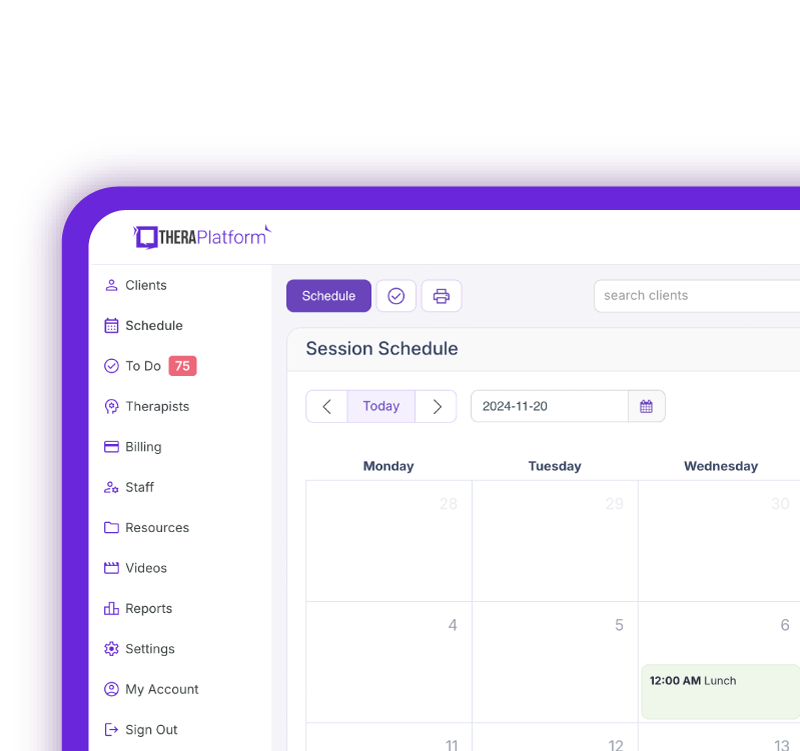
If you’d prefer to have some control over these items yourself, consider an EHR and practice management tool that can batch and automate some of that work for you. EHRs like TheraPlatform offer user permissions that are assistant-friendly, enabling staff to manage billing, calendars, and documentation securely.
Watch this video to discover TheraPlatform’s EHR benefits for your practice
IT and technology support for a therapy business
With the role of telehealth and Electronic Health Records (EHRs) in today's healthcare, technological downtime can have costly implications. Therapy cancellations, billing delays, and increased compliance risks are possible and are worth the cost of prevention.
Key ways an IT pro can help a therapy business
- Tech setup to ensure hardware/software is reliable for teletherapy use.
- Managing data migration when switching systems
- Applying virus protection
- Ensuring systems are fully HIPAA compliant
- Troubleshooting and general maintenance
Locate a reliable tech partner or service subscription by asking colleagues for referrals or finding subscription services that work specifically with small healthcare practices.
Free Resources for Therapists
Click below and help yourself to peer-created resources:

Additional private practice support roles for a therapy business
Depending on the growth and specific needs of your practice, other specialized professionals to consider adding to your support team include:
- Marketing/branding: Social media, website design, Search Engine Optimization (SEO), copywriting and other marketing efforts
- Billing services: Claims, insurance panels, Explanation of Benefits (EOBs)
- Peer consultation and clinical supervision: Navigating ethical dilemmas, collaboration, and prevention from burnout
- Office management: Cleaning services, administrative Standard Operating Procedures (SOPs)
How to find the right people for your practice
Tapping into your professional network is key to finding the proper support.
- Ask your network: Colleagues, Facebook groups, listservs, and local business networking groups such as BNI are excellent resources.
- Look for therapist-focused service providers: Seek administrative and financial service providers who specifically specialize in therapy or healthcare-related businesses.
- Compare hiring freelancers vs. agencies: flexibility and cost differences matter.
- Vetting tips: Request professional references, take advantage of a short introductory trial period before hiring, and ensure contract basics are fulfilled (e.g., clearly defined scope of work, confidentiality, and expectations).
Running a private practice is a huge accomplishment! Just remember, you don't have to do it all alone. A strong support system is foundational—not optional—for sustainable growth of your practice. Empower your business with people and tools designed for therapy professionals.
Streamline your practice with One EHR
- Scheduling
- Flexible notes
- Template library
- Billing & payments
- Insurance claims
- Client portal
- Telehealth
- E-fax
Resources
Resources
TheraPlatform is an all-in-one EHR, practice management, and teletherapy software with AI-powered notes built for therapists to help them save time on admin tasks. It offers a 30-day risk-free trial with no credit card required and supports mental and behavioral health, SLPs, OTs, and PTs in group and solo practices.
More resources
- Therapy resources and worksheets
- Therapy private practice courses
- Ultimate teletherapy ebook
- The Ultimate Insurance Billing Guide for Therapists
- The Ultimate Guide to Starting a Private Therapy Practice
- Mental health credentialing
- Insurance billing 101
- Practice management tools
- Behavioral Health tools
Free video classes
- Free on-demand insurance billing for therapist course
- Free mini video lessons to enhance your private practice
- 9 Admin tasks to automate in your private practice
References
Mahajan, H. B. (2022). Emergence of healthcare 4.0 and blockchain into secure cloud-based electronic health records systems: solutions, challenges, and future roadmap. Wireless Personal Communications, 126(3), 2425-2446. https://link.springer.com/article/10.1007/s11277-022-09535-y
Phillips, R. S., & Saunders, G. H. (2024). Occupational stress in United Kingdom audiologists. American journal of audiology, 33(3), 756-767. DOI: https://pubs.asha.org/doi/10.1044/2024_AJA-24-00024
Singh, R., Volner, K., & Marlowe, D. (2023). Provider burnout. In StatPearls [Internet]. StatPearls Publishing. DOI: https://www.ncbi.nlm.nih.gov/sites/books/NBK538330
FAQs about therapy business support services
Why do therapists need legal support in private practice?
Legal guidance helps ensure proper business formation, compliant contracts, ethical operations, and risk management to protect your license and minimize liability.
What’s the difference between a bookkeeper and a CPA?
A bookkeeper handles day-to-day finances, while a CPA manages tax filings, high-level planning, and ensures compliant financial practices to reduce audit risk.
When should a therapist hire admin or tech support?
If administrative duties interfere with client care, cause stress, or delay billing and scheduling, it’s time to outsource to assistants or use EHR automation tools.