
Early intervention telehealth: the parental interview
Early intervention telehealth provides flexibility and accessibility, but comes with challenges that can be overcome through parent interviews. Get interview tips.

Early intervention telehealth provides flexibility and accessibility, but along with those benefits comes a few challenges, which look a little different depending on the client’s age and needs.
Summary
- A weekly check-in builds rapport, helps tailor goals, and ensures families feel heard. Download my free Considerations for working with children and parents worksheet.
- Parents’ real-life challenges (e.g., mealtime struggles) naturally point to therapy targets.
- Conversation and coaching can replace overly detailed activity plans while still driving progress.
- An EHR can help keep notes about interviews organized should therapists choose to document the conversations.
→ Click Here to Enroll in My Free On-Demand Top to Bottom Teletherapy Video Course [Enroll Now]
One common concern therapists have? “What if I run out of things to say during a virtual session with a toddler?".
This fear is valid. Early intervention telehealth poses unique challenges - short attention spans, a lack of physical movement, and inevitable screen fatigue. Unlike in-person sessions, you can’t engage your toddler-aged client by handing them a new toy or engaging them through movement.
The solution? Begin every session with a weekly parent interview. Instead of over-preparing an endless list of digital activities, reframe the session itself.
Parent interviews for early intervention telehealth don’t just help fill potential gaps in session time. More importantly, they create meaningful structure, elevating the overall quality and impact of therapy by making sessions more family-centered.
Streamline your practice with One EHR
- Scheduling
- Flexible notes
- Template library
- Billing & payments
- Insurance claims
- Client portal
- Telehealth
- E-fax

Why weekly parent interviews work for early intervention telehealth
A weekly caregiver interview can transform early intervention telehealth sessions into collaborative, family-centered partnerships rather than therapist-directed performances through a few factors.
Rapport-building
A brief, genuine discussion at the beginning of each session can go a long way when it comes to building trust between the caregiver and therapist. This conversation lets the therapist validate the parent’s experiences and struggles, making them feel heard.
As one review article on clinical interviewing explains, “Building rapport is not just preparation for therapy - it is therapy” (Pashak & Heron, 2022).
Starting the early intervention telehealth session with a parent interview models relationship-focused care. Parents may be more receptive to feedback and more likely to follow through on home strategies. This can lead to increasing your client’s progress in therapy.
Source of organic goal ideas
Creating functional, impactful goals for your client doesn’t just come from referencing general milestones. Ensure that therapy goals directly align with the family’s daily routines and struggles. Real-life stressors = therapy gold.
When parents share difficult moments like a mealtime meltdown because their child wanted to eat a particular food - look at this as an opportunity to create a goal around requesting “more.”
Built-in accountability
Regular check-ins naturally create accountability, increasing home program follow-through. Parents are subtly motivated to stay consistent with home practice because they know you’ll be following up during your next session.
Less planning, more meaning
It’s common for therapists to feel the need to prepare multiple activities to keep toddlers engaged. Incorporating a parent interview alleviates the pressure for therapists to create 12 mini activities every session.
Centering the session around the family’s daily life allows you to focus on empowering family-centered coaching, not therapist-directed “performance”.
A 2023 review of 16 studies found that adopting a family-centered approach in early intervention telehealth not only boosts its perceived value of therapy from families but actively improves both child and family outcomes.
Practice Management + EHR + Telehealth
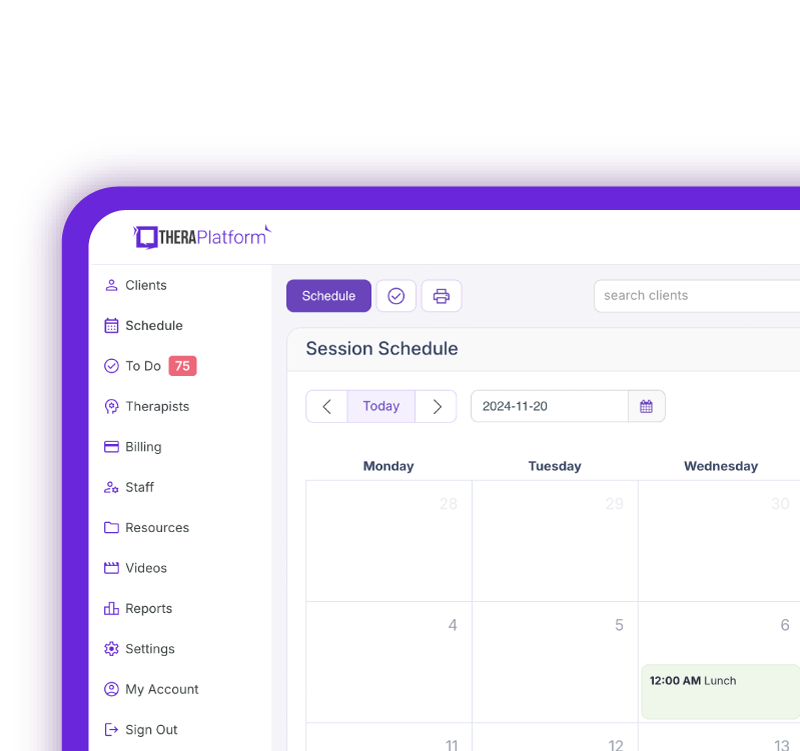
Manage more in less time in your practice with TheraPlatform
How to structure a parental interview for early intervention telehealth
Adapt parent interviews to fit the unique style and needs of each family.
Formal vs. informal style
Formal
- Screen-shared forms (e.g., checklists)
- PDF guides (e.g., intake-style questions)
- Structured data collection
Informal
- Natural conversation
- Reflective listening (reflect back what you hear)
- Guided curiosity (follow the parent’s lead)
Both approaches are effective. Some families appreciate structure and others value flexibility – try to match the family’s comfort level.
Verbal script examples
Prepare a few go-to phrases that can help you naturally initiate the conversation.
- “Before we get started, I want to check in on how things went this week. What was one high point and low point?”
- “You mentioned a toy-throwing last week. I had suggested using verbal praise every time he played correctly with toys. Did anything change after trying the praise strategy?”
Free Resources for Therapists
Click below and help yourself to peer-created resources:

Sample parent interview questions for early intervention telepractice
Organize your questions into categories to ensure that you cover key areas.
Routine-based questions
These are questions that apply to real life, helping to embed therapy into the child’s daily routines.
- “Tell me something fun you did with your child this week.”
- “What was a hard moment this week?”
Progress and participation
Assess the family’s engagement and the child’s progress in natural contexts.
- “Did you get a chance to try the strategy of expectant waiting this week?”
- “What did your child seem more interested in this week?”
- “Have you noticed anything getting easier or harder?”
Goal alignment
These questions ensure that your current therapy goals continue to align with the family’s evolving needs.
- “Is there anything new you’d like to work on?”
- “Any upcoming situations we should prepare for (e.g., travel, visitors)?”
Caregiver well-being (Optional Add-On)
A quick, genuine check-in on the caregiver can go a long way in building trust.
- “How are you doing?”
- “Is anything making it harder to do therapy at home right now?”
Therapist tips for success for early intervention telepractice
Be flexible
Every family is different as some will prefer structure, while others thrive on building rapport through a casual, conversational approach. Don’t force a formal routine if it doesn’t fit the parent’s style. Showing flexibility will build rapport over time, making sessions more productive.
Focus on function, not formality
Whether you choose to type notes or have natural discussion, the goal of the parent interview is to gain insight. Avoid falling into “checklist mode” where you simply read a list of questions. Instead, lean into reflective, engaging discussion.
Reuse and adjust
Create a “master list” of 10–15 go-to questions. Modify questions as needed based on your client’s age, diagnosis, or the family’s unique learning style.
Addressing common challenges for parental interviews during telepractice
The parent interview doesn’t always yield as much information as you might hope for. Here are some ways to troubleshoot common challenges.
The parent doesn’t want to talk
If a parent is reluctant to share information, it could be because they are shy, stressed, or just not comfortable being in the spotlight.
Try opening up communication by making statements that build safety and show empathy.
- Offer praise: “Thanks for always showing up and staying engaged.”
- Normalize difficulties: “Most families don’t try every single strategy. Let’s talk about what felt realistic.”
They say ‘nothing new happened’ every week
When parents default to this, they may be struggling to identify small changes. Help spark their memory of specific moments.
- Reframe questions: “What part of the day felt the hardest?” or “Was there a time your child surprised you or did something you didn’t expect?”
How weekly check-ins improve documentation for early intervention telehealth
Not only do parent interviews enhance the effectiveness of therapy, but they can also streamline your workflow.
- Better narrative for progress notes: Richer details make it easier to write a stronger case for continuation of services.
- Clearer goal tracking for IFSP/IEP teams: Demonstrate data-driven progress through consistent updates.
- Streamlined planning for future sessions: You gain insights into the family’s needs, guiding your plan for the next therapy session.
Weekly parent interviews are a powerful tool that can transform awkward early intervention telehealth sessions into impactful, productive therapy.
While interviews can help avoid overplanning a plethora of digital activities and the engagement challenges that go hand in hand with toddler telehealth sessions, benefits also include:
- Building rapport and trust
- Generating functional, family-centered goals
- Encouraging accountability and home carryover
- Reducing therapist stress
Whether formal or informal, the key is simply to start the conversation. Over time, you’ll create a routine structure for your telehealth sessions that makes them more effective and family-focused.
How telehealth platforms can support your early intervention via telepractice
Telehealth platforms support early intervention by making sessions more flexible, family-centered, and goal-driven. See a list of the best telehealth platforms.
Tools like secure video calls, shared whiteboards, and integrated EHRs allow therapists to start each visit with weekly parent interviews, helping build rapport, identify real-life challenges, and set functional goals.
This approach reduces overplanning, keeps therapy relevant to daily routines, and boosts caregiver accountability, while also simplifying documentation and progress tracking for therapists.
Choosing the best HIPAA-compliant teletherapy platform
Telehealth use has skyrocketed since the pandemic, with teletherapy emerging as a trusted, convenient, and secure alternative to in-person care for both children and adults. Therapists and clients report high satisfaction, and teletherapy now accounts for 13–17% of U.S. healthcare visits.
To protect privacy, providers must use HIPAA-compliant video platforms. The top platforms not only secure sessions with encryption but also support scheduling, billing, documentation, and client portals to streamline practice management.
The best teletherapy platforms go beyond video conferencing. By combining compliance, reliability, stable video, resources, games and practice management tools, they help therapists deliver care that’s safe, effective, and adaptable to modern client needs.
Marketing is also another aspect of owning a practice that can be conducted through a secure HIPAA-compliant platform as you can communicate with existing clients via chat, email and more.
Why therapists choose TheraPlatform as their teletherapy platform
Whether for solo practice or larger clinics, therapists choose TheraPlatform for its blend of usability, flexibility, and robust telehealth tools.
Watch this video to discover how TheaPlatform elevates Telehealth sessions
Here are top reasons why therapists choose TheraPlatform for teletherapy:
- Efficiency and convenience: Everything down to payments, scheduling, documentation, and insurance claims is managed in one integrated platform, saving time and reducing friction.
- Security and compliance: TheraPlatform is fully HIPAA and PIPEDA compliant, with encrypted video sessions, secure data storage, and 24/7 monitoring for peace of mind.
- Engagement tools: Built-in interactive features like whiteboards, games, media sharing, screen annotation, and therapy-specific “apps” enhance client engagement especially useful in pediatric and speech therapy.
- Client-centered functionality: The secure client portal empowers clients to book sessions, complete forms, submit documents, and make payments, reducing admin work for the therapist.
- Customization and flexibility: Therapists can create and customize templates for notes, treatment plans, and intake forms allowing them to tailor workflows to their practice style.
- All-in-one practice management: Combines telehealth, EHR, billing, insurance, scheduling, and documentation, eliminating the need for multiple tools or software.
- Therapy-specific design: Unlike generic telehealth platforms, TheraPlatform is purpose-built for mental health, speech therapy, OT, PT, and more with features tailored to each specialty.
- Professional credibility: Recording features, branded portals, and compliance tools help therapists present a more professional, trustworthy experience to clients.
- Positive user experience: Therapists appreciate having everything in one place and often report a smoother workflow, fewer tech issues, and faster onboarding.
What therapists are saying about TheraPlatform telehealth
Therapists praise TheraPlatform for its ease of use, seamless scheduling, and built-in billing tools like superbills. They value the platform’s features including intuitive charting, customizable notes, and interactive telehealth tools as well as the responsive support team, which listens to feedback and implements updates.
Many highlight that the platform offers the best of all worlds, combining excellent video conferencing with resource sharing and an engaging, client-centered teletherapy experience.
"There's seriously no better platform out there! Easy to use … syncs to your personal schedule, provides superbills …"- Coastlinespeechtherapy (Source)
“It is not just the platform, it is the team behind TheraPlatform, always willing to help and receptive to feedback to bring updates requests to live,” Orly, Smarty Therapy PC (Source)
"The video conferencing is excellent and the ability to share resources and the interactive screen make Telehealth a rich experience."- Kathy J. (Source)
"TheraPlatform has been the best of all worlds! … intuitive charting, in-system billing, customizable notes …"-Kendrah B. (Source)
Streamline your practice with One EHR
- Scheduling
- Flexible notes
- Template library
- Billing & payments
- Insurance claims
- Client portal
- Telehealth
- E-fax
Resources
TheraPlatform is an all-in-one EHR, practice management, and teletherapy software built for therapists to help them save time on admin tasks. It offers a 30-day risk-free trial with no credit card required and supports mental and behavioral health, SLPs, OTs, and PTs in group and solo practices.
More resources
- Top-to-bottom approach to launching teletherapy on-demand video academy
- Teletherapy worksheets
- Teletherapy blog
References
McCarthy, E., & Guerin, S. (2022). Family‐centred care in early intervention: A systematic review of the processes and outcomes of family‐centred care and impacting factors. Child: Care, Health and Development, 48(1), 1-32. https://onlinelibrary.wiley.com/doi/full/10.1111/cch.12901
Orel, M., & Licardo, M. (2025). Systematic review of telepractice for early intervention with families of children with autism spectrum disorder. Advances in Autism, 11(1), 19-37. https://www.emerald.com/aia/article-abstract/11/1/19/1244992/Systematic-review-of-telepractice-for-early?redirectedFrom=fulltext
Pashak, T. J., & Heron, M. R. (2022). Build rapport and collect data: A teaching resource on the clinical interviewing intake. Discover Psychology, 2(1), 20. https://link.springer.com/article/10.1007/s44202-022-00019-5
FAQs About Early Intervention via Telepractice
How can therapists keep early intervention telehealth sessions engaging?
Starting with a parent interview helps guide goals, reduce overplanning, and keep sessions family-centered.
What benefits do weekly parent interviews provide?
They build rapport, uncover real-life challenges to target, and create accountability for home practice.
How do telehealth platforms support early intervention?
Features like secure video, whiteboards, and EHR integration streamline communication, documentation, and progress tracking.